THE SATURDAY LIST: Ten Best Moments at the 69th Tony Awards

Tony Awards 2015

Poster for the 69th Annual Tony Awards

The 69th Annual Tony Awards took place last Sunday, so with almost a week to reflect on how the ceremony landed, it’s time to share my list of the ten best moments at this year’s ceremony. Many of these observations are based on my Facebook updates and Tweets from when I watched the presentation, which didn’t measure up to a couple of others in recent memory, largely due to choices made around the hosting of the show and some choices made about what to include in the televised show and what to leave out. Nonetheless, the Tony Awards still had its highlights – and these were those that spoke most strongly to me.

10. The Curious Incident of the Dog in the Night Time Wins Best Play

It was great to see The Curious Incident of the Dog in the Night Time winning Best Play, in a year that was pretty good to British nominees. It is so difficult to do justice to the Best Play nominees through extracts at the ceremony though. Certainly “The Grand View of the Year in Plays” feature at this year’s Tony Awards‬ didn’t work; neither did the isolated moments that preceded the actual award presentation itself. I personally love the longer clips from years gone by, some of which were showcased in Broadway’s Lost Treasures. And once again, the weird phenomenon that there is actually no distinction, when it comes to plays at the Tony Awards, between the writing and the production of the Best Play, raises its head. (The playwright involved here is Simon Stephens.) Any solutions for the Tony Awards?


9. Alex Sharp wins Best Actor in a Play for The Curious Incident of the Dog in the Night Time

Everyone loves a good acceptance speech. This was quite a night for the recently graduated Alex Sharp. Pure gratitude. (The runner up in the acceptance speech category is Kelli O’Hara, who won for The King and I after years of not winning. A career award, perhaps, but I am glad she won a Tony at last.)


8. The Greys Introducing Fun Home

When Joel Grey opened up about his sexuality earlier in the year, many people asked, “What’s the point?” I didn’t. I think it is always a moment to celebrate, especially since we still live in a world where there is so much uncertainty around gender identity and where people struggle to come to terms with themselves, let alone with how others might treat them. So it was great to see Joel Grey and his daughter, Jennifer, introduce the performance of Fun Homem a show which must have a special resonance in their life. And besides that connection, this was just an introduction that felt genuine and polished and not as though it was trying too hard. (Here’s some red carpet footage of the pair; their introduction in full doesn’t seem to be up on YouTube.)


7. Lisa Kron and Jeanine Tesori win Best Score for Fun Home

A groundbreaking win, with this award enabling two women to win all of the writing awards for musical theatre at the Tony Awards. Kron had just won the award for Best Book, which is why her speech is short and sweet here. It’s a pity these moments were excluded from the televised broadcast.


6. Judith Light

This might seem arbitrary to some, but I am a big Judith Light fan. Every Tony Awards night, I wait for ‪her to appear. And when she does, I am never disappointed. This year we saw some flawless presenting work from this generous and talented woman. (The runner up for the “Hostess with the Mostes‬‬‬'” award is the fabulous Debra Messing.) ‪


5. “Love and Love Alone” from The Visit

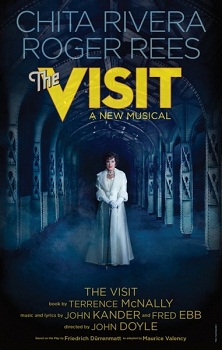
“Love and Love Alone” sounds like a classic John Kander and Fred Ebb number: a simple vamp underscoring an intelligent observation about life – with a twist. It was great to see Chita Rivera on stage performing this number with Michelle Veintimilla, with the older and younger versions of Claire dancing opposite each other. There was something about this that was reminiscent of Follies. The segue into the second song felt arbitrary and although the number clearly has the Kander and Ebb stamp on it, I felt that it played weirdly out of context and that the performance would have been stronger showcasing “Love and Love Alone” on its own. The full sequence of that song has a great emotional arc, although its ending isn’t fully satisfying with something unrealised in that moment. Watching this, it also struck how rare it is to see dance as storytelling in a major commercial musical these days. Have people lost faith in the kind of musical theatre dance that characterises, communicates narrative and deepens the storytelling?


4. The Performance from An American in Paris

Sorry, Singin’ in the Rain, but An American In Paris is my favourite 1950s MGM movie musical. The dance in this extract from the new stage adaptation of the film was superb, with incredible fluidity and control. Following the extract from the ballet, “S’Wonderful” and “I Got Rhythm” reminded everyone what a great song it is. Does “I Got Rhythm” ever disappoint, no matter what Gershwin catalogue show it ends up in? And the design is so stylish! It was great to see the show pick up Tony Awards for Best Orchestrations (Christopher Austin, Don Sebesky and Bill Elliot), Best Choreography (Christopher Wheeldon), Best Lighting Design (Natasha Katz) and Best Scenic Design (Bob Crowley and 59 Productions). (There is a part of me that wished that Brandon Uranowitz or Max von Essen picked up the Best Featured Actor prize. I’ve got nothing against Christian Borle, but Something Rotten seems to be a deeply awful show and I kind of resent it winning anything at all.)


3. The Performance from On the Town

The performance from On the Town kicked off with Tony Yazbeck singing a winning “Lucky to Be Me” in his glorious voice. Starting off in the house, he flirted with Josh Groban, gave flowers to ‪Anna Wintour‬ and danced with Chita Rivera and Rita Wilson as he made his way to the stage. One of the first things that I thought was how amazing the score of On the Town is. When Yazbeck arrived on stage, he was joined by his co-stars and the ensemble for “New York, New York” on the gigantic stage at Radio City Music Hall. I loved this. This show is a true classic.‬‬ I was sad the show walked away empty handed and would have loved to see the show win Best Revival of a Musical.


2. Tommy Tune’s Grace

Tommy Tune‬ is all grace. I loved his introduction to the award for Best Directing in a Musical, in which he remained dignified following the Tony Awards basically offering him the worst tribute medley ever after as a compensation for not allowing him to receive his Lifetime Achievement Awards. All television audience were able to see of that moment was a short clip of Tune receiving his award, which launched into three snippets of songs from shows in which he was instrumental in bringing to Broadway: “We’ll Take a Glass Together” (from Grand Hotel), “Our Favorite Son” (from The Will Rogers Follies) and “My One and Only” (from My One and Only). One minute of performance from start to finish. That was no tribute; it was a travesty. A disappointing moment from the Tony Awards saved by an icon’s magnanimity. The clip I’ve chosen to represent this moment is the acceptance speech we all should have seen on the televised show.


1. “Ring of Keys” from Fun Home

The performance of the night, and the best moment of this year’s Tony Awards, was “Ring of Keys” from Fun Home. As the clip was introduced, I thought that the clip might kill me. It slayed me. I was a teary mess by the end of it. Sydney Lucas is phenomenal. This is magnificent stuff. If you haven’t yet discovered this absolute gem of a musical (which took home the Best Musical prize too), do it.

So that’s my list for today. What were your favourite moments at this year’s Tony Awards? I’d love hear about them via the comment box below.

Posted in The Saturday List | Tagged , , , , , , , , , , , , , , , , , , , , , , , , , , , , , , , , , , , , , , , , , , , , | Leave a comment

Forgotten Musicals Friday: ALL AMERICAN

Ray Bolger in ALL AMERICAN

Ray Bolger in ALL AMERICAN

It’s not often that you look back at a forgotten musical, even when it comes to many of the most notorious flops, and can see very clearly why it is has been forgotten, why it flopped – or both. All American is precisely such a musical. Although the original cast recording of the show has been in my CD collection for the better part of two decades, I’d only really listened to it once before hauling it out so that All American could be this Friday’s Forgotten Musical – and now that it’s had a couple of spins, it probably won’t come off the shelf for another listen anytime soon.

My memory from listening to All American all those years ago is that it had great music, but that pretty much everything else was dispensable. Returning to it now, the music by Charles Strouse still seems to be the strongest ingredient of the piece. The lyrics, by Lee Adams, also seem to contribute a great deal to the mix, but there was something about them that made me hesitant. By the time I hit “It’s Fun to Think”, I was convinced that the lyrics weren’t well matched to the narrative. Two tracks later, “Nightlife” left me without the shadow of a doubt that this was the case. The song is sung by Susan, a character that recalls Kim in the Strouse and Adams’s earlier collaboration, Bye Bye Birdie. Both characters want more than the limitations her mundane confinement allows; in Susan’s case, it is because she has been gated for trying to sneaking into the men’s dormitories. Fine. But when Susan starts singing about Cole Porter and wanting the beguine to begin to a tune that might have represented hip theatre music a decade earlier, the piece starts to damn itself as a piece of storytelling within the context of the musical as a whole. A pity, because taken on its own terms, it’s a fine song.

Ray Bolger in ALL AMERICAN

Ray Bolger in ALL AMERICAN

This kind of rift intensifies when the score is paired with what’s going on in the plot. Fashioned by Mel Brooks from Robert Lewis Taylor’s novel Professor Fodorski, the narratives seems to grate up against the score, and everything seems to take a turn for the worse in the second act, for which director Joshua Logan crafted the book. Everyone on the creative team seems to lose track completely of what they are trying to say and the way in which they are trying to say it. What is most peculiar about this inconsistency is that Strouse and Adams were so in step with the milieu in which they were writing just a couple of years earlier that they were able not only to dramatise situations and attitudes contemporary to the time in Bye Bye Birdie, but also to satirise them. In All American, they are are so out of touch that the generation gap between the professors and their college students barely exists. It’s ironic then, that the it was in fact the generation gap between the writers and the director, Josh Logan, that seems to be most commonly attributed to the failure of the show. Strouse comments:

Josh was from a different generation, he looked at America, college, the youth culture in ways that were different from ours. Many times, later on, he told me he felt he had put his finger into the show the wrong way. He had seen it in more of the flesh and blood realities of the characters than we had, and, because of that, their physicality became more important than the satirical point of view we had initially envisioned.

Anita Gillette, Ron Husmann, Eileen Hurlie and Ray Bolger in ALL AMERICAN

Anita Gillette, Ron Husmann, Eileen Hurlie and Ray Bolger in ALL AMERICAN

To backtrack a little, maybe it is worth mentioning the plot of All American at this point. Professor Stanislaus Fodorski is a Hungarian immigrant, recently arrived in the United States to teach in the science faculty at the Southern Baptist Institute of Technology. Fodorski soon marks his mark, teaching engineering by comparing it to football, which in turn benefits from being approached scientifically. Fodorski finds himself attracted to the Dean of the college, Elizabeth Hawkes-Bullock, while the show’s secondary romance follows two of the students, Susan Thompson and Ed Bricker.

The similarities to Bye Bye Birdie are obvious, with two romances – an older couple  and a younger one – built around popular obsessions of the time in both shows. But here, Strouse and Adams found themselves with Brooks and Logan instead of their Bye Bye Birdie collaborators, Michael Stewart and Gower Champion, whose path had diverged from that of their colleagues when they had decided to work with Bob Merrill in Carnival! the previous season. It’s an object lesson if ever there were one about how important it is to find the right collaborators and to do whatever it takes to make sure that everyone is working on the same musical.

Youthful antics in ALL AMERICAN

Youthful antics in ALL AMERICAN

What All American is able to offer, if a cohesive musical is nowhere to be found, is a couple of great songs, notably “We Speak the Same Language”, “Once Upon a Time”, the abovementioned “Nightlife” and “I’ve Just Seen Her”. “What a Country!” uses a distractingly similar hook to “It’s a Scandal! It’s a Outrage!” from Oklahoma!, but the lyrics are still fun. These are all preserved on the cast recording featuring a strained performance by Ray Bolger and the intolerable vocals of Eileen Hurlie om the one hand, and the very agreeable delivery of the Ed and Susan’s songs by Ron Husmann and Anita Gillette on the other. In fact, if nothing else, the cast recording reveals how skewed the balance is between the two plots: Ed and Susan should be more prominent in the score. Consequently, the cast recording is not one that prompts the thought, “What went wrong?” The flaws of All American make themselves felt very clearly on disc. Other thoughts? “Physical Fitness” sounds a bit like something Leonard Bernstein might have chucked out of Wonderful Town and “It’s Fun to Think” seems like something that could slot into a Rodgers and Hart musical from the 1930s. But what can you do?

Ray Bolger in ALL AMERICAN

Ray Bolger in ALL AMERICAN

So the big question: is All American fixable? Well, I think it offers as good a case for a ‘revisal’ as any, and at least the three writers are still with us, even if the youngest of them is 86 years old. If all three were robust enough to take on the task, I don’t see why they shouldn’t. Except, of course, the men who saw youth culture for what it was in the 1960s will see things through different eyes, which might leave us back at square one. Maybe the easiest fix would be to shift the 1960s setting to post-World War II and to tweak things from there. Could All American be reinvented a glorious 1940s-styled period piece? Who knows? I guess only a full production would reveal the answer, and I’d be willing to give it a shot.

To close off, here’s a recording of what most people consider to be the hit song of the show – but which of course was a trunk song from ten years earlier that eventually found its home in All American. On the cast recording, you have to suffer through Bolger and Herlie’s vocals and be able to look past them to find any beauty in the song, so here’s Frank Sinatra crooning “Once Upon a Time” in a way that lets the song speak for itself.

While you’re listening, why not share some of your own thoughts about All American in the comment box below. I’d love to hear your opinions!

Posted in Forgotten Musicals Friday | Tagged , , , , , , , , , , , , , , , , , , , , | 2 Comments

Forgotten Musicals Friday: THE YEARLING

THE YEARLING Artwork

Artwork for THE YEARLING

My choice for today’s “Forgotten Musicals Friday” is a musical that, for no obvious reason, captured my imagination: The Yearling. It has no commercial recording and even though Barbra Streisand was a champion of the score in the early years of her career, one doesn’t really read much about the show in general. Nonetheless, The Yearling is a musical that pops into my head every now and then, so I thought it was time to dedicate a column to it.

Based on The Yearling by Marjorie Kennan Rawlings, the show had a book and lyrics by Herbert Martin and music by Michael Leonard. Martin shared credit for the book with show’s producer, Lore Noto. The original Broadway production of The Yearling opened on 10 December 1965, with the show’s closing for it’s 3-performance run already having been announced. It was directed by Lloyd Richards, with choreography by Ralph Beaumont. Some think that perhaps with a better director, the show itself will have been better; others tell tales of how the show ran out of money and couldn’t afford to run long enough to catch on with audiences. Both stories seem like reasonably valid options.

At the heart of The Yearling is a a twelve-year old boy named Jody, who lives with his struggling family. His parents, Penny and Ora, face their hardships as best they can, even though at the top of the show things are looking particularly difficult for them with a a bear having killed their sow. Jody longs for a pet deer and circumstances eventually line up so that he is able to raise a motherless fawn. A year later, when the fawn eats the family’s new crops, Jody is fold to kill the yearling, an order that brings about the climax of the show.

The original Broadway cast of THE YEARLING

The original Broadway cast of THE YEARLING

When asked, people who saw the show will tell you they liked the score, which I’ve heard described as both lovely, pleasant and even well-crafted. Some complain that the score doesn’t reflect its rural 1870s setting well, but many musicals evoking milieu by filtering songs in popular contemporary forms through arrangements and orchestrations. Maybe, if The Yearling were ever staged in a high profile production again, that might be a fixable problem. A score that features a song that Stephen Sondheim listed as a song he wishes he had written can’t be all bad. If you’re keen to have a listen to that little gem from this score, scroll down to the YouTube playlist at the end of this post, where you can hear it performed in versions by Streisand and, in an even jazzier version, by Greta Matassa. Neither arrangement really reflects the setting of the show, but as neither is being presented in the context of the show itself, I suppose we can’t be too concerned by that here.

My favourite song from the score is one that has become something of a standard, “Why Did I Choose You?”. Although some might try and direct you to Barbara Cook’s performance of the song in concert, for me it doesn’t get better than Streisand singing the song in her first television special. (Both, as well as several other versions of the song are featured in the YouTube playlist below.)

Although there have been rumours flying around the Internet for some time about a full recording of the show being made, the only easy way to hear these songs is in versions recorded by artists who were moved enough by the material to interpret them on their own recordings. Every now and then, a song also turns up on a compilation album like Unsung Musicals II (which includes “Everything in the World I Love”). While there is a live recording done by the producers for a private LP pressing as well as a recording of several songs from the show done for a radio show, these aren’t readily available for ordinary folk like me to hear.

Getting back to the show, those same people who praise the score will also tell you that the book was flawed, even dull, and that, perhaps, the material was not suitable for (what they think should be a good premise for) a musical. I’m more likely to give credence to that former point than to the latter; the musical is such a versatile medium, even more so these days than in the past. Maybe in a post-War Horse world, there’s merit in seeing if the show can be done without a live deer, as in the original production. It might be the key to telling the story in an evocative, contemporary manner that makes the piece compelling in a way that perhaps it wasn’t in 1965.

Keen to share any thoughts or memories about The Yearling? Head to the comment box below. I’d love to hear them!

Posted in Forgotten Musicals Friday | Tagged , , , , , , , , , , , , | 25 Comments

Monday Meditation: I’m Over Being Concerned About What Musicals I Should Like

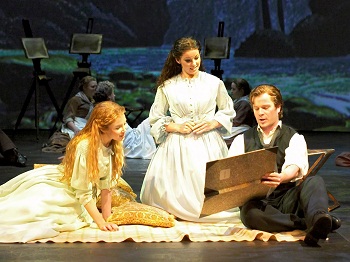
Ruthie Henshall as Marian Halcombe, Alexandra Silber as Laura Fairlie and Damian Humbley as Walter Hartright in THE WOMAN IN WHITE

Ruthie Henshall as Marian Halcombe, Alexandra Silber as Laura Fairlie and Damian Humbley as Walter Hartright in THE WOMAN IN WHITE

Have you ever read one of those polls on a musical theatre forum asking what your guilty pleasures are? I always struggle to participate in threads like those because I really do find worth in even the worst musicals. It’s possible to learn just as much – and sometimes even more – about musicals from a bad musical as from a great one. If I don’t like a particular musical, I simply don’t engage it with as often. And if I like a musical, I don’t really feel the need to apologise for my feelings. After all, liking a musical is a very different thing from commenting on its artistic success: the former is simply linked to one’s opinion; the latter has a foundation in technique, which makes the discussion far more complicated. As Stephen Sondheim wrote, in a lyric that I’m particularly fond of quoting in this regard: ‘Nice is different than good.’

So. Some confessions then.

Although I’m not supposed to like The Woman in White, I think it has a great deal more to offer than meets the eye, particularly when you come at it from the angle that what Andrew Lloyd Webber is doing is creating an atmospheric piece in the style of Benjamin Britten and that musically, the show largely achieves this. (That doesn’t make the lyrics any better, but it does keep drawing me back to the musical to see what it has to offer.)

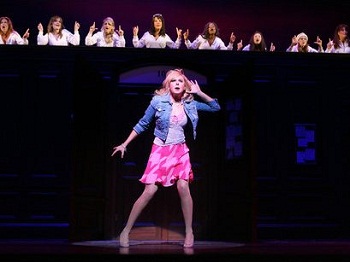
Laura Bell Bundy in LEGALLY BLONDE

Laura Bell Bundy in LEGALLY BLONDE

Although many musical buffs lament the adaptations of movies into musicals, I just can’t get enough of Legally Blonde. It’s pretty much a 21st-century take on Jerry Herman musicals like Hello, Dolly! and Mame and offers, I think, equal pleasure.

And although it’s verboten to show any love whatsoever for jukebox musicals, I really enjoyed Mamma Mia! and think it is more intelligent theatrically than most people expect and it’s certainly a cut above the more dreckish attempts and crafting a show around a particular artist’s songbook. We Will Rock You, anyone?

Those are only three of many shows that convention says I shouldn’t like. But so what? Convention can’t dictate what I like or not, nor can it for you, dear reader. Perhaps you can use today to celebrate the musicals that others might force you to call guilty pleasures. I know I’m going to!

This post is inspired by and a response to “I’m Over Being Concerned About What I Shouldn’t Do” in Shirley MacLaine’s I’m Over All That and Other Confessions.

Posted in Monday Meditation | Tagged , , , , , , , , , , , , , | Leave a comment

Musical Theatre Sunday School: Comfort in Times of Trouble

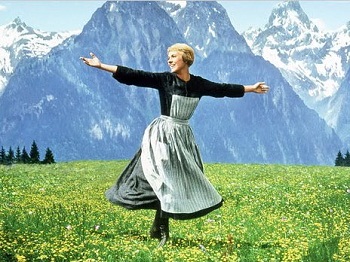
Julie Andrews sings the title song in THE SOUND OF MUSIC

Julie Andrews sings the title song in THE SOUND OF MUSIC

In the past couple of weeks, we’ve looked at some of the fundamentals of musical theatre, and of course we’ll return to those and to others in due course. This week, I thought our reflection could focus on how musicals can bring us comfort in times of trouble. Whether we’re fans of new or old musicals, one thing we’re always faced with is someone who is ready to lash out at a musical that has sentimental value to us – especially as we make our way around the Internet – who seek to diminish our connection with that musical.

Arguments on message boards tend to become heated around musicals like that hold this kind of place in people’s hearts. In the heat of the moment, people tend to forget that a musical being well written is not always the same thing as a musical being one you like. Keeping the two separate and remembering from which side you’re approaching the discussion makes for first prize discussions. But as we all know, it’s not always that simple. And that’s just representative of the discussions we have with people who think musicals have any worth whatsoever! So I’d like to start off by offering this reflection in grace and peace and hopefully it won’t lead to any arguments later down the line. Let’s be compassionate towards each other and acknowledge, when we can, that there’s a difference between – as Stephen Sondheim put it – what is “nice” and what is “good” and that the overlap may or may not be all that great between the two.

The Reality of Comfort Music(als)

I think that we would all accept that music is a huge source of comfort. If theatre is a mirror to reality, then I think it is a fair assumption that we might easily struggle characters in musicals who are sorrowing and troubled who find in music. The comfort of music helps them to face their difficulties. Some examples might include:

  • the title song in The Sound of Music, which brings Maria peace as she wanders in the mountains singing her song and which brings the family together after she has taught the song to the children and “My Favourite Things”, which is used both by the Mother Abbess and the children when trying to find a way through seemingly impossible circumstances;
  • “Moonshine Lullaby” in Annie Get Your Gun, which Annie sings as a lullaby to the children, but also to soothe the wonderful, bittersweet ache she feels having fallen in love with Frank, knowing that she is not the kind of woman he is aiming to marry;
  • “You’re Never Fully Dressed Without a Smile”, which the orphans in Annie sing to lift their spirits and, possibly, “Maybe” if we consider at least part of it to be some kind of lullaby;
  • “Married”, which settles the jitters that September romances bring to Fraulein Schneider and Herr Schultz in Cabaret; and
  • “You’ll Never Walk Alone”, a hymn known by Nettie and the community in Carousel, the words of which Julie has used in a sampler, that is used twice in the show to give peace to one of the characters.

Some of those songs are ones that I find very comforting and cathartic myself. There are others of course, and we all have songs like those to which we return from time to time. I would so like for you to share some of yours with me in the comment box. Sharing our love for musical theatre is one way of helping the art form we know to grow and develop and to advance our understanding and appreciation of the genre we all love so dearly – at least as much as our heated debates can do! Sometimes its great to take a moment to share the things we like, because perhaps we might see something we never saw before in a show we disregarded or a score we thought we disliked.

Posted in Musical Theatre Sunday School | Tagged , , , , , , , | Leave a comment

Musical Theatre Sunday School: Divine Integration

Boq and Nessa in WICKED

WICKED’s Boq and Nessa proving it is possible to woo successfully with clunky lyrics

There are three separate elements of divine integration in musical theatre: the book, the music and the lyrics. For most people, understanding technique when it comes to book and lyrics is more concrete, while the understanding of musical techniques tends to be more abstract and grounded in an emotional or spiritual response. It’s easy to spot bum rhyme in a lyric (‘Listen – Nessa / Yes? / Uh – Nessa / I’ve got something to confess, a / reason why, well – / why I asked you here tonight’), but just what is wrong with “Defying Gravity” when it makes teenage girls the world over feel so good about themselves?

For many followers of musical theatre, this opens up an all too easy gap whereby all responses to musicals are deemed subjective. It is in the understanding of musical theatre technique and in the construction of a critical framework based on that understanding that objectivity in evaluating a musical’s success or failure can arise. As conventions shift over time, what was good once might appear less so now, and what was once considered repellent might today be viewed as ahead of its time. In the 1920s, for example, a great score was what was primarily needed for a musical to be considered great, so while lyrics received considerable attention, the books did not. So while we might not be seeing full scale, unrevised productions of Lady Be Good or Oh, Kay! today, “Fascinating Rhythm” and “Someone to Watch Over Me” still pop up in concert repertoires and jukebox musicals based on the Gershwin songbook. Conversely, a show like Richard Rodgers and Lorenz Hart’s Pal Joey earned mixed reviews for its initial production in 1940, but really started getting street cred in the following decade when audiences could accept an anti-hero as the protagonist in a musical.

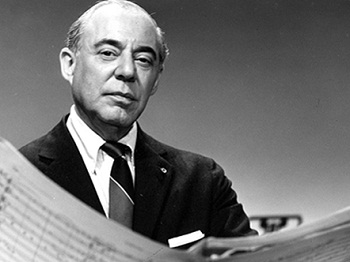
Richard Rodgers

Richard Rodgers – undoubtedly a great composer, but what is it that makes his music better than Burton Lane’s?

So maybe the challenge for the week is to go and learn about one technical aspect related to the craft of writing the book, music or lyrics of a musical and to think about it in relation to your favourite musicals. Try to get objective about your subjectivity, and then see what comes of that.

Although the three parts aiming for divine integration in musical theatre are distinct art forms with distinct roles, they are one in purpose. They are perfectly united in bringing to pass the possibility of a great musical. And there are many: South Pacific, Gypsy, Fiddler on the Roof, Follies, The Wild Party and A Gentleman’s Guide to Love and Murder are just some of the great musicals we’ll all be watching and listening to for years to come.

Posted in Musical Theatre Sunday School, Theatremaking, Theory and Practice | Tagged , , , , , , , , , , , , , , , , , | Leave a comment

THE SATURDAY LIST: My 5 Current Musical Theatre Obsessions

Ethel Merman in ANNIE GET YOUR GUN

Ethel Merman in ANNIE GET YOUR GUN

For today’s edition of the “Saturday List” on Musical Cyberspace, I thought I would share my 5 current musical theatre obsessions, the things that I am finding most fascinating in the world of musical theatre – right here, right now. This might be a bit fanboy-ish, but I think that musical theatre fans sharing the aspects of musicals in which they’re interested at any given time is a great way of opening up discussions, finding out about new musicals and interrogating old favourites. Here we go!

1. Fixing Annie Get Your Gun

This might be a presumptuous foot on which to to start off, but I’ve been thinking a great deal about Annie Get Your Gun this past week and the way that the most recent Broadway mounting of the show tried to shift the show to satisfy our current socio-political norms. Along with many others, I don’t think that Peter Stone achieved what he set out to do in his revised book and I think that there is a way to shift the problematic parts of the show without gutting the piece entirely. For those who need a fact check, Annie Get Your Gun is a 1946 musical with a score by Irving Berlin and a book by Herbert and Dorothy Fields. What’s interesting about the show is that the 1999 revival wasn’t the first time the material was revised. The 1966 revival cut a couple of characters (the secondary romantic pair, Tommy and Winnie) and numbers (the charming “Who Do You Love, I Hope” and the more easily forgotten “I’ll Share it All With You”) to create a version of the show that focused more clearly on Annie and Frank, including also a new duet for the pair, “An Old Fashioned Wedding”. The focus of the 1999 revisions was political correctness, so although Tommy and Winnie’s numbers were reinstated, “I’m an Indian Too” and “Colonel Buffalo Bill” got the chop, along with “I’m a Bad, Bad Man”. The show was also framed as a show-within-a-show, with “There’s No Business Like Show Business” being used as the device that pulled everything together. At the end of the day it just doesn’t work. It feels like a hack job done on material that has a lot more going for it than that for which Stone gave it credit. What are my thoughts? Well, I do agree that there is no place in Annie Get Your Gun for a number like “I’m an Indian Too”. In fact, the only tweaks that need to be made to Annie Get Your Gun have to do with the way that Native Americans are represented in the piece – so I guess there are a couple of edits in the book that would go along with the excision of the song, and the way that the ceremonial dances that come towards the end of the first act would have to be interrogated too. Why isn’t “Colonel Buffalo Bill” a problem for me? Well, it’s not a number that represents Native American people: it’s a number that represents the way that Native American people were represented by showmen at the turn of the century. Yes, the way that shows like Buffalo Bill’s Wild West presented Native Americans was patronizing and racist – but that’s the way it was. No amount of revisionist editing can change that. But I think there is a responsibility to shift the way that Native American characters are represented in the show. As for the feminists who dislike Annie’s throwing of her final competition with Frank to win his affections – well, it’s your job to comment on that if you desire. Personally, I think it shows that she is smarter than him and knowing how to use her head around Frank after they’re married is going to do her a whole lot more good than a broken heart would, plus it reflects the attitudes of the time period in which the show is set.

2. The Wild Party

I just can’t get enough of Michael John LaChiusa’s masterpiece, and especially of the song that for me is at the deep, dark centre of the show, “People Like Us”. First off, let’s not discuss for too long the other adaptation of Joseph Moncure March’s 1928 poem, which might as well be called The Wild Party Jr based on the level of its intellectual approach to the material, even if the material itself is far too provocative for the “jr” treatment. Sorry, Andrew Lippa, but that’s just the way it is. LaChiusa’s version of The Wild Party is just the best. Love it. Love it. Love it. Secondly, although the Best Musical prize at the Tony Awards was completely hijacked by Contact, which – despite being a fantastic dance show – simply was not a musical at all and should never have been nominated for the award in the first place. Thirdly, the show’s detractors will wail that one can’t sympathise with the characters and that the show shuts you out cold as a result. Wrong. The characters are fascinating – that’s what counts – and they draw you in. Fourth, let’s get back to “People Like Us”. It is a fantastic song that manages to capture the characters in the moment and the decay of the period as well as being a zeitgeist moment. I could go on for ages about this show, but then I’d never get to my next obsession. Let’s leave things with an appreciation of the incredible layers LaChiusa’s work has. Pure brilliance.

3. I Remember Mama

This is a passing obsession, I know, but the last musical of Richard Rodgers (with lyrics by Martin Charnin and Raymond Jessel and a book by Thomas Meehan) is one that I find very interesting at the moment. Nobody says it was brilliant, but those who don’t say it was a complete failure say that it was a sweet show that came along thirty years too late. It does kind of remind me of Meet Me in St Louis and it certainly is an old-fashioned show. I think the show’s heart is in the right place. I also think that the comedy songs are handled poorly. The two songs written for Uncle Chris are clunkers. Charnin and Meehan are both still with us. I wouldn’t mind seeing them take another pass at the material to see what they can come up with. But one rule, please – only use music written by Rodgers for the show. “Boys and Girls Like You and Me” and “The Sweetest Sounds” don’t need to be shoehorned into another show.

4. Michelle Williams in Cabaret

I’ve become obsessed with trying to find footage of Michelle Williams in Cabaret. Tumblr has yielded a couple of audios, but other than that I’ve had no luck. I’ve loved Williams since her Dawson’s Creek days and I am dying to see (something of) her take on Sally Bowles, particularly seeing how great an actress she’s become. (Start by watching Brokeback Mountain if you don’t believe me.)

5. “They Just Keep Moving the Line”

All right, this isn’t strictly musical theatre, but it’s close enough. I keep on finding this song, written by Marc Shaiman and Scott Wittman for the TV series, Smash, making its way into my mind. It’s so wonderfully Kander and Ebb-ish, Megan Hilty kills it, and it is great to belt out in the car. Or in the shower. Or at the mall. Anytime, actually. Just do it. You won’t regret it.

And that’s it for this week. What are your current musical theatre obsessions? How about heading down to the comments below and letting me know – perhaps your obsessions of today will be my obsessions tomorrow.

Posted in The Saturday List | Tagged , , , , , , , , , , , , , , , , , , , , , , , , , , , , , | Leave a comment

Musical Theatre Sunday School: In the Beginning…

Capturing the spirit of THE BLACK CROOK

A drawing capturing the spirit of THE BLACK CROOK

In the beginning, there was music and there was drama, and musical theatre was without form. Broadway was in darkness. And Henry Jarrett and Harry Palmer moved upon the face of the district, by arrangement with William Wheatley.

“Let there be light,” they said: and there was The Black Crook. And audiences saw The Black Crook, that it was good, and musical theatre was born from the dark waters of the ballad opera and pantomime. And The Black Crook was called musical comedy, and everything else was called variety, vaudeville and burlesque. And the Mulligan Guard shows and Floradora were among the first musicals.

And George M. Cohan said, “Let there more of the American spirit in musical comedy, and let me write, direct, produce and star in these new musical comedies.” And Cohan made Little Johnny Jones, Forty-five Minutes from Broadway and George Washington Jr. and divided the musical comedy from fantasy extravaganzas like The Wizard of Oz: and it was so. And these were the age of the second musicals.

Bessie Wynn in BABES IN TOYLAND

Bessie Wynn in BABES IN TOYLAND

And Victor Herbert said, “Let the music of our operettas have its own American sound and let and American version of operetta appear” – and it was so. And Victor Herbert called his home grown operettas Babes in Toyland, The Red Mill and Naughty Marietta; and the gathering together of his more comical music he called It Happened in Nordland, Miss Dolly Dollars and Little Nemo: and Franz Lehar saw that it was good. And Franz Lehar said, “Let Basil Hood and Adrian Ross write an English adaptation of Die Lustige Witwe, and let The Merry Widow more romantic European style operettas: and Jerome Kern saw that it was good. And these were the third musicals.

And Jerome Kern said, “Let me fix the scores of these imported musicals, to divide our own sound from theirs; and let this new sound be used for the Princess Theatre musicals, for Oh Boy! and Leave it to Jane and Oh! Lady! Lady! And let them be lights in the heavens to give light to Irving Berlin, Harry Tierney, Joseph McCarthy, Vincent Youman, Richard Rodgers, Lorenz Hart, George Gershwin, Ira Gershwin and Oscar Hammerstein II: and it was so. And Florenz Zeigfeld and George White made two great lights: the greater Follies to rule the best, and the lesser Scandals to rule the rest: John Murray Anderson made The Greenwich Village Follies also. And producers set No, No Nanette, The Vagabond King, Sunny, Oh Kay! and Dearest Enemy in the firmament of the musical theatre to give light to Broadway: and audiences saw that they were good. And these were the fourth musicals.

And Oscar Hammerstein II said, “Let the waters of the Mississippi bring forth a musical that has life, which may fly above the earth in the open firmament of heaven.” And Oscar Hammerstein II and Jerome Kern created Show Boat: and the world saw that it was good. And Florenz Zeigfeld blessed them, saying, “Be fruitful, and multiply, and fill the houses of Broadway, and let musicals multiply throughout the earth. This was the age of the fifth musical.

Ethel Merman in ANYTHING GOES

Ethel Merman in ANYTHING GOES

And the audience said, “Let the composers and lyricists bring forth musicals of every kind.” – and it was so. And George and Ira Gershwin made Strike Up the Band, Girl Crazy and Of Thee I Sing; and Richard Rogers and Lorenz Hart made On Your Toes, Babes in Arms and Pal Joey; and Noel Coward made The Third Little Show, Tonight at 8:30 and Set to Music; and Cole Porter made Anything Goes, Leave it To Me and DuBarry Was a Lady; and George Gershwin, Kurt Weill and Moss Hart made Lady in the Dark: and audiences saw that they was good.

And Richard Rodgers and Oscar Hammerstein II said, “Let us remake musical theatre in our image: and let the book have dominion over the songs, and over the choreography, and over the direction, and over all the production, and integrate every creeping thing that creeps upon Broadway.” So Richard Rodgers and Oscar Hammerstein II created Oklahoma!: in the image of the musical play they created it.

And audiences blessed them, and audiences said unto all librettists, composers and lyricists, “Be fruitful, and multiply, and replenish Broadway and subdue it: and have dominion over the great white way, and over the musicals of other lands, and over every musical theatre production that is heard upon the earth.” And the librettists, composers and lyricists said, “Behold, we give you Annie Get Your Gun and On the Town and Bloomer Girl and Carousel and The Song of Norway and Brigadoon and Kiss Me Kate and Finian’s Rainbow and South Pacific.” And it was so. And audiences saw everything that they had made, and, behold, the musicals were very good.

And this was the sixth age of the musical.

Posted in Musical Theatre Sunday School | Tagged , , , , , , , , , , , , , , , , , , , , , , , , , , , , , , , , , , , , , , , , , , , , , , , , , , , , , , , , , , , , , , , , , , , , , , , , , | Leave a comment

THE SATURDAY LIST: Musical Theatre Related Things that Get Me Excited

The company of NOAH OF CAPE TOWN Photo credit: Giovanni Sterelli

Would NOAH OF CAPE TOWN work as a live TV musical?
Photo credit: Giovanni Sterelli

It’s time for another “Saturday List” and today I thought I would share some musical theatre related things that get me excited. Let’s jump right in, shall we?

1. The Return of the Live TV Musical

Last year, the live TV musical made a comeback with The Sound of Music – Live!, which did great business ratings wise, caused a great deal of debate between musical theatre fans and ultimately was a very mixed bag. A wooden central performance by Carrie Underwood as Maria Rainer and treacly direction by Rob Ashford were two of the weakest aspects of the production, while some of the production’s strongest moments were delivered by supporting players Audra McDonald as the Mother Abbess, Laura Benanti as Elsa Schrader and Christian Borle as Max Detweiler. The biggest problem, however, was that the whole thing just felt plotted out within an inch of its life and there was no sense of the spontaneous joy that a musical like The Sound of Music should have. Nonetheless, thanks to its good ratings, we now have live TV productions of Peter Pan, Grease and The Music Man to which we can look forward. I was so enamoured by the whole I idea, that I wrote an article for BroadwayWorld South Africa suggesting that the local South African television channels take up the gauntlet of producing live TV musicals of some of the landmark South African shows – a great way to smarten up the dismal local television industry.

2. New Movie Musicals

Movie musicals tend to be something of a hit and miss affair. Chicago? Hit. Nine? Miss. All right, there are those that fall somewhere in the middle too, like Dreamgirls and Hairspray. But I’m always excited when a new movie musical makes it all the way from initial rumours to the big screen and things are looking great at the moment, with Into the Woods, Lucky Stiff and The Last Five Years all on their way. I can’t wait to see a trailer for The Last Five Years, but as we all know Into the Woods and Lucky Stiff both have trailers out at the moment. Lucky Stiff looks like it might be a bit of a muddle and Into the Woods looks fantastic. I suppose we won’t really know until they’re released, but it’s so much fun to speculate!

3. Michael John LaChiusa

Ever since I first discovered the work of Michael John LaChiusa, when a good friend introduced me to Marie Christine, I fell in love with the complexity, intelligence and heart that LaChiusa combines to create his brilliant contemporary works of musical theatre. One of the key voices in the genre today, he has created a diverse range of musicals, including the atmospheric Hello Again, the unsettling Bernarda Alba and a masterpiece in The Wild Party. Besides his work in the theatre, he also has no qualms within the field of peer review, which really is the way forward for serious criticism in the arts, and published the controversial article “The Great Grey Way” in Opera News, an excellent response to the state of mainstream musical theatre at the start of the 21st century. Whichever way you look at it, LaChiusa is an inspiration.

4. Pasek and Paul

I discovered the work of Benj Pasek and Justin Paul when I performed in the South African premiere of their breakthrough piece, Edges. What I really loved about that piece was its combination of pop and musical theatre idioms in a way that really honoured the tradition of musical theatre while maintaining a completely contemporary sensibility. The pair has gone on to create the Tony-nominated musical, A Christmas Story, which honestly seemed like it was dead in the water to me until they were brought on board and created a fantastic score for the piece; an adaptation of James and the Giant Peach, with which I’ve yet to familiarise myself; and one of my favourite recent musical theatre scores for the show Dogfight, which features a book by Peter Duchan. I can’t wait to see what they have in store for us next!

5. Falling Down the YouTube Rabbit Hole

I’ve had to be really careful not to fall down a YouTube rabbit hole while working on this column. Musical theatre fans will all know what I mean: the YouTube rabbit hole is a great way of discovering new musical theatre pieces, finding once-off performances by musical theatre stars that just blow you away (Angela Lansbury doing “Thoroughly Modern Millie” at the Oscars, anyone?) and rediscovering performances you had forgotten. One of my most recent favourite finds, when I was pushed into the rabbit hole by Anna Kendrick, was this tribute to Shirley MacLaine.

6. Falling down an iTunes Rabbit Hole

Another great rabbit hole one that you fall into when you just let your iTunes run in the background. While it helps you to revisit some of your favourite favourites, it also reminds you of things you might not specifically seek out for a listen. One of my exciting finds this week as something I had not listened to in ages, a song I had forgotten that I completely love: “One White Dress” from A Family Affair.

7. Finding my Own Musical Theatre Voice

Perhaps this one is a little indulgent, but this year has very much been about finding my own musical theatre voice, after a bit of a break in writing and composing for the musical theatre stage. I was able to collaborate with Roland Perold on a piece called You Bet Your Life that premiered at the National Arts Festival this year and rediscovered a lot about who I was as an artist in the process. Although there are plans for continuing to develop You Bet Your Life, I’m also busy editing my 2008 musical adaptation of The Snow Queen so that it can be released for further licensed productions, first in a version for intermediate phase school pupils, with family theatre and foundation phase versions to follow. On we go…

So what musical theatre related things make you excited? Looking forward to hearing what your favourite things are, either in the comment box below, on Twitter, on Facebook or anywhere else this piece ends up being shared.

Posted in The Saturday List | Tagged , , , , , , , , , , , , , , , , , , , , , , , , , , , , , , , , , , , , , | 2 Comments

CD Reviews: A GENTLEMAN’S GUIDE TO LOVE AND MURDER

A GENTLEMAN'S GUIDE TO LOVE AND MURDER

The album cover for A GENTLEMAN’S GUIDE TO LOVE AND MURDER

The arrival of the original Broadway cast album of a show like A Gentleman’s Guide to Love and Murder is always accompanied by a sense of great expectations. Showcasing a score that has been being refined since the show’s premiere in 2012 at the Hartford Stage in Hartford though its arrival on Broadway late last year, it is wonderful to report that the album offers a fantastic listening experience that embodies everything a contemporary musical comedy should be.

A Gentleman’s Guide to Love and Murder is based on Roy Horniman’s 1907 novel, Israel Rank: the Autobiography of a Criminal. In this version, the half-Jewish anti-hero of the novel becomes half-Castilian Monty Navarro (Bryce Pinkham), a young man who discovers that he is a member of the titled the D’Ysquith family. His mother having been cast out by her relatives owing to her indiscretions with Monty’s father, finding his place in the family seems impossible – until Monty decides to eliminate the eight heirs (all played by Jefferson Mays) who are stand between him and the earldom. While he is busy with his task, he bounces between two romantic intrigues with childhood sweetheart and social climber Sibella Hallward (Lisa O’Hare) and distant cousin Phoebe D’Ysquith (Lauren Worsham).

For the most part, the score marries Gilbert and Sullivan-style comic opera with traditional English music hall. This is filtered through the sensibilities of the classic musical comedy format and there are hints of Richard Rodgers and Lorenz Hart, Noël Coward and Cole Porter in the ballads. The disc gets off to a witty start as the ensemble offers “A Warning to the Audience”, letting the listener (and the audience, in the theatre) know precisely what they are in for. Highlights include the Lord Adalbert D’Ysquith’s “I Don’t Understand the Poor”, in which he lists all of the offences that the lower classes present to him; “Poison in My Pocket”, a contrapuntal piece in which Monty plots to bump off one of his unsuspecting victims; “Inside Out”, a touching duet for Phoebe and Monty; “Lady Hyacinth Abroad”, with its politically incorrect nods to the way the British viewed their Empire many moons ago; and “Why Are All the D’Ysquith’s Dying”, in which Lord Adalbert and the ensemble ponder the plague that seems to have fallen upon the family.

A GENTLEMAN'S GUIDE TO LOVE AND MURDER

Jane Carr as Miss Shingle and Bryce Pinkham as Monty Navarro (Photo credit: Joan Marcus)

Robert L. Freedman and Steven Lutvak have married their music and lyrics beautifully. The score has plenty of humour and bears repeated listening. Even when the lyrics works a little too hard, as in “Better With a Man”, or when an accumulation of sounds mars a rhyme scheme (in “Sibella”, ‘lips’ sounds like it desperately wants to rhyme with ‘bliss’, when ‘bliss’ is really rhymes with the ‘kiss’ that comes a line or two later), this is soon forgiven. In any case, it is difficult to see how the humour of “Better With a Man” could be contrived without all of those sweaty double entendres and “Sibella” is just such an exquisite piece musically that the flaw, like those of the woman in question, soon fades away.

The performances are fantastic across the board. Pinkham hits just the right note as Monty, making him sound as endearing as anything with his appealing tenor and ingratiating take on the role. O’Hare and Worsham also both carry off their duties with aplomb and it is wonderful to hear two roles that will offer many musical theatre sopranos, both the soubrette-ish and the lyrical as Gilbert and Sullivan might put it, the opportunity to ply their craft in a world too obsessed with belty, screlty musical theatre performances. Of course, Mays features strongly in his contrasting roles as the entire D’Ysquith family. His ability to characterise and interpret is flawless. True, his pronunciation of the word ‘poor’ somewhat scuttles the rhyme scheme of his first big number (the aforementioned “I Don’t Understand the Poor”), but this is a minor quibble. There is also a delightful cameo performance by Jane Carr as Miss Shingle, the woman who reveals to Monty the truth about his heritage, in the exposition-filled “You’re a D’Ysquith” that follows the opening number.

A Gentleman’s Guide to Love and Murder is a fantastic addition to the musical theatre collection of any fan of the form. It is the kind of show that one might think would never get to Broadway – a literate musical comedy based on unlikely source material and which eschews pop music styles from the past few decades. Long may it live, and may it never be forgotten!

A Gentleman’s Guide to Love and Murder was released by Ghostlight Records on CD on 1 April 2014, having been available digitally since 25 February 2014. The album can be purchased from Ghostlight Records, iTunes, Amazon and any other reputable music outlets.

Posted in CD Reviews | Tagged , , , , , , , , , , , , , , , | Leave a comment