

| Music | Andrew Lloyd Webber |
| Lyrics | Charles Hart |
| Book | Andrew Lloyd Webber and Richard Stilgoe |
| Source | Le Fantome de l’Opera by Gaston LeRoux |
| Premiere | West End: 9 October 1986 (15 236 performances) Broadway: 26 January 1988 (13 981 performances) Direction: Harold Prince Choreography: Gillian Lynne |
| Adaptations | 2004 Film Adaptation 2006 Live Las Vegas Spectacular (Phantom) 2011 Concert Film Adaptation 2025 Live Immersive Production (Masquerade) |
| Licensing | Andrew Lloyd Webber Show Licensing |
If ever a musical divided audiences and critics, The Phantom of the Opera is it. No other musical has run longer on Broadway, yet the show received mixed reviews from the critics. Fans embrace the lush orchestrations of tunes they can hum as they leave the theatre, while some academics lament the score’s repetitive nature and pop sensibilities. Only in its translation from the page to the stage does the show seem to unite those who view it: headed by Harold Prince, with choreography by Gillian Lynne, the original production was deftly staged and startlingly theatrical, brought to life in a series of glorious and unforgettable designs by Maria Björnson. The epitome of the megamusical production style popularised in the 1980s, The Phantom of the Opera is a lushly romantic operetta made modern, using all the trappings contemporary theatre stagecraft has at its disposal.
Synopsis and Musical Numbers
Prologue
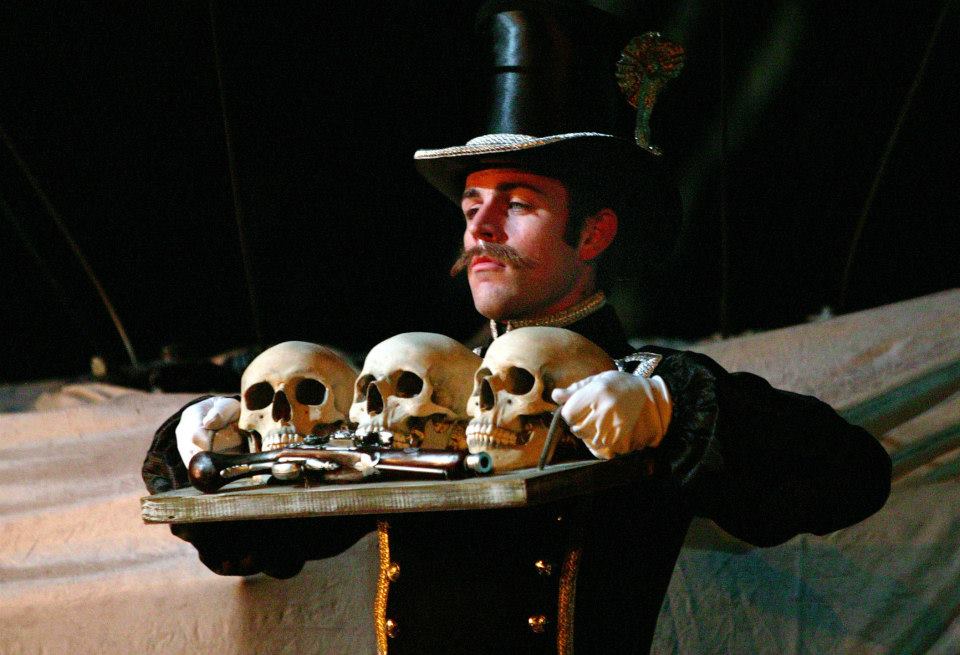
Paris, 1911. An auction is being held on the stage of the Paris Opera House. One man seems to be buying many sentimentally valued items, including a musical box featuring a mechanical monkey. This man is Raoul, Vicomte de Chagny. (“Prologue”) The next item is a reconstructed chandelier, which featured in the ‘famed tragedy of the Paris Opera’. The auctioneer calls for a demonstration of the new wiring, and suddenly the chandelier rises to the theatre’s ceiling, transporting the audience back in time (“Overture”).
Act I
Paris, 1881. The company is rehearsing a new opera (“Hannibal Rehearsal”). The manager of the Paris Opéra House arrives and announces his retirement, introducing the new managers, André and Firmin. André asks Carlotta, the company’s Prima Donna, to perform a piece from the opera for them. As she is singing, a backdrop falls suddenly, almost killing her. Joseph Buquet, the chief flyman, is called, but he can offer no explanation. The ballet girls whisper that it must be the work of the Opera Ghost. Carlotta is furious and storms out, vowing not to return until strange occurrences of this kind stop. The new managers, left without a leading lady, have their problems compounded when Madame Giry, the ballet mistress, hands them a note from the Opera Ghost, in which he demands a salary and the use of Box Five for all performances. Meg Giry, Madame Giry’s daughter, suggests that her friend Christine Daaé could take Carlotta’s place. Christine has been taking singing lessons, but claims she does not know her tutor’s identity. At Madame Giry’s insistence, the managers grant Christine an audition (“Think of Me”). At the performance that evening, Raoul watches from the managers’ box and applauds her performance. An unseen voice echoes his praise.
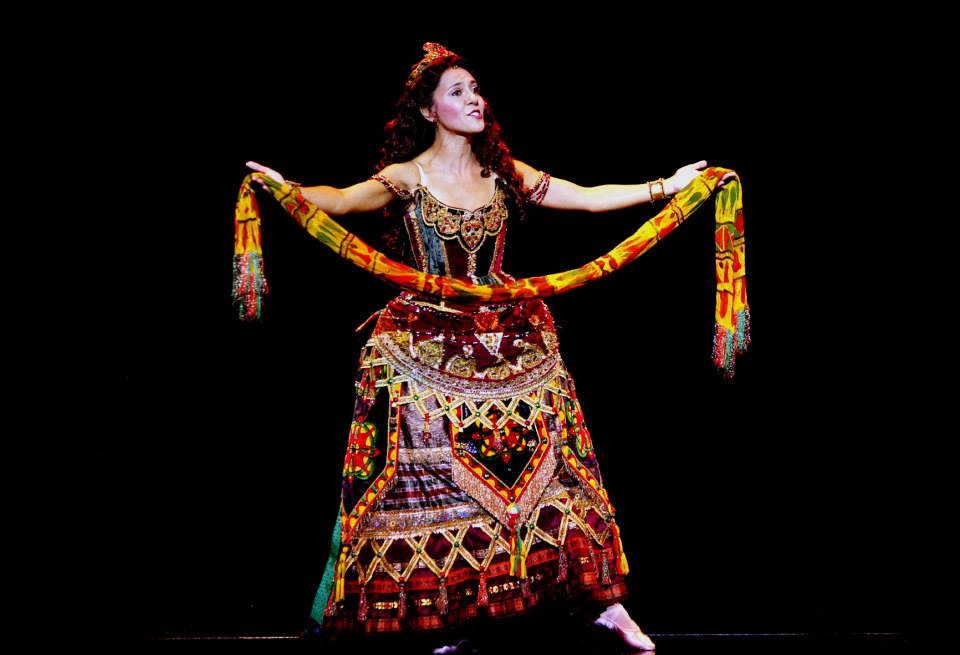
Meg asks Christine about her teacher, but all Christine can tell her is that it is an angel her late father had promised to send her (“Angel of Music”). She has never seen him and only hears him in her dressing room. Raoul goes backstage to her dressing room to congratulate Christine. They realise that they were playmates as children (“Little Lotte”). Raoul insists on taking her out to dinner and leaves to get his coat. As soon as he is gone, the strange voice is heard again, and gradually a figure appears behind the mirror. It is the Phantom (“The Mirror (Angel of Music (Reprise))”). The mirror glides open, and he draws Christine inside with him. Raoul returns and hears the voice, but the door is locked. Suddenly, the dressing room door opens. When Raoul enters, the mirror has slid shut, and the room is empty.
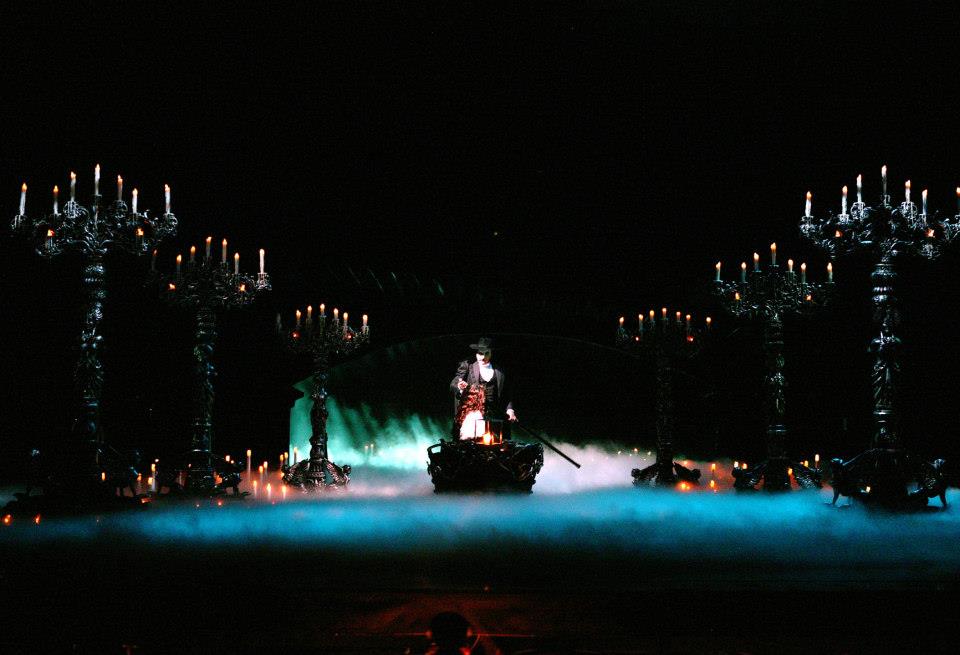
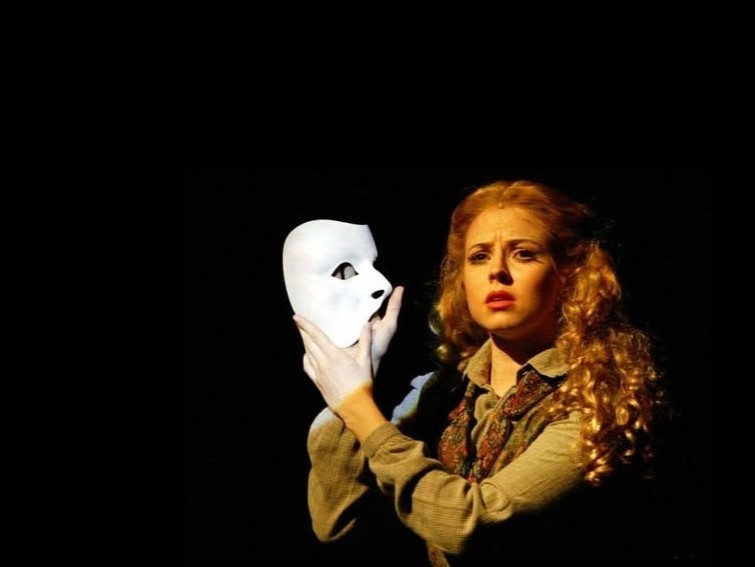
Christine and the Phantom journey through the labyrinth beneath the Opera House, crossing a lake to arrive at the Phantom’s lair (“The Phantom of the Opera”). The Phantom explains that he has been teaching Christine so she may sing for him (“The Music of the Night”). Christine faints, waking the next morning to the sound of the music box with the monkey playing a haunting tune (“I Remember”). The Phantom is seated at his organ, absorbed in his composition. Christine quietly approaches him and unmasks him from behind. Furious, he turns on her, and Christine recoils from the horror of his face and his anger (“Stanger That You Dreamt It”). His anger spent, the Phantom breaks down, and Christine, moved by pity, returns his mask. He takes her back to the surface.
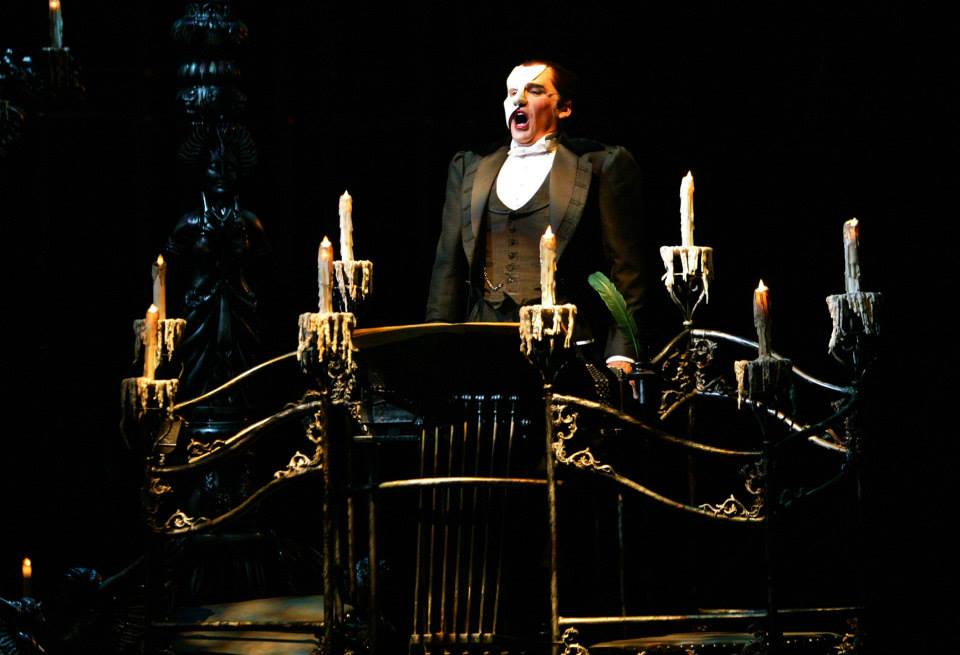
Buquet thrills the ballet girls with tales of the Opera Ghost (“Magical Lasso”). Madame Giry cautions Buquet not to mock the Opera Ghost openly lest he summon the Phantom’s vengeance on them all. There is confusion everywhere surrounding Christine’s sudden disappearance. Raoul, Carlotta, Piangi, Madame Giry and Meg all meet in the managers’ offices, brandishing letters some of them have received from the Phantom (“Notes”). The letter that causes the most debate is one demanding that Carlotta be replaced by Christine in the lead role of the upcoming production of Il Muto. The managers reassure Carlotta that she will remain the star and that Christine will be cast in a silent role. The Phantom’s voice is heard warning them against that course of action (“Prima Donna”).
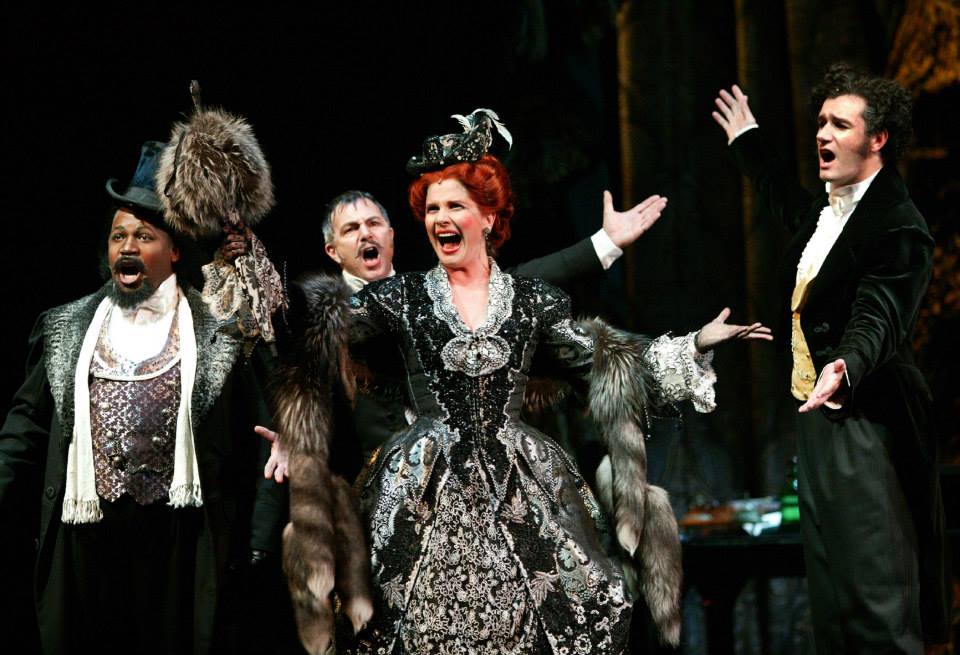
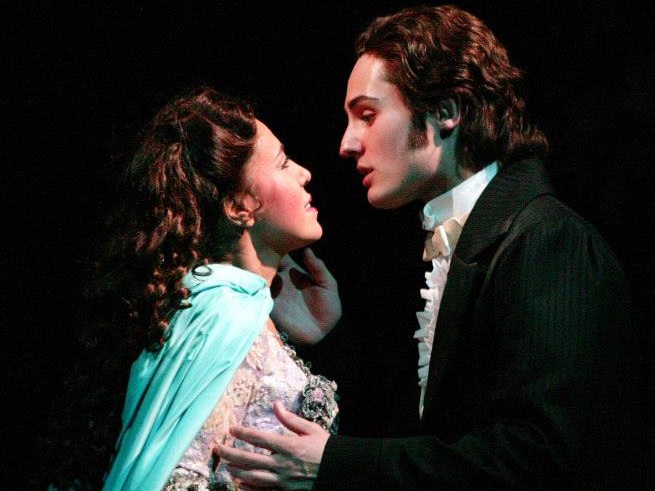
For the performance, Raoul sits in Box Five (“Il Muto“). The Phantom interrupts the show, repeating his demands, and when these are still ignored, he magically causes Carlotta to croak like a toad instead of singing (“Poor Fool, He Makes Me Laugh”). The managers give in to the Phantom and offer a ballet sequence while Christine changes for the performance. During the ballet, Buquet’s body, hanged with the Punjab lasso, falls from the flies. In the ensuing panic, Christine and Raoul flee to the roof. She tells him about her experiences with the Phantom (“Why Have You Brought Me Here?”). Raoul is incredulous, but offers her protection. They profess their love for one another and agree to leave together that night (“All I Ask of You”). Once they leave, the Phantom emerges from where he has been listening and vows revenge. As the cast of Il Muto take their bows, he brings down the chandelier, which lands at Christine’s feet on the stage (“AllI Ask of You (Reprise)”).
Act II
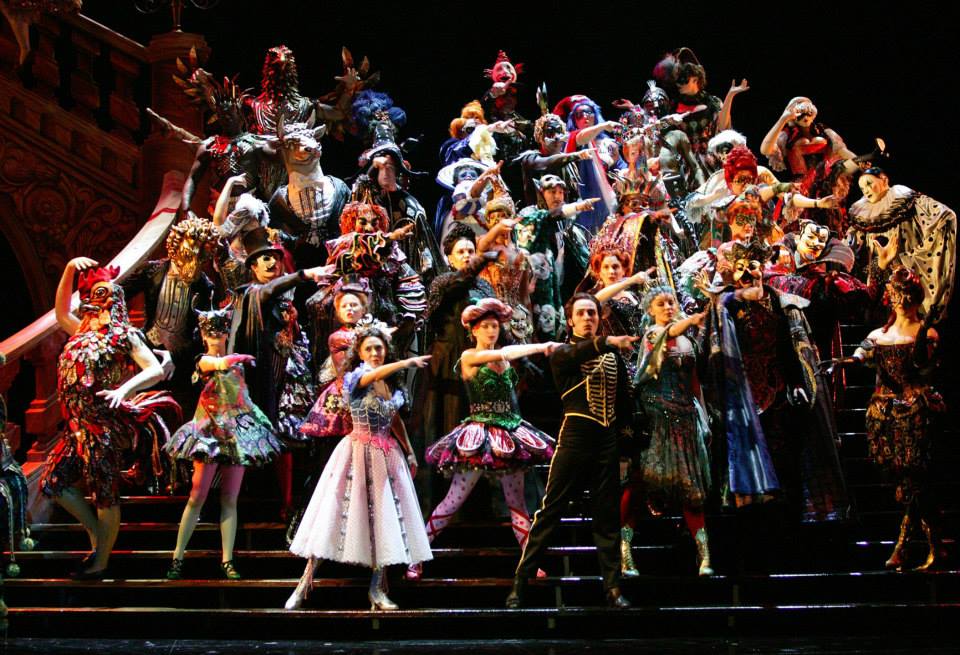
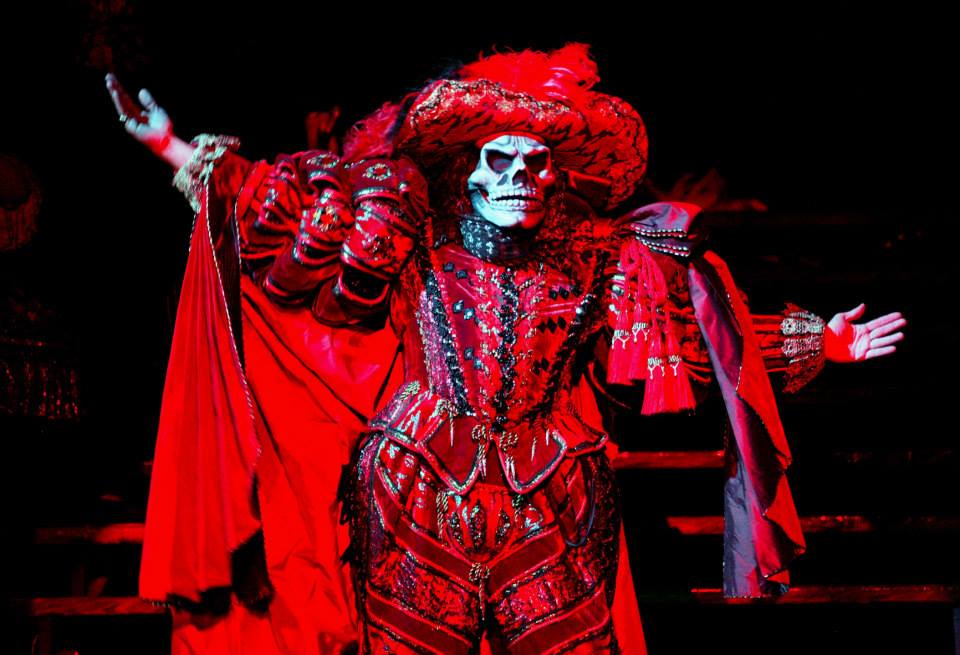
Paris, 6 months later (“Entr’acte”). The Opera hosts a ball to celebrate the New Year (“Masquerade”). Andre, Firmin, Meg, Giry, Piangi and Carlotta arrive to celebrate, glasses in hand. Raoul and Christine also attend. She is admiring a new acquisition, an engagement ring from Raoul, which she has attached to a gold chain around her neck. A figure dressed as Red Death appears on the staircase. It is the Phantom. He gives André the score of his new opera, Don Juan Triumphant, and demands that it be performed (“Why So Silent”). He tears the engagement ring from Christine’s neck, then disappears.
Raoul questions Madame Giry about the Phantom, and she tells him what she knows – that he is a deformed genius who escaped from a freak show, and was presumed dead, but that he still lives somewhere in the Opera House. Andre and Firmin have no wish to perform the Phantom’s work (“Notes (Reprise)”). However, Raoul proposes a plan to lure the Phantom to a performance of Don Juan Triumphant to trap him using Christine as bait. Christine does not want to become involved, but eventually agrees (“Twisted Every Way”). The frustrated company begins rehearsals. Christine visits her father’s grave (“Wishing You Were Somehow Here Again”). While there, the Phantom appears and attempts to regain his influence over her (“Wandering Child”). However, Raoul arrives and takes Christine away. The Phantom is furious and declares war on them both (“Brabo, Monsieur”).
The performance of Don Juan Triumphant begins (“Don Juan Triumphant“). Police officers have secured all the doors. As the opera progresses, it becomes obvious that Piangi has been replaced by another singer (“The Point of No Return”). Christine unmasks the Phantom on stage, much to the audience’s horror. Policemen rush onto the stage, but the Phantom takes Christine and escapes. Piangi is discovered behind the scenes, having been hanged with the Punjab lasso. Raoul follows the Phantom, aided by Madame Giry (“Down Once More”). She shows him the way to the lake. They are followed by an angry mob (“Track Down This Murderer”). In the Phantom’s lair, Christine confronts the Phantom with the fact that his true disfigurement is in his soul. Raoul arrives, and the Phantom lets him in, only to trap him in a noose and offer Christine an ultimatum: either she stays with him or Raoul dies (“The Point of No Return (Reprise)”).
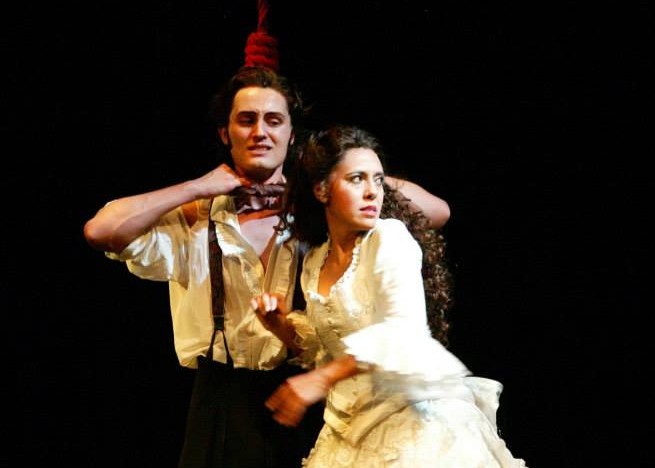
Christine’s answer is to kiss the Phantom. Stunned by this act, the Phantom lets them both go. Christine returns his ring, and he tells her he loves her. She leaves with Raoul in the boat. As the mob arrives at the lair, the Phantom sits in his throne, drawing his cloak around him. Meg is the first to arrive. She approaches the throne and tears the cloak away. All that is left is the Phantom’s mask (“Finale”).
Characters
Principal Roles
The Phantom of the Opera. 30s – 40s. High baritone or tenor (with a good low range) from low A flat to high A flat. Needs a dynamic, bravura, ‘star’ performance, both frightening and irresistible.
Christine Daae. 20s. Beautiful young singer. Soprano voice that combines elements of classical and pop singing. A light, floaty soprano. She sings briefly to high E.
Raoul, Vicomte de Chagny. Late 20s – early 30s. Dashing, handsome young aristocrat. High baritone (2 octave range from A flat to A flat).
Monsieurs Firmin and André. Late 30s – 50ish. The managers of the Paris Opera House. Trying to be elegant, they are slightly befuddled and bumbling. Need good instincts for stylish comedy. Good supporting roles. Baritones; one sings to A, one to G.
Carlotta Guidicelli. 30s – early 40s. The prima donna of the Paris Opera. A diva in every sense of the word. Coloratura soprano, to high E. Requires opera training.
Madame Giry. Late 30s – early 50s. The Opera’s ballet mistress. An ominous, stern, forbidding figure. Mezzo soprano to high B flat.
Ubaldo Piangi. Late 30s – 50s. The opera’s leading tenor, Italian style singer, sings to high C. Requires opera training.
Meg Giry. Late Teens – Early 20s. A member of the Corps de Ballet. Must dance on pointe and sing mezzo soprano to G.
Speciality Roles
Don Attilo (in Il Muto)/Passarino (in Don Juan Triumphant). 30s – 40s. Bass or Bass baritone with a solid and legitimate low F. Should be a physically interesting character man with a good sense of comedy.
Wardrobe Mistress/ Confidante (in Il Muto). 30s – 40s. Contralto or low mezzo. Physically interesting character woman. Short and round or tall and thin.
Monsieur Reyer. 30s – 40s. Tenor. Character role. The repetiteur (vocal coach) of the Paris Opera. An agitated, finicky, meticulous fellow. A strict disciplinarian, always on the verge of hysteria.
Monsieur Lefèvre. Late 30s – early 50s. Manager of the Paris Opera House who is handing over his position at the top of the show. Eager to be rid of the whole situation. Good instincts for stylish comedy.
Ensemble Roles
1905: Auctioneer, 2 Porters, Bidders. 1881: Joseph Buquet, Stagehands, Madame Firmin, Policemen, Chief Fire Officer, 2 Fire Marshals, Marksman, the Ballet Chorus of the Opera Populaire*. In Hannibal: Princess, Slave Master*. In Il Muto: Fop, Two Epicene Men (a Hairdresser and Jeweller), Shepherd*. In Don Juan Triumphant: Innkeepers Wife, 2 Pages.
*The dancers in The Phantom of the Opera should be strong classical dancers, not tap dancers, jazz dancers or ‘hoofers.’ Female dancers must be under 5’6” and must be experienced, classically trained dancers. They should have a degree of innocence about them and look very young (18-25). Male dancers must be 6’0 or taller and must be classical/ballet dancers. They should have solid classical technique with a musical theater flair.
Cast Recordings
The Phantom of the Opera is one of those shows that has numerous recordings in various languages, making the task of reviewing each of them in any depth rather difficult, so I’ll be focusing my attention on a handful of the English-language recordings. When available, links to the albums on Spotify have been provided; simply click on the image to listen to the recording.

This was the recording that introduced the world at large to a show that would become an international sensation. A comprehensive overview of the score and indeed the show as a whole is provided over two discs, providing an immersive listening experience. As the Phantom, Michael Crawford conveys the torture of a human being so damaged that he dwells on the edges of humanity. Vocally, he’s not my favourite Phantom, but his approach to the role from an acting standpoint is compelling. His performances of the songs demand attention. It’s also not easy to dismiss Sarah Brightman in the role that was written for her. While she certainly isn’t the best Christine that has appeared in the show over the quarter century it’s been running, there’s a sweet vulnerability in her performance that certainly suits the role. (Note, however, Ms Brightman, that the correct pronunciation of opera includes no final “r”.) Steve Barton is probably the least controversial of the three leads. His is a fine performance in a thankless role. The supporting cast delivers the goods.
The Canadian Cast Recording was the first English language recording to follow the London Cast Recording. A highlights recording that skips a great deal of the bits and pieces in between the songs proper, the main reason for having this recording in your collection would be to have some record of Rebecca Caine’s marvellously acted and sung performance in the show. Although vocally, her voice sounds perhaps a shade too mature for the role, Caine takes the operetta cliché that is the stuff of Christine’s character and moulds it into something more complex. Every Christine that has followed surely owes something to Caine’s performance in the role. As far as Phantoms go, Colm Wilkinson plays into the extremes of the role, which creates a darker, more fractured take on the role. It certainly works in the Phantom’s more powerful moments, but quieter moments (as in the parts of the generally over-articulated “Music of the Night” or the Phantom’s reprise of “All I Ask of You” near the end of Act I) come across in a rather contrived manner. Byron Nease is a blustery peacock of a Raoul and all the less sympathetic for it. The supporting cast members are fine, but perhaps feel a little weighed down by the seriousness of the approach that was clearly taken in this production of the show.

Let’s face it. It’s rare for studio recordings to hold their own against genuine cast recordings, even when, as in this case, some of the performers have played the roles they are singing on stage. On this recording, we have Claire Moore, Sarah Brightman’s alternate in the original cast, singing the role of Christine several years after she played it on stage. There are two problems here. Firstly, there’s the general maturity of her voice, which is only natural given the passage of time between 1986 and 1993. The second is that Moore doesn’t really nail the arc of the role vocally, climaxing in her first number (“Think of Me”) and never bettering the standard she sets there. That said, her performance of “Think of Me” is outstanding, my personal favourite from a vocal perspective. Barring a suave and charming contribution from John Barrowman as Raoul and a sincere performance from Megan Kelly as Meg, the rest of the recording is basically a wash. Graham Bickley is a bland Phantom, neither mysterious nor virtuosic in a role that requires at least that and more. The big numbers all disappoint in one way or another: the title song is too slow and lacks punch; the balance of “Prima Donna” is all over the place, leaving it to sound like a quartet; and the mix on “Masquerade” is too wet, an echo of the bright, sharp sound it was designed to have, to make any real impact on the listener. If you are looking to buy a single recording of the show, don’t let it be this one. This is one for the completists.

If the 1993 Studio Recording is one for the completists, then so is this one. The movie may be no great shakes, but at least when you’re watching it, you have the visuals to distract you, for better or worse, from a soundtrack that offers very little by way of general satisfaction and very little compared with other recordings of the show. Emmy Rossum delivers a bland reading of Christine, which has less to do with her innate talent than with the take on the character in the film, something that is largely wrapped up in Joel Schumacher’s inability to tell the story in any particular style or with any particular vision. Gerard Butler battles valiantly with the score, and it’s this conflict that one follows rather than that which is meant to be going on dramatically. Patrick Wilson sounds fine as Raoul, but makes little impression in the bigger scheme of things. (Of course, that is partly to do with the way the character is written, even in the stage version of the show.) The highlight of the recording is Margaret Preece, who sings the role of Carlotta, who is played by Minnie Driver in the film. That sums up the problem with this album: when Carlotta is the highlight of the proceedings, you know that something is amiss.
Between the opening night of The Phantom of the Opera in London and this, the 25th Anniversary concert, things changed. It became en vogue for the Phantoms to become younger and sexier and for the Raouls to become snobbier and snottier. Part of this can be attributed, I think, to the Las Vegas production, in which glamour and shortcuts triumph over sense and depth, and part of it to the premiere of Love Never Dies, in which some of the characters that appear in both shows develop in ways so extreme such that back-dated tweaks were made in the original so that some parts of the sequel make a bit more sense. Those two landmarks in Phantom history also delivered to us the two leads in this 25th anniversary concert: Sierra Boggess (who got her big break playing Christine in the Las Vegas production and then originated the role in Love Never Dies) and Ramin Karimloo (who played Raoul on stage in 2003, Christine’s father in the film adaptation of the show and eventually the Phantom in both The Phantom of the Opera and Love Never Dies). The recording is a live one and, like many live recordings of musical theatre, never completely satisfies. Boggess is a rather shrill Christine, sounding at her best earlier on in the show. By the time we get to “Wishing You Were Somehow Here Again”, it’s all interpretation and no technique. The best musical theatre actresses can deliver both. But perhaps what is most distracting about Boggess’s performance is her accent, which falters on some of the vowels and anytime she hits the lateral consonant. Karimloo was more effective vocally in Love Never Dies, but he sounds fine on this recording, even if he veers a little towards blustery genericism now and then. Hadley Fraser gets the dynamics of his relationship with Christine wrong, playing up Raoul’s chauvinism too much when he is with her. Perhaps this is one of the concessions made so that Phantom dovetails more neatly with Love Never Dies, but it doesn’t quite work. Wendy Ferguson as Carlotta delivers an exemplary “Think of Me”, but then checks out vocally when she is in non-diegetic scenes: it seems to me that Carlotta should be acted the other way around if that difference is going to be there. The rest of the cast ranges from delightful (Daisy Maywood as Meg) to appalling (Barry James as Monsieur Firmin, who is barely tolerable). Overall, the album is a third choice, trailing behind both the Original London and Canadian cast recordings. I would rather buy one of those and get the filmed version of this concert, if you’re going to get it at all.
Film and Video Recordings
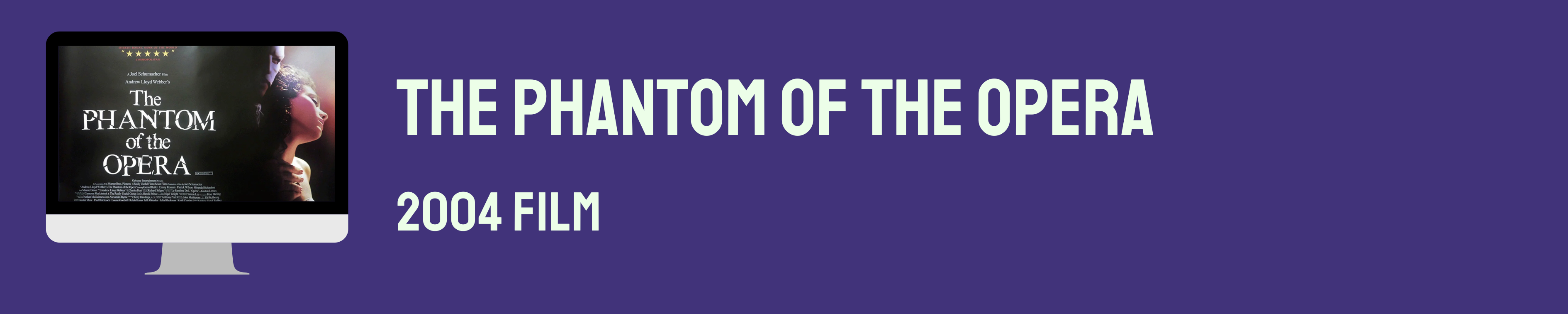
The film version of The Phantom of the Opera is almost a complete misfire. The film strips away anything and everything that worked in the stage show. What should have been, at the least, a visual feast turns out to be a crashing bore.
The adaptation, by Joel Schumacher and Andrew Lloyd Webber, saddles the film with awkwardly conceived additions to the framework story and the poorly considered decision to use sung recitative as speech. Simply shifting the mode from one form to the other (with the change of medium as justification) doesn’t work: recitative is heightened, much like Shakespeare’s blank verse, and is not intended to be spoken but to be sung. If Schumacher and Lloyd Webber wanted to construct a more traditional book musical for the film, which would be a poor choice for this material in any case, they should have rewritten the verses as dialogue from scratch.
The direction, by Schumacher, is all over the place. Is this high camp? Is this melodrama? Is it a dark, post-modern operetta? I doubt Schumacher could answer this question, and the film shows it. While there is little stylistic unity, nothing is playful or political enough to make the film a truly postmodern take on the story. All that Schumacher’s dreadful direction and Peter Darling’s poorly conceived staging for the dances – I hesitate to call it choreography – does is make one appreciate the Harold Prince and Gillian Lynne’s brilliant contribution to the stage show even more.
Visually, the film is sumptuously, but not always well designed. The Phantom’s make-up represents a poor effort in that department; the costumes for the “Masquerade” sequence are designed using a woefully spare palette; and the Phantom’s lair is a triumph of mediocrity. Once again, it makes one appreciate the stage show even more. Maria Björnson’s designs may not reach for the realism that film requires, but they are truly brilliant.
Then we get to the cast. First off, the film is unevenly cast. Some, like Patrick Wilson (Raoul) and Simon Callow (André) would be able to do this kind of thing in their sleep. Others are less suited to their roles, like Gerard Butler, a younger and sexier Phantom than usual, at least more so than the character was conceived in the original production, who lacks the vocal elasticity and control for the role. Emmy Rossum comes across as bland, delivering a performance that just never goes anywhere. The root of the problem, I feel, is the direction. It’s as if nobody here is in the same film and everyone just played around on their own steam while the cameras rolled. With a brilliant director, even this cast might have delivered the goods; with Schumacher at the helm, they never stand a chance.
There are moments of magic to be had, such as the transformation from the monochromatic prologue into the full colour main body of the film and the much of the subsequent tour through the opera house or some of the excesses to which Minnie Driver’s Carlotta, with vocal help from Margaret Preece who sings the role brilliantly, is subjected during “Prima Donna”. However, these moments are few and far between.
One might ask why it’s worth bothering to buy the film on DVD or Blu-Ray (if you’re still collecting physical media) if it is so bad. Get it for the brilliant “Behind the Mask” documentary, a feature that deals with the making of the show more than the movie and offers up clips from the stage production and some of the original performances of the songs, with vastly different lyrics, as it was presented in a draft form at Lloyd Webber’s own musical festival at Sydmonton. That bonus feature alone is worth the price of the DVD for fans of the show.
Scripts and Scores
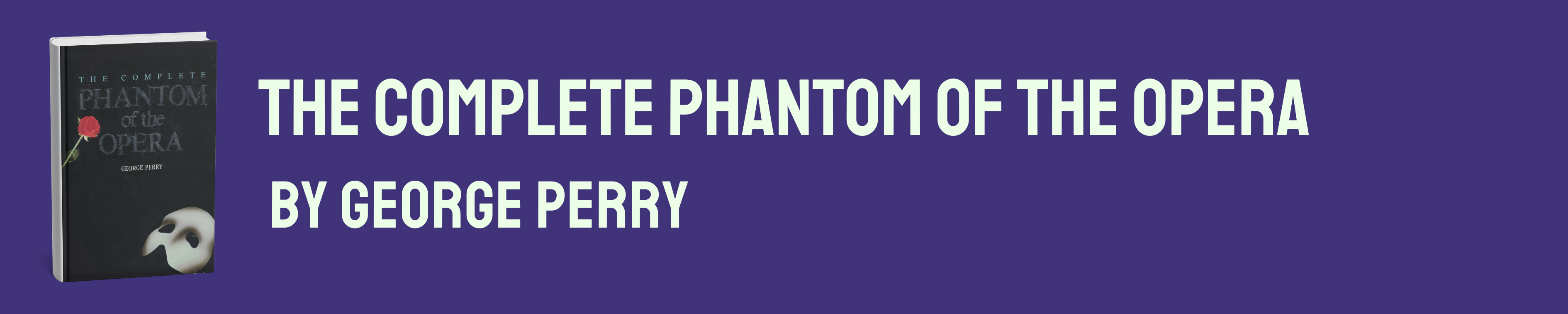
The complete libretto of The Phantom of the Opera is published in a fascinating book called The Complete Phantom of the Opera. Along with the libretto, the book includes essays on the historical period in which the show is set, on the original novel and on the development of the show. Many photographs illustrate each of these sections of the book, making for a satisfying book that one can dip into as one pleases. No matter your opinion of the show itself, this is a superb book to have in one’s musical theatre collection.
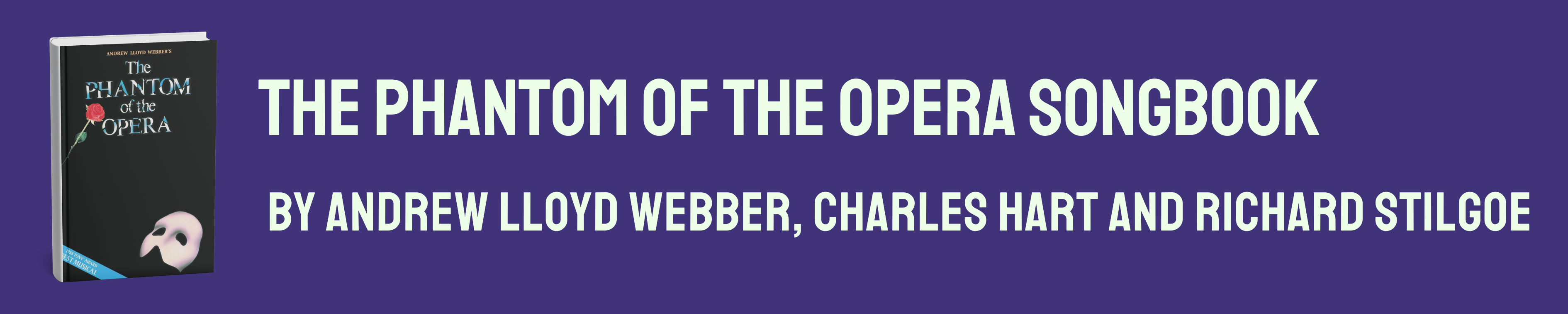
Although a complete vocal score of the show is not available for purchase, a set of vocal selections arranged for piano has been published. The 9 songs included are: “All I Ask of You”, “Angel of Music”, “Masquerade”, “The Music of the Night”, “The Phantom of the Opera”, “The Point of No Return”, “Prima Donna”, “Think of Me” and “Wishing You Were Somehow Here Again”. The book is illustrated with photographs from the show and is great for someone who would like to learn songs from the show for their repertoire or just for something who likes to play showtunes on the piano for leisure.
Books

The original novel upon which The Phantom of the Opera is based is an interesting piece of literature. Originally published as a serial in 1909-1910, the tale is expectedly disjointed – an amalgam of the genres of horror, romance and mystery. The biggest difference between the book and the show, besides the overall romantic tone taken on in the musical adaptation, is the absence in the show of a character referred to in the book as “the Persian”. The character is a fascinating one, in some ways as fascinating as the Phantom of the Opera himself. A worthwhile read./

For fans of the novel and the musical alike, Phantom is a must read. A prequel to both, it charts the history of the man who became the Phantom from his birth to the end of his life. Using the approach of telling his life story through a chain of voices – his mother, his own, a father figure from whom he learns architecture in Italy, the Persian and Christine – the novel manages to keep Erik (the Phantom) enigmatic even as it unpacks his enigma. If only Andrew Lloyd Webber had chosen to turn this book into a musical instead of Love Never Dies – it could have been wonderful.

Terry Pratchett’s Maskerade is a book for fans of both The Phantom of the Opera and musical theatre in general. The plot deals with two witches, Granny Weatherwax and Nanny Ogg, who set off for the big city (Ankh-Morpork) to recruit a new member for their coven, namely Agnes Nitt. Trouble is, Anges has her eyes set on a life in the Opera House and her friend, Christine, is getting all the lead roles thanks to the Opera House Ghost while Agnes has to sing from the wings to overpower Christine’s tremulous efforts. The book is a comic romp through the world of The Phantom of the Opera with nods to many other musical theatre classics along the way.

Somewhere out there, there are fans of the film adaptation of The Phantom of the Opera. This book is for them. For those who want further record than the DVD of Joel Schumacher’s inept direction, Emmy Rossum’s bland Christine and Gerard Butler’s mediocre Phantom. Yes, there are pieces about the history of the story, other adaptations of the book and the theatre production. But there isn’t much you can’t find in better places. You know what would have been more welcome than this? And what still would be? An updated edition of The Complete Phantom of the Opera that reserves only a chapter for documenting this failed attempt at bringing the show to screen.

