
This week, the announcement that Jamie Lloyd’s London Palladium revival of Tim Rice and Andrew Lloyd Webber’s Evita will transfer to Broadway in the spring of 2027 has everyone on a rainbow high! Evita charts the meteoric rise of Eva Perón, who climbs from poverty to become Argentina’s dazzling and divisive First Lady. Told through a thrilling pop-operatic score and framed by a watchful narrator, Che, it explores fame, power, ambition, love and the cost of becoming a legend.
Eva is one of the great star roles in the canon, so it’s even more thrilling to hear that the high-flying, adored star of the UK production, Rachel Zegler, will reprise her Olivier Award-winning performance as Eva Perón. The news of this long-expected rainbow tour makes it the perfect time to delve a little into the show’s history, so let’s take a look at four of its biggest milestones!
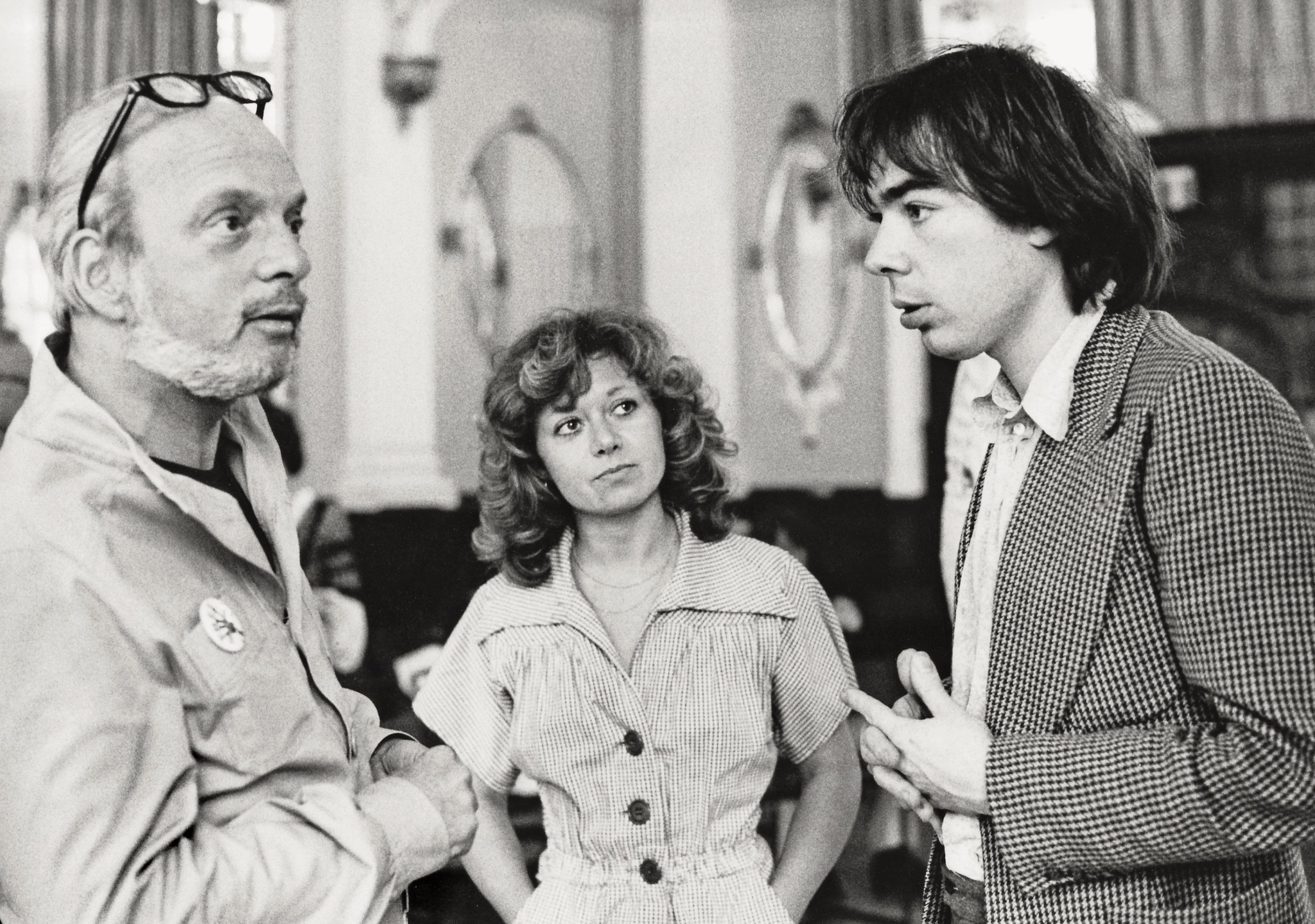
First – The 1978 World Premiere Production
The first incarnation of Evita was really the concept album on which the stage production was based. Like Jesus Christ Superstar before it, the recording was a smash success; in fact, its popularity surpassed that of its predecessor all over the world, except in the USA. “Don’t Cry for Me, Argentina” became a hit single, as did “Another Suitcase in Another Hall” and “Oh, What a Circus.” The album still makes for compelling listening today, with Julie Covington’s raw delivery of Eva’s songs remaining, in some ways, definitive.
It took some work to transfer what worked on an album to something that worked on stage, and it was the great Harold Prince who helped shape the piece into a production that would define the visual language of the stage interpretations for decades. The stage production starred Elaine Paige, who had built a reputation for herself as a bankable stage star in musicals like Hair, Grease, Billy and The Boy Friend. Evita would make Paige a first-class star, and she became synonymous with the role in Britain. David Essex (Che), Joss Ackland (Juan Perón), Mark Ryan (Agustin Magaldi) and Siobhán McCarthy (Perón’s Mistress) rounded out the principal cast. Even when viewed today, Prince’s staging is electric, with moments of sheer brilliance, including the extended funeral sequence that opens the show, the montage that narrates Perón’s rise to power in “A New Argentina,” and Eva’s iconic address from the balcony of the Casa Rosada. Even more traditional, self-contained songs like “Buenos Aires” and “Rainbow High,” some of my favourite musical theatre songs from the 1970s, have a lasting impact.
I’m not sure whether Prince navigated all of Evita‘s challenges successfully, and I still wonder whether the “Montage” that takes us from Eva’s final collapse through to her deathbed is dramaturgically satisfying. Prince’s production uses it as a kind of coup de théâtre to get from “Eva’s Final Broadcast” to the “Lament,” but I’m not convinced it accomplishes as much dramatically. There’s a similar moment in Jesus Christ Superstar, where Andrew Lloyd Webber and Tim Rice needed to create a moment for the audience to question the final worth of Jesus’ sacrifice. They put the words into Judas’ mouth, writing the song “Superstar”, which innovatively achieved its intention. In contrast, the “Montage” in Evita feels like something of a shortcut, leaving it to Prince and those who follow in his footsteps to make the number deliver something more than the sum of its parts. It’s worth mentioning that the 1996 film adaptation dispensed with the “Montage” and did not feel incomplete without it – so is this sequence perhaps this great musical’s greatest flaw?
Nonetheless, the original production of Evita had an enormously long sustained run of 3176 performances, closing almost eight years after it opened. Before Cats and The Phantom of the Opera came along, Evita proved that Lloyd Webber had a magic touch that could lead to long-term commercial success with this diamond of a show.
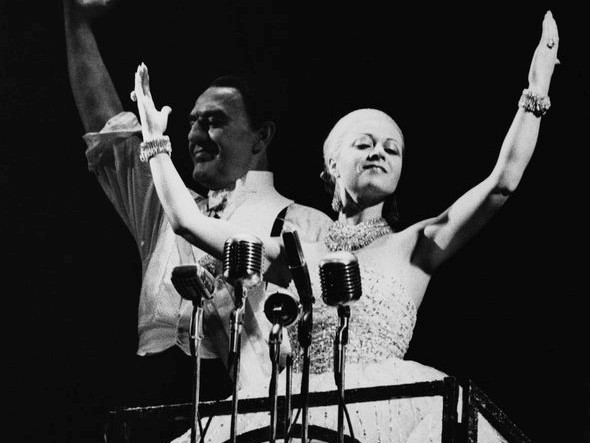
Blow-up – The 1979 Original Broadway Production
While the original Broadway production of Evita ran half as long as its West End counterpart, it still represents a “blow-up” moment in the show’s history. For many musical theatre fans, myself included, Broadway often cements the international legitimacy of a musical and this is certainly true in the case of Evita. The West End is where everything started, but Broadway is the place where it exploded into global prestige and the stuff of theatre legend.
Like Elaine Paige before her, Patti LuPone, who played Eva Perón, had a slew of acting credits on her resume before taking on this role. In fact, she had already had quite a diverse career, acting in classical plays as well as more contemporary creations. As had happened with Paige, this role established her as a star, and her interpretation still shapes discussions of the role. The same could be said for Mandy Patinkin, who played Che. Bob Gunton (Juan Perón), Mark Syers (Agustin Magaldi) and Jane Ohringer (Perón’s Mistress) took the other three major roles alongside them.
Evita was also a juggernaut at the Tony Awards, receiving eleven nominations, walking away with seven wins, including Best Musical, Best Book of a Musical and Best Original Score. LuPone and Patinkin walked away with honours for their performances, while Harold Prince won for his direction and David Hersey for his lighting design. The Tony Awards performance of “A New Argentina” is among the best ever included in the ceremony, as famous for its sheer electric drive as it is for the moment where LuPone misses Gunton’s arm as she steps toward him after one of her impassioned solos.
The backstage dramas surrounding Evita added to the show’s compelling mythology. The famously intense working conditions and LuPone’s later stories about the experience added to the lore. LuPone received death threats. There were several bomb scares, and in at least one case, the show went on in spite of it. LuPone felt her alternate was gunning for her and reports that someone posted the alternate’s good reviews next to LuPone’s poor ones in the basement of the Orpheum Theatre during the show’s San Francisco tryout. There were also rumours that Prince repeatedly tried to find a way to bring Paige across to replace LuPone, but that he was thwarted only by Actor’s Equity. Hit productions are generally remembered for their polish; flops, for their battle scars. Evita had both.
Lastly, Evita was a production that prefigured the 1980s megamusical boom. In this case, it seemed that this kind of spectacle and a through-sung score could coexist with intelligence. If only that remained the case.
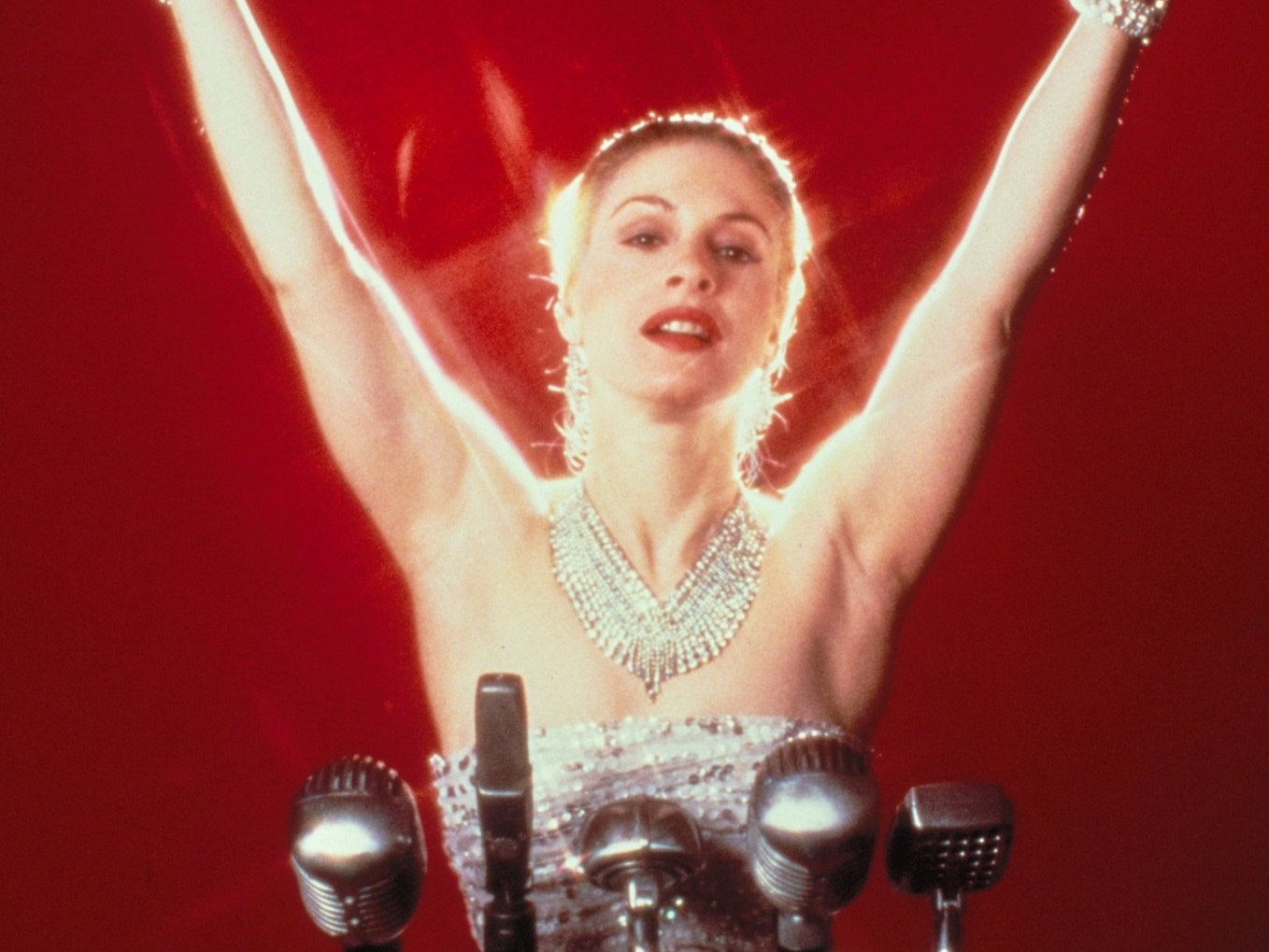
Biggest – The 1996 Film Adaptation
Madonna as Evita. In the 1990s, musical theatre star casting didn’t get bigger than this. Michelle Pfeiffer, Glenn Close, Meryl Streep and even Jennifer Lopez were considered for the role, but it was the Material Girl herself who won the role. Many were sceptical, decrying the casting in the same way many objected to Ariana Grande’s casting in Wicked – until they saw her on screen. And even then, Madonna had her detractors, including Patti LuPone, who infamously said on Watch What Happens Live with Andy Cohen that ‘Madonna is a movie killer. She’s dead behind the eyes. She couldn’t act her way out of a paper bag. She should not be on film or on stage. She’s a wonderful performer for what she does, but she is not an actress.’ Once again, the behind-the-scenes drama of Evita created a sideshow that rivalled the main attraction itself.
Evita was not an unqualified success, but given that it was made in a decade when any movie musical was considered dead in the water before it even opened, it certainly stepped up the show’s global impact. While Alan Parker, the film’s director, was insistent that the film would not become a glorified Madonna video, which it didn’t, the film reached millions of people beyond the theatre audiences who saw the show on stage. This was pop culture on a global scale, and like the stage show, it was more popular outside the USA than in it. Its impact left such an impression that the way the stage show was crafted shifted. Some of the orchestrations were adjusted, and perhaps most controversially, the song that had been written for the film, “You Must Love Me,” found its way into the stage show. It seemed to be a logical step, given that it was “You Must Love Me” that made Evita an Oscar-winning film. That said, its poorly grafted insertion into the Harold Prince production that does little for either the song or that incarnation of the show.
There were also other differences in the film, such as the re-allocation of “Another Suitcase in Another Hall” from Perón’s Mistress, now a much more minor role (played by Andrea Corr, of The Corrs fame), to Eva herself, which helped complicate the character’s trajectory after Eva arrives in Buenos Aires and consequently, heightened her ascent to Argentina’s First Lady. Che, played in the film by Antonio Banderas, without any hint of the Che Guevara persona that had dominated the concept album and stage production, was able to rock out in “The Lady’s Got Potential,” a number cut from the album in favour of “The Art of the Possible” on stage. Jonathan Pryce and Jimmy Nail completed the principal cast as Juan Perón and Agustín Magaldi. All delivered great performances in what is, all things told, a fairly underrated film.
Of her own experience of making the film, Madonna said, ‘This is the role I was born to play. I put everything of me into this because it was much more than a role in a movie.’ This, in essence, is what makes Madonna’s performance and film itself work – along with its fabulous design and gorgeous cinematography. On the silver screen, Evita became something more than the whole of its parts. It became an experience as true to itself as the original concept album and Prince’s production had been.
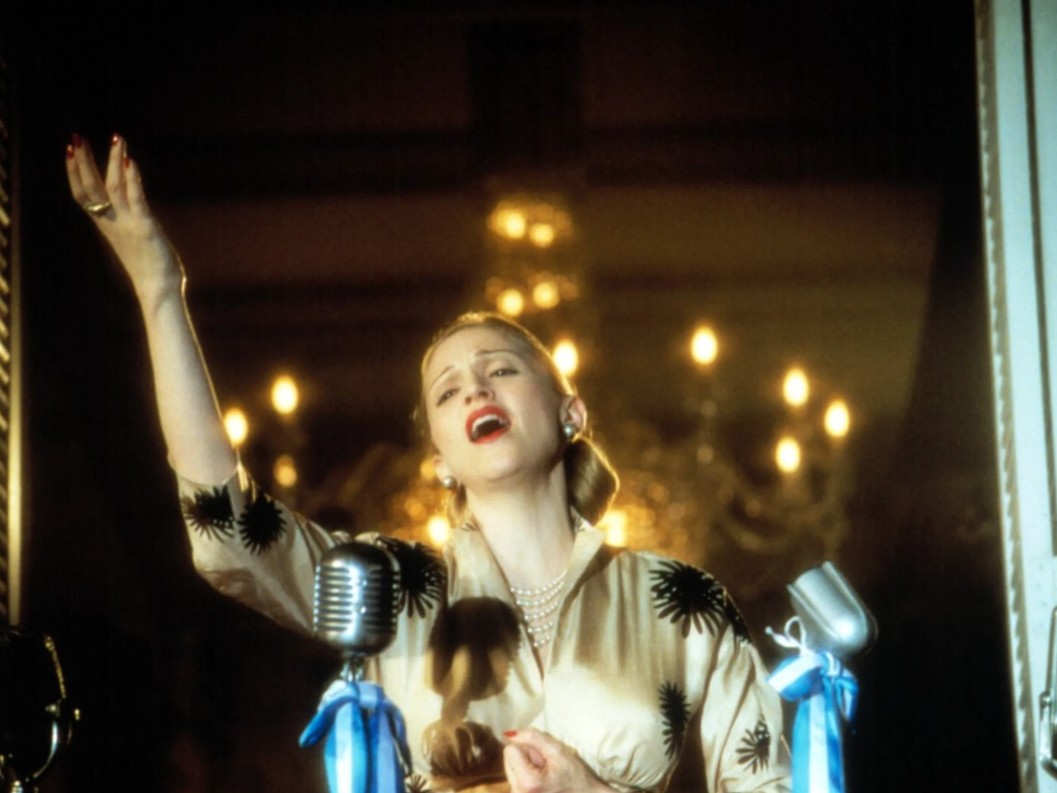
Latest – The 2020s Revival
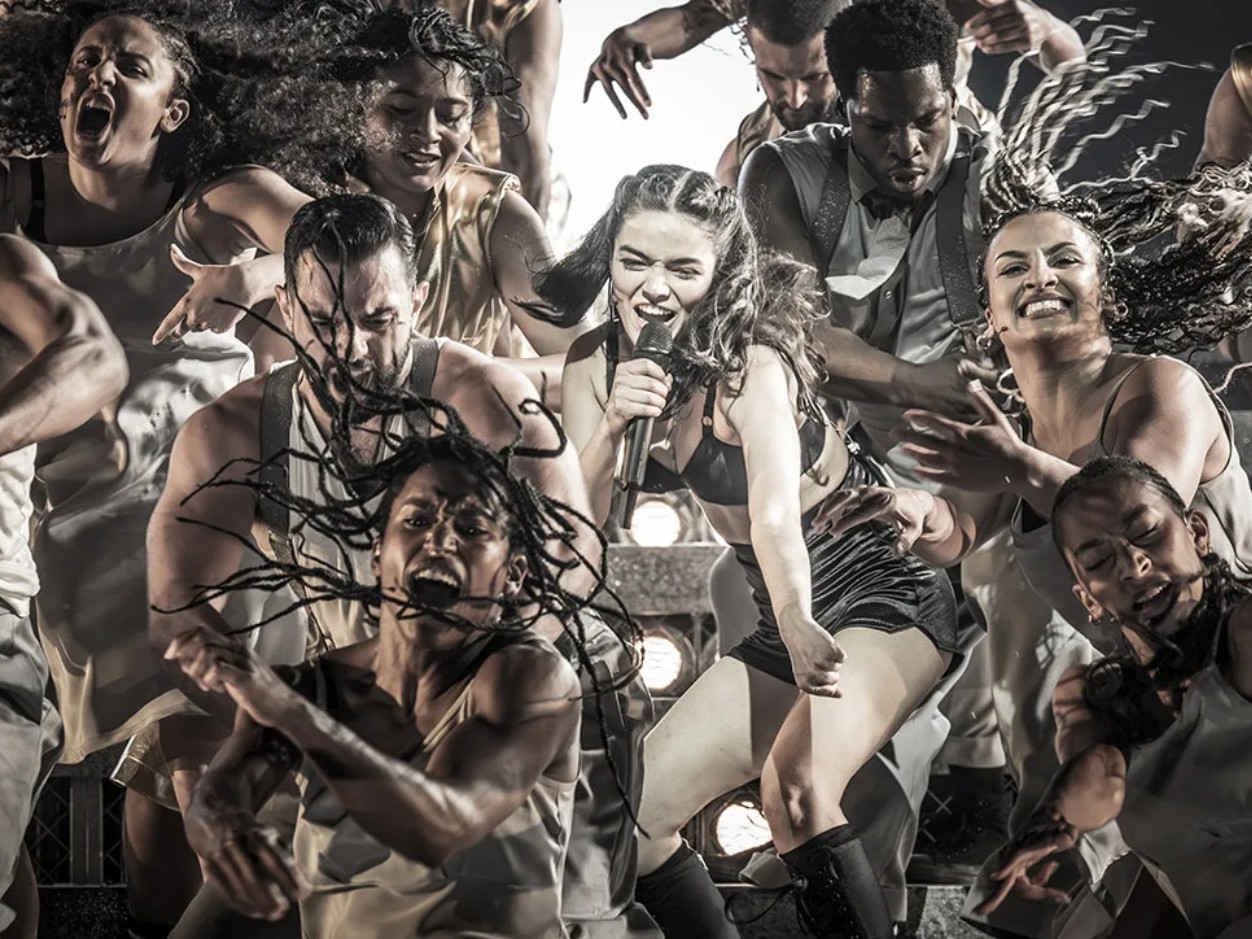
When Jamie Lloyd directed his new production of Evita, he delivered something that felt current. His concept is very much attuned to the times. It was highly photogenic, easily translating to clickable social media content, and generated a huge buzz. Not all of it was positive, with some critics questioning the overall coherence of Lloyd’s direction and others, including Andrew Lloyd Webber, voicing concerns that the show’s themes were diluted in favour of the production’s thrilling high-energy approach. In fact, the production even inspired a series of memes based on the joke that Lloyd’s leading men end up in their underwear, covered in blood, dirt, or paint, reflecting the aesthetic that defined both Joe Gillis (in Lloyd’s reinterpretation of Sunset Boulevard) and Che. It’s a superficial dig, for sure, and the counter-argument is that Lloyd is a theatrical auteur, but it still points to a tendency in his work to favour the cosmetic over what is thematically vital to a specific musical’s dramaturgy.
One thing that Lloyd does incredibly well in his productions is to draw out a flashy performance from his leading ladies. Rachel Zegler, his Eva, appears to be following in the footsteps of Nicole Scherzinger, whose turn as Norma Desmond won her an Olivier Award in 2024 and a Tony Award in 2025. Zegler, who won her Olivier Award just last month, will likely dominate the season when Evita comes to Broadway. In the West End, Diego Andres Rodriguez played Che, with James Olivas, Aaron Lee Lambert, and Bella Brown co-starring as Juan Perón, Agustín Magaldi, and Perón’s Mistress respectively. Currently, we are still waiting for further casting to be announced, but one thing we do know is that Zegler won’t be appearing on an outdoor balcony for “Don’t Cry for Me, Argentina” as she did in the West End, due to safety concerns about how such a staging choice might play out in the USA.
Lloyd Webber has been asked if Lloyd will adjust his staging to make Evita‘s story and themes clearer for the Broadway transfer. His reply? ‘Jamie Lloyd is Jamie Lloyd.’ Although rumours persist that there has been a fallout between the two, things clearly are not bad enough to have halted this production, but it seems that wherever Evita goes, drama follows. “Oh, What a Circus” indeed!
Evita’s Waltz
Eva Perón’s complicated legacy is defined by duality. Tim Rice himself articulated this in his approach to depicting her in the show as, in his words, “a fabulous bitch.” Even today, her reputation is obscured by the conflicting perspectives held of her by different groups of people. With its rocking score, Evita is nothing less than a winner of a show, one of Andrew Lloyd Webber’s best.


Evita is one of my favorite shows!
I think the score is incredibly inventive. When I think about the greatest Broadway songs, most of them are about love. The best songs in Evita are about politics, money, power, manipulation: I love “And the Money Kept Rolling In,” “High Flying, Adored,” “Waltz for Eva and Che,” “I’d Be Surprisingly Good For You,” and “A New Argentina,” none of which are particularly traditional, even “High Flying,” which kind of sounds like a basic 70’s Broadway tune, but isn’t at all. Plus the original cast was explosive, which may even be why I love the show so much: you can’t beat Mandy Patinkin and Patti LuPone right at the beginning of their careers, to say nothing of Bob “Warden Norton” Gunton and Mark Syers (can I just say, it blew my mind when I realized that Augustin Magaldi was also the Russian diplomat/the thief/the guy under the floor/Sailor #3 in the original Pacific Overtures). Oh, and I also loooove “Rainbow Tour” – ‘Ah, Señora Peron, it’s an easy mistake, I’m still called an admiral, yet I gave up the sea long ago!’ 🙂
There’s some very weird text-setting, though. When I was a kid I had this score memorized, I was so obsessed, and then later on I realized that actually, I had never been able to understand some of the lyrics. I knew by then how bad Patti’s diction was (and Mandy’s isn’t always so hot either!), but when I started looking at the songs, I discovered that the lyrics and their settings really don’t help the actors enunciate. I still don’t know the words to the chorus of “Waltz for Eva and Che” – ‘”‘There is evil… ever around… fundamental system of government quite incidental?’ Actually, I guess I do, but what does that even mean? How about ‘There is no one, no one at all, never has been and never will be a lover, male or female, [wicked high belting here] who hasn’t an eye on, in fact, they rely on tricks they can try on their partner! They’re hoping their lover will help them or keep them, support them, promote them, don’t blame them, you’re the same!’ Who sets a complicated text like that by having their leading lady belt at the top of her lungs? “Rainbow High” is similar, much as I love it. And ‘I wanna be a part of B.A., Buenos Aires, Big Apple!’ Do you know how long it took me to know what she was saying there? Years. And the bit in “Oh, What a Circus” when he sings “Sing, you fools, but you got it wrong” is completely impossible – ‘Show business kept us all alive from… something something something forty-five! But the star is gone, her something won’t something, that’s a pretty bad state for a state to be in.’ Oh well. I really do love Evita. And Joseph. After that I could kind of take or leave Andrew Lloyd Webber shows (though they all kind of have their moments).