Here’s a rare look at the original production of Chicago.
This first set of clips is from an out-of-town tryout, shot by Fred Ebb himself (as legend has it), so we get to see some stuff that never made it into the final version of the show!
This second clip features Gwen Verdon and Chita Rivera doing “Nowadays/Hot Honey Rag” on The Howard Cossell Show, also in 1975.
This is a real treat to see… but can you imagine what we’d have on record today if YouTube had existed in 1975?!!
This man has created great work for some great divas and others have performed his work to great acclaim: Ethel Merman, Chita Rivera, Donna Murphy, Joanna Gleason, Elaine Stritch, Bernadette Peters, Maria Friedman and Judi Dench are just a few.
But is there anyone that beats Angela Lansbury, for her hat trick of Anyone Can Whistle, Gypsy and Sweeney Todd? She’s just one of the best there is. Take a look:
101 Dalmatians II is one of the better Disney DTV sequels. While it’s not in the same league as the original, it’s also nowhere near as abysmal as some of the sequels have been. The team behind this film at least tries to match the tone set by the original and that’s mainly why the film works – even when the narrative isn’t quite as focused as it could be.
But the highlight for me is the appearance of Will Young on the soundtrack as he sings “Try Again”, underscoring a montage of failed attempts on the part of Thunderbolt and Lucky to get the attention of the British press with their “heroic” events. Here’s the video, courtesy of YouTube:
While I was looking for the music video, I also managed to find a video of Will Young offering some words of wisdom on the message of the song.
It is amazing what you can find on YouTube. It never ceases to amaze me. Today: two clips from the short-lived original London production of the Stephen Sondheim musical Sweeney Todd Not the greatest quality, but interesting to see….
I rather like Sheila Hancock in the clip of “A Little Priest”, but Denis Quilley just doesn’t seem to have the fire of Len Cariou or George Hearn.
Andrew Wadsworth, who starts off singing the reprise of “Johanna” in the second clip sounds stunning – and what you can hear of Mandy More’s Johanna is also beautiful. I liked Quilley much better here, although there’s something not quite right about the rhythm of his throat-slitting. But that could just be because the closeness of the camera. I think he’s super in the finale when Sweeney and Lovett rise out of the stage to single the final ballad.
Some further browsing around reveals that the London production added “The Beggar Woman’s Lullaby” (which some say give the Beggar Woman’s true identity away too soon) and cut the “Parlor Songs” (which are loads of fun – “Sweet Polly Plunket” is a delightful little song). I wonder what this iteration of the original Harold Prince production was like. It only ran 157 performances, so clearly the Brits didn’t take to it….
Still, I think Prince did a fantastic job on that first production. Seeing it as recorded on the television broadcast of the 1982 US touring company was an experience that I found completely thrilling. People often criticize that TV filming because it’s a mere shadow of the brilliant original production. I get that – but if that’s the case, oh my goodness, what a brilliant shadow it is.
I was browsing through some old bookmarks and came across the trailer for Rob Marshall’s upcoming film version of Nine, Arthur Kopit and Maury Yeston’s musical based on Frederico Fellini’s 8½:
I really, really, really want this film to be phenomenal. I don’t just want something that’s OK or pretty good; I want something that’s absolutely fantastic. The cast looks great – Daniel Day-Lewis, Nicole Kidman, Marion Cotillard, Penélope Cruz, Sophia Loren, Judi Dench, Kate Hudson and Stacy Ferguson. And Marshall seems to have proved that he knows what he’s doing when it comes to musicals. The one thing that makes me pause is that some bits in the trailer look an awful lot like what Marshall did in Chicago and I honestly don’t know how I feel about that. At the very least I feel somewhat ambivalent about it. Is Marshall forcing Nine into a concept where, as in Chicago, the numbers are all diegetic? I guess I’ll have to wait until November (or whenever it’s released over here) and see…. Till then I’ll live in the hope that I’ll stop by my local cinema and be completely blown away by what’s up on the screen.
It’s hard to believe that it has been a year since our production of the Craig Lucas and Norman René-conceived Stephen Sondheim revue, Marry Me a Little, at the Intimate Theatre, in which I played the “Man” and which was directed by one of my best friends and a great colleague, Jacqui Kowen. Thinking back to that wonderful experience, I wish it could have been more extended. The great thing about Sondheim’s material is that you never seem to stop discovering new layers within the pieces as you go along and I found that this accelerated tremendously as the run continued. Even today, I’m still finding answers for things that perhaps didn’t work perfectly.
I really enjoyed performing the show, which nonetheless has some problems in the way that it’s structured: “Uptown Downtown” just seems squeezed in for the sake of it (although I think I might have thought of a way integrate better than we did) and there is a huge psychological jump from “A Moment With You” to “Happily Ever After” which, linked only by “Marry Me a Little” seems a little fast. On the plus side, the divisions between fantasy and reality are pretty clear and the more you can play with those lines, the more interesting the show becomes.
The audiences, for the most part, seemed to appreciate the show and there wasn’t a single performance where someone didn’t come up to us after the show with a a story about how he/she really identified with a particular song or lyric because of a particular experience in his/her life. For me, the fact that we were actually communicating something to people that made them reflect about their lives was something that I found profoundly moving.
There is actually an incredible amount of stage business notated in the ‘book’ – such as it is – that does very little but distract the audience from the soul-stirring words. Much of this extra business was cut in our production. While still working within the concept, we tried to find a greater level of focus that came from playing the material instead of playing with pencils that fell from the desk and flushing toilets and spending forever preparing food that there wasn’t really time to eat anyway. Ultimately this served the material far better and helped the audience to follow the journey of the characters through this one evening in their lives far more clearly.
Because there is a character arc in the material, this is something that became really important to us as a point in putting this show together creatively. How do you get an audience that lives in a primarily visual culture to respond to something that is essentially an auditory experience where not only music but also words are really important? Particularly when the culture of the audience does not necessarily include Sondheim’s work as a reference point, which might prepare them for this experience. I really think this is a huge problem with audiences unaccustomed to listening to what lyrics have to say, which is particularly necessary with Sondheim’s work.
In a sense this is why “Two Fairy Tales” works so well as an opening number – besides focusing the concept for the evening, it really makes the audience realise that they have to listen because they are faced with a number that they can understand without hearing every word but in which it becomes apparent that the more words they hear, the richer their experienced will become. And so it means that their is a greater degree of attention through the much simpler “Saturday Night” and that they are settled in for for the real playing with words that happens from “Can That Boy Foxtrot?” through much of the rest of the show.
One of the things that was said to us again and again during the run was that it took a couple of numbers for audiences to tune into the idea of listening to the lyrics and the people who came twice only really managed to fully appreciate “Two Fairy Tales,” which opens the show, the second time they came to watch because they knew they had to listen from the very beginning. And there was certainly a deeper sense of appreciation for the lyrics in people who saw the show a second time.
As a side note, I must say that I cannot believe how badly the original cast recording represents the show, with the song order rearranged and the poor performances. It’s even more disappointing once you’ve seen the show in action, so to speak, than when you first hear the recording and you’re just trying to make sense of it.
Casting has been announced for Daniel Zaitchik‘s musical adaptation of Picnic at Hanging Rock that will take place at the Eugene O’Neill Theater Center later this month. Whitney Bashor, Charlie Brady, Matt Doyle, Jessica Grove, Veronica Kuehn, Hannah Laird, Anne Letscher, Anne Nathan, Lauren Nolan, Laila Robins, Sarah Shahinian, Nick Sullivan, Kate Wetherhead, Jessica-Snow Wilson, Lauren Worsham and Valerie Wright will appear in the production, which will be directed by Joe Calarco.
The 1945 Original Broadway Cast Recording of CAROUSEL
Where to begin? Richard Rodgers and Oscar Hammerstein II’s Carousel, which first premiered in 1945, has been recorded several times over: both the original Broadway and London cast performances were preserved, and since then we’ve had numerous revival and studio cast recordings. But perhaps it’s prudent to go back to the beginning… and then spend some time looking at a few of the major recordings of the score.
The 1945 Original Broadway Cast Recording is something special, preserving the original cast performances and providing enough of the score so that one gets a relatively good idea of the show. Yes, some songs are shortened (like “If I Loved You”), but the only song that gets left out completely is “Geraniums in the Winder”. The other cut material comprises mostly reprises and dance music. The principal cast members are all good singers. John Raitt’s baritone rounds out the songs nicely, Jan Clayton gives a moving reading of Julie’s songs, and Murvyn Vye is fun as Jigger. We did get a reminder of the original Julie and Billy’s performances on a TV special in 1954. Watching that performance reveals how masterful Rodgers and Hammerstein’s work on the show was and also gives us some idea of how fantastic Raitt and Clayton must have been when the show premiered 9 years earlier.
Looking at the same scene as it appears in the disappointing 1956 film – well, it just doesn’t compare. Neither does the 1956 Soundtrack, although it does give one a better impression of the film than it deserves. Overall, it’s too polished: the sound of the bigger orchestrations sound more generic, more Hollywood than the New England setting of the material. Gordon Macrae and Shirley Jones, while delivering highly listenable covers of the songs, are a bit too light in the central roles. There’s also not enough contrast in vocal colour between them and the other leads. Logically enough, this makes Barbara Ruick and Robert Rounseville stand out to a greater extent – and of course, this means that the balance in the cast is somewhat off-kilter. Regarding its completeness, there is more material here than on the OBCR: the ballet music is included but “Geraniums in the Winder” and “The Highest Judge of All”, which were cut from the film, are not.
Another recording that often gets mentioned in discussions about the show is the 1987 Studio Cast Recording. Some folks love it, but it’s not really one of my favourites. Although it’s almost complete, cutting only the Act 2 ballet music, there’s a bit too much tiptoeing around the roles on the part of the singers for everything to settle completely. Samuel Ramey’s singing of Billy is impressive, but he doesn’t get the character to move through the material in his interpretation of the pieces. To a lesser extent, the same is true of Barbara Cook, whose work I genuinely adore elsewhere. I suppose my major beef with this album is that it is a typical studio recording, albeit an excellent one and far more successful than most, but it never really catches alight in the way Carousel should.
The 1996 Broadway Revival Cast Recording of Carousel
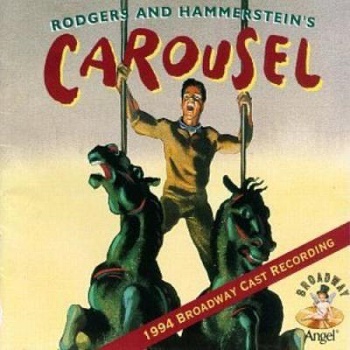
My personal favourite recording of Carousel is the 1994 Broadway Revival Recording. What is really fantastic about this recording is that there is such a fantastic balance between acting and singing. While the principals have enough voice to serve the material, they also communicate the stakes of what’s going on dramatically in the score and in the show as a whole. The “Carousel Waltz” is played so beautifully on this recording – it’s heartbreaking. Michael Hayden’s idiosyncrasies as both an actor and a vocalist force you to engage with Billy and the journey of his character. Sally Murphy sings to your heart and completely gets the arc of the character from “If I Loved You” through “What’s the Use of Wond’rin'” all the way to the end of the show. One of the highlights of the recording is Audra MacDonald’s Carrie, an interpretation that really reveals her versatility as both an actress and a vocalist. She is perfectly matched by Eddie Korbich, and their rendition of “When the Children are Asleep” is unmatched. (I’d definitely pick this one over its counterpart, the 1993 Royal National Theatre Cast Recording, although I really enjoyed Joanna Riding’s Julie on that disc.)
As I’ve noted above, there are many other recordings of the show, some of which are not yet available on CD. Nonetheless, I think these recordings represent the main players of a musical that provides a truly emotional experience not only when seen live in the theatre, but also when appreciated musically on your CD player or iPod in your own time.
Fela! will be opening on Broadway later this year. I must admit I haven’t particularly followed the show’s journey prior to this announcement, but it looks as though Fela! might become one of the major musicals of this season – hopefully not only because of the lack of much else that’s exciting, but also because it ends up being a great show within itself. The press release for the show describes it as follows:
Audiences are welcomed into the extravagant, decadent and rebellious world of Afrobeat legend Fela Anikulapo Kuti. Using his pioneering music (a blend of jazz, funk and African rhythm and harmonies), [Fela!] explores Kuti’s controversial life as artist, political activist and revolutionary musician.”
The show has a book by Jim Lewis, who also provided additional lyrics for the show) and Bill T. Jones (who also serves as the show’s director-choreographer). Following a limited engagement Off-Broadway last year, which received incredibly positive reactions from critics and the public, Fela! is aiming to make it’s official Broadway bow on 23 November, with previews starting October 19th.
Having revisited Dreamgirls this weekend, I’ve been browsing around the ‘net a little and saw a few comments from people who were surprised that the film was passed over for a Best Picture nomination at the Oscars. I know this is a little after the fact, but since I never keep my mouth shut and this is, after all, my blog – here goes.
Let’s face it – the Academy doesn’t always get it right. Let’s look back a couple of years where Crash took home the award that really belonged to Brokeback Mountain. That’s just one instance.
But…
I wasn’t surprised that Dreamgirls didn’t get a “Best Picture” nomination at the Academy Awards. At the end of the day, I think the film has a couple of fundamental flaws that denied it from the privilege of being nominated as “Best Picture”. One of these is that director Bill Condon didn’t quite manage to get the non-diagetic singing to work as it should have – there’s stuff in “Stepping to the Bad Side” and “Family” that ultimately just doesn’t work. Sometimes the screenplay doesn’t quite seem to know where it sits stylistically. I certainly wasn’t distracted by the changes made to the play, but the film wants to have its cake and eat it in terms of what it chooses to use or discard. And although the film has some amazing moments and although it is an immensely emotional experience, these aren’t don’t make up for the gaps left by other elements of the production.
Insofar as comparing Dreamgirls to the most recent musical Best Picture winner, Chicago, I think that Chicago is a far more successful film in the way it is executed as a film production. You can, I suppose, debate the adaptation but I think that the transition from stage to screen is excellently conceptualized. Within reason, a film adaptation shouldn’t be about how literally faithful or not the movie is to a stage production of a show. Chicago, for me, hit the nail on the head in capturing the metaphor that is inherent in the text of the show and adapting that to the medium of film. Sure, it isn’t the emotional experience that Dreamgirls is. But it isn’t meant to be. Chicago itself is a colder, more intellectual musical that, like a wolf in sheep’s clothing, that is presented in a form that appears more comfortable and appeasing. But Dreamgirls is intended to be an emotional rollercoaster, which it certainly is – just not one where every part of the equation adds up to equal “Best Picture”.


 Musical Cyberspace