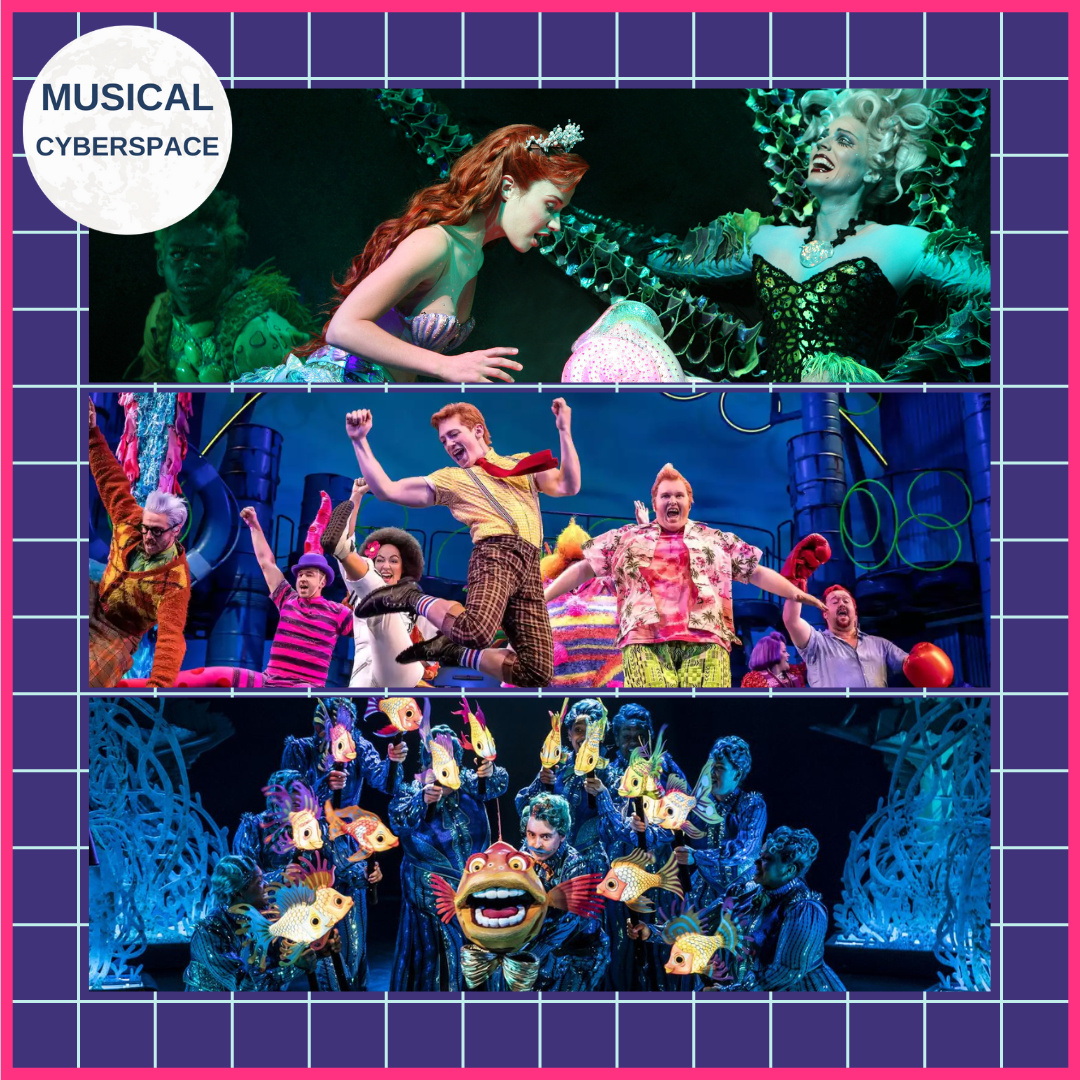
The Saturday List: Leslie Uggams’s Broadway Musicals Are Bustin’ Out All Over!

Leslie Uggams, an acclaimed actress and singer with a career spanning over six decades, is probably best known for her performance in the historic television mini-series, Roots, as well as for her more recent appearances in the musical drama television series, Empire, and Amazon’s post-apocalyptic drama series, Fallout.

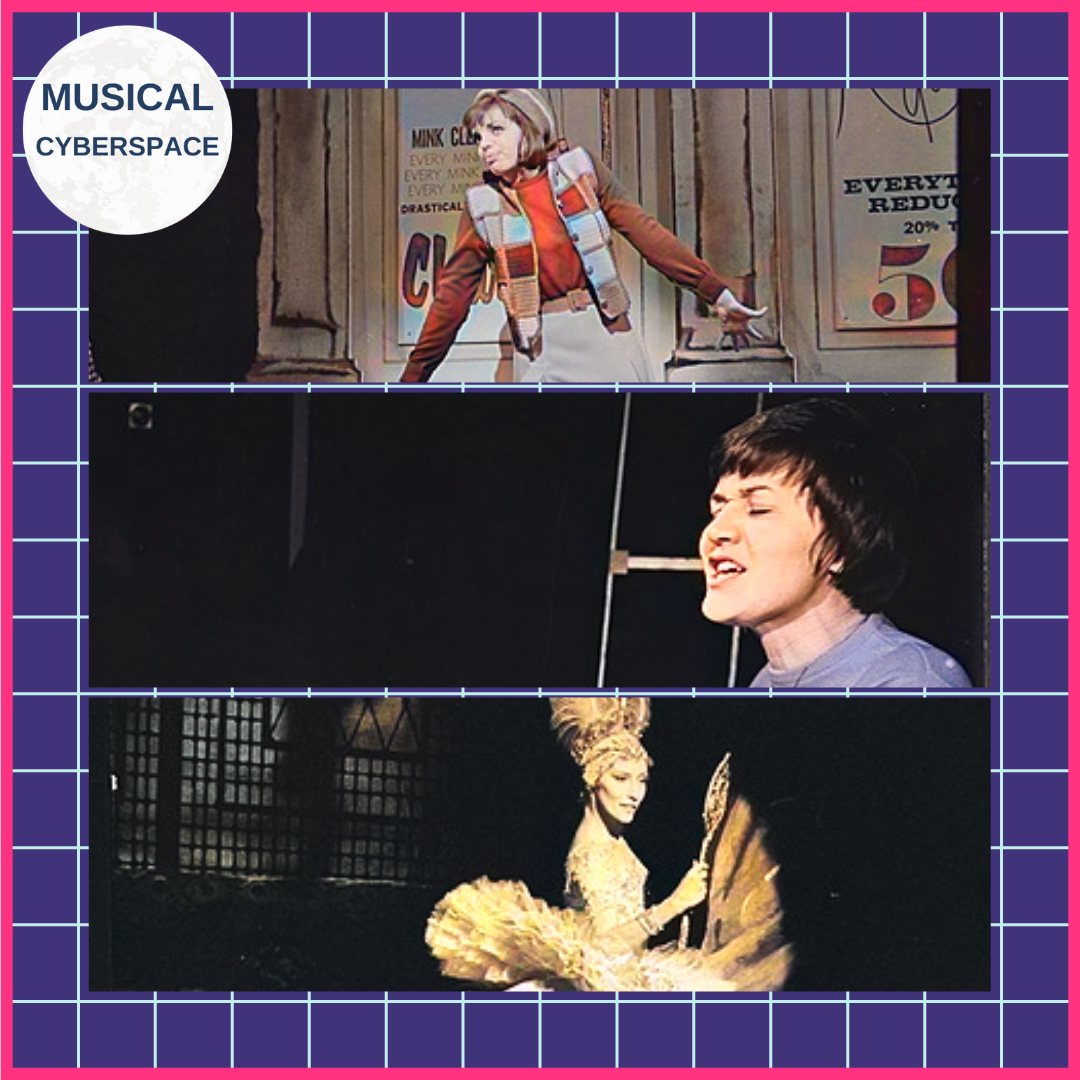
Leslie Uggams in HALLELUJAH, BABY!, JERRY'S GIRLS and ANYTHING GOES on Broadway
Leslie Uggams in Hallelujah, Baby!, Jerry’s Girls and Anything Goes on Broadway

On the big screen, she’s leapt back into pop culture consciousness in Deadpool, having also appeared in the sequel to that tongue-in-cheek comic book delight, with a return appearance slated for the upcoming Deadpool & Wolverine. However, Uggams has also left an indelible mark on the musical theatre scene, where her captivating presence, warmth and versatility have given us some thrilling performances over the years. In celebration of her 81st birthday today, 25 May, we’re ranking the six Broadway musicals in which Uggams has starred.

Honourable Mentions

While some great shows are not a part of her Broadway resume, Uggams has also delivered remarkable performances on stages beyond the Main Stem. Her roles in Stormy Weather, Gypsy, Pipe Dream and Jelly’s Last Jam further demonstrate her sheer talent. Additionally, her famed performance of “June Is Bustin’ Out All Over” where she was compelled to improvise the song’s lyrics during a live telecast due to a prompter mishap, reflects the unique joy she brings to her performances.

6. Her First Roman

Her First Roman places last on our list, representing an intriguing but ultimately less successful entry in Uggams’s Broadway career. This musical adaptation of George Bernard Shaw’s play Caesar and Cleopatra paired Uggams with Richard Kiley in a story that mixed romance and political intrigue. Indeed, enough political intrigue was contrived to allow Cleopatra to accompany Julius Caesar when he left Egypt at the end of the show. So much for Mark Antony. Uggams played Cleopatra, bringing her signature effervescence and vocal strength to the role in songs like the catchy “Many Young Men From Now.” Despite valiant performances from the two leads, Her First Roman struggled with Ervin Drake’s uneven writing and a lacklustre score, leading to a short run – despite a lot of show doctoring on the road, including the addition of three numbers by Jerry Bock and Sheldon Harnick. One thing Uggams’s portrayal of the iconic Egyptian queen was able to reinforce was her ability to tackle diverse and challenging roles. While Her First Roman gave musical theatre history little else than one of its greatest flops, it certainly provided a reminder of just how multifaceted a performer Uggams could be even in the face of material that must have prompted audiences to ask – in the words of one of the songs from the show – “What Are We Doing in Egypt?”

5. Blues in the Night

Blues in the Night may be one of the least celebrated of Uggams’ Broadway outings, but it still gave her a chance to showcase her immense talent, notably in ”Lover Man.’ the moving torch song most associated with Billie Holiday. This revue-style musical comprised a series of similar blues and jazz songs, highlighting the highs and lows of love as three women negotiate their respective relationships with – what else? – a “Dirty No-Gooder” if ever there was one. The show’s lack of a cohesive plot and character development places are two big factors that see it placed it at the bottom of this list. While it was nominated as Best Musical at the Tony Awards, it lost to Cats – ironically another musical that is often (some would say unfairly) criticised for its plot and character development. Frank Rich probably summed up the show’s key issue in his review for The New York Times: on paper, the idea works, but it doesn’t make the leap from the page to a fully realised night of musical theatre brilliance. Whatever it is that makes a great revue like Ain’t Misbehavin’ work – well that’s what Blues in the Night just doesn’t seem to have.

4. Jerry’s Girls

When it comes to Jerry Herman”s musicals, both those that hit and those that miss, there is one thing they all have in common: great songs. Jerry’s Girls, the second revue to appear on this list, celebrates Herman’s greatest tunes (and the women that in many cases have sung them) and started modestly as an act at Onstage in 1981 before being transformed into a full-scale production that toured and finally landed on Broadway in 1985. Uggams shone in this revue alongside two other Broadway legends, Dorothy Loudon and Chita Rivera, delivering memorable renditions of songs like “I Won’t Send Roses” from Mack and Mabel and “It Only Takes a Moment” from Hello, Dolly! alongside some lesser-known gems like “Shalom” from Milk and Honey. While there is no cast recording of the Broadway version of the show, thankfully Jay Records produced an album of the touring version, in which Uggams appeared alongside Carol Channing and Andrea McArdle, so posterity can enjoy the best songs she delivered in the show, “If He Walked into My Life,” the only rendition that rivals Angela Lansbury’s original version, and “I Am What I Am,” in which her charisma and vocal prowess are undeniable. What could have been better than Uggams in Jerry’s Girls? Well, how about Uggams in a Hello, Dolly! or Mame? It’s true that she appeared in both of those shows for Houston’s Theatre Under the Stars and Boca Raton’s The Wick Theatre respectively – but how great would it have been to see her headline those shows on Broadway too?

3. Thoroughly Modern Millie

In Thoroughly Modern Millie, Uggams played Muzzy Van Hossmere, a glamorous and wise character who helps guide the protagonist, Millie, through the challenges of 1920s New York City. The role was originated by Sheryl Lee Ralph on Broadway and gave Uggams, who replaced Ralph in the show’s second year, a chance to showcase her elegance and charm in numbers like “Only in New York” and “Long as I’m Here with You.” The musical’s lively score, engaging plot, and vibrant characters made it a standout production in its debut season on Broadway, and although Jeanine Tesori and Dick Scanlan’s songs for Muzzy weren’t among the greatest hits of the show score, their sophistication and warmth almost make them better than flashier songs like “Forget About the Boy” and “Gimme Gimme.”

2. Hallelujah, Baby!

Jule Styne, Adolph Green, Betty Comden and Arthur Laurents’s Hallelujah, Baby! (a musical we’ve taken a look at in our old Forgotten Musicals Friday column) was a groundbreaking musical in its time, addressing the struggles and triumphs of African American people in the 20th century. Uggams starred as Georgina, a young woman who wants much more than the life she has been born into. She works towards her dream of stage stardom through the Great Depression and World War II and by the time the 1950s arrive, so has she. Georgina becomes a popular singer in an exclusive nightclub and just as it seems her dreams have come true, an old love interest, Clem, who has become a civil rights activist, challenges the worth of her personal triumph in the context of the wider struggle for justice and equality for African American people. As Georgina, Uggams delivered a Tony Award-winning performance that captured the resilience and spirit of the character. The show’s ambitious scope and powerful message were well received in its original and only outing on Broadway and Uggams’s ability to navigate the emotional and historical complexities of the role made her a bona fide Broadway star.

1. Anything Goes

Topping our list is Anything Goes, a timeless classic where Uggams took on the role of Reno Sweeney in a 1980s revival. The story – in case you don’t know it – is a bit like A Midsummer Night’s Dream on a boat. Billy Crocker is in love with Hope Harcourt, an heiress who is engaged to Lord Evelyn Oakleigh, and Reno is in love with Billy. After a series of madcap encounters, Billy marries Hope and Evelyn, Reno. Replacing Patti LuPone might be a daunting challenge for any Broadway star, but Uggams was up to it. Her portrayal of the brassy nightclub singer was commanding and charismatic, perfectly balancing humour and heart. With a score by Cole Porter, including iconic numbers like “I Get a Kick Out of You,” “Blow, Gabriel, Blow” and the title song, Uggams’s performance was a tour de force. Her impeccable timing, powerful vocals, and magnetic stage presence make this fabulous production one of the crowning jewels of her Broadway career. If only we had a cast recording of Uggams in the show as a memento of her star turn.

    Final Thoughts

    Uggams’ contributions to Broadway are a testament to her extraordinary talent and enduring legacy. Each of these musicals, from the jazzy Blues in the Night to the long-lasting charm of Anything Goes, highlights different facets of her abilities as a performer. As we celebrate her birthday, we honour not only the roles she’s played, but also the indomitable spirit she brings to the stage every time the curtain rises. Brava, diva ultima!

    Posted in The Saturday List | Tagged , , , , , , , , , , , , , , , , , , , , , , , , , , , , , , , , , , , , , , , , , , , , | Leave a comment

    The Saturday List: A Final Sense of Genius in Sondheim’s HERE WE ARE

    The release of the cast album of Here We Are, the final new musical to feature music and lyrics by Stephen Sondheim, seamlessly integrated into a book by David Ives, marks the end of an era. Following a limited run at The Shed’s Griffin Theatre, which started late last year and ended in January this year, the release of the cast recording offers to many more of us than those who could see the show, the last first listen of a new Sondheim musical.

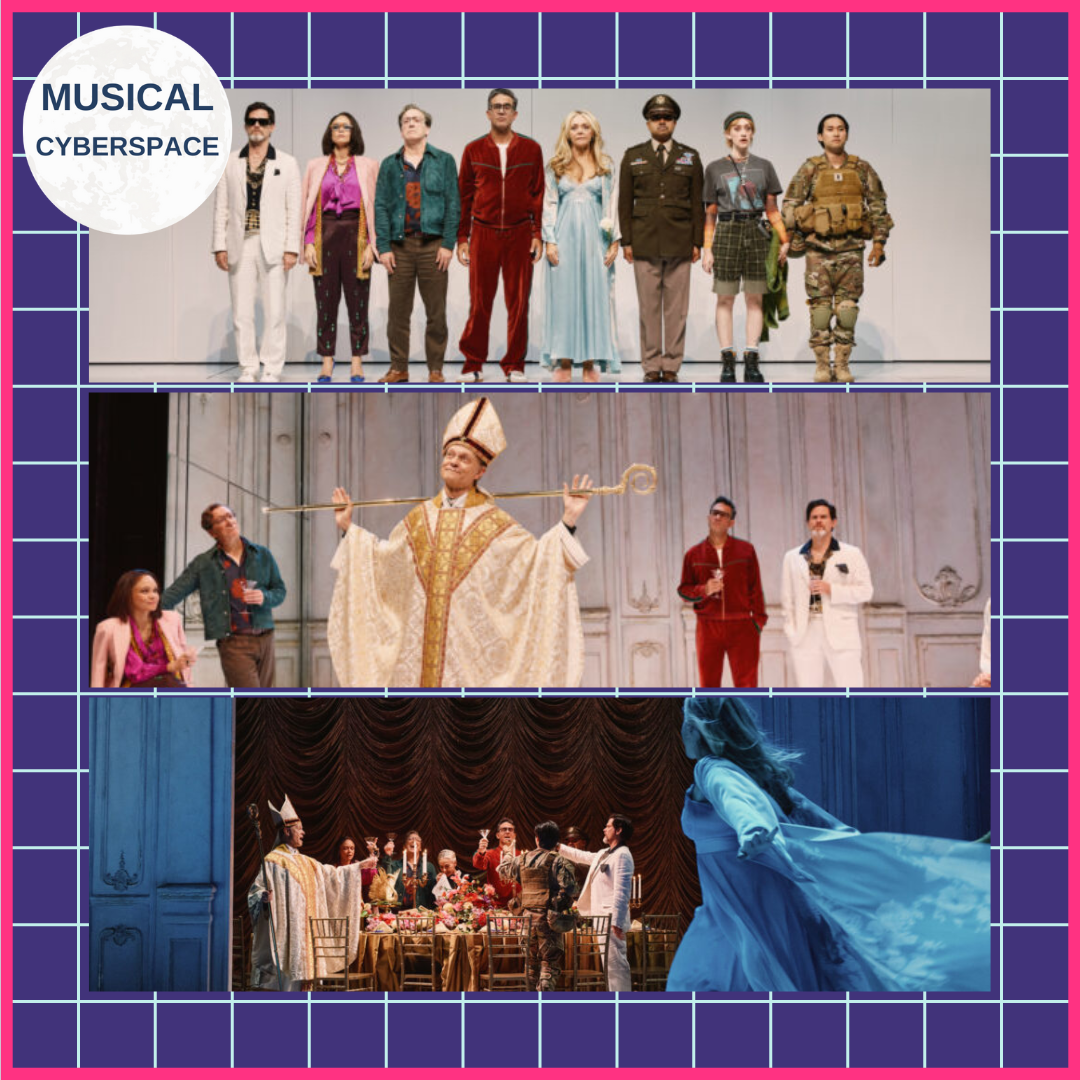
    The original cast of HERE WE ARE featured Francois Battiste, Tracie Bennett, Bobby Cannavale, Micaela Diamond, Amber Gray, Jin Ha, Rachel Bay Jones, Denis O’Hare, Steven Pasquale, David Hyde Pierce and Jeremy Shamos.
    The original cast of Here We Are featured Francois Battiste, Tracie Bennett, Bobby Cannavale, Micaela Diamond, Amber Gray, Jin Ha, Rachel Bay Jones, Denis O’Hare, Steven Pasquale, David Hyde Pierce and Jeremy Shamos.

    Here We Are is based on two films by Luis Buñuel, The Discreet Charm of the Bourgeoisie and The Exterminating Angel. It’s about a group of people – the kind of rich folk who are easy to satirise and whom we love to hate – looking for a place to have brunch. In the face of an apocalyptic social revolution, they grapple with what it all means to be “here,” wherever that may be.

    For my part, I’ve tried to avoid much of the press about the show, including its reviews, and the social media circus that surrounded the run. I wanted to have the experience of discovering Here We Are on my own terms as far as possible. So after a first listen of the cast album, here’s a list of five ways we see Sondheim’s sense of genius in his last original cast album. The road awaits… so let’s find our way down it together.

    5. A Sense of Completion

    Avoiding the word on the street when it came to Here We Are meant missing much of the gossip about how complete the show was, given Sondheim’s death in November 2021 and thus, its post-humous premiere. Listening to the album, I never experienced the sense that the show was unfinished and was then delighted to read David Ives and Joe Mantello’s views on the point of view that the show as produced is some kind of compromise of Sondheim’s vision:

    In spring 2021, Joe happened to re-read the script and realized that, though there were musical transitions and underscoring and orchestrations to be added, the piece was complete as it stood. Steve had written numbers up to a point in the action where the characters had nothing to sing about. Small wonder his Blackwing pencil had stalled . Following his own dictum, the content had dictated the form and told him to stop. He didn’t need to write another note.

    We two did some tightening on our own and set up a reading. After hearing the results, Steve agreed: that indefinable thing, The Show, was all there. He gave the nod to a production and by the time he died two months later, Here We Are was already pointed toward the stage.

    As the show headed into production, rumors and opinions and misinformation flew about whether the show was “finished” – rumors almost exclusively floated by people who had nothing to do with the show. One would have thought we were trying to put something over on the world rather than giving it what everybody wants: i .e ., more Sondheim. Were we supposed to just ditch all his work? Lock away what a great and perpetually game-changing American artist had had on his mind during the last years of his life? People quoted Steve toward the end as saying that the show wasn’t “finished” yet, but nobody knew better than Stephen Sondheim that a show isn’t finished until the curtain call on opening night. Sometimes not even then.

    For me, Here We Are tells a story on its own terms. It doesn’t adhere to any impression of what a musical is meant to be and it is all the stronger for it. Browsing some of the reviews and social media criticism of the show after my listen, there seems a sense that the second act lacks musical material, but to my ear, it feels as though what is needed to drive the action forward is all there. I will concede that in terms of the way the show plays, as Jesse Green puts it in his review for The New York Times, it may feel like a ‘not quite fully solved puzzle of a show’ – but in terms of what’s written, it is both entertaining and philosophical, and more to the point, feels finished.

    4. A Sense of Occasion

    Almost as exciting as starting to listen to the cast album of Here We Are was the moment before I hit play. In the theatre, there is that moment where we enter the transaction of the play, when the house lights fade and it all begins. I had that same feeling when I waited to start listening to this gorgeous score. And when the first notes of “Here We Are,” the overture, played, I was immediately transported. The show draws you into the world of Leo and Marianne Brink’s fabulous apartment on this most glorious day and by the time we first hear one of the show’s catchphrases – ‘Everybody into the car!’ – we’re all right here with this modern-day Ben and Phyllis as well as Fritz, Claudia, Paul and Raffael. The forward movement of this show’s opening is simply wonderful and there is absolute joy in hearing the music, lyrics and dialogue all come together to serve something greater as “The Road I – Part 1” kicks into high gear.

    3. A Sense of Song

    Here We Are is much more in line with Sondheim’s later work where everything is folded into one integrated structure. Structurally, it has a great deal in common with Passion and Sunday in the Park with George, although it’s worlds away in tone, perhaps more like Anyone Can Whistle or Assassins than anything else in that sense. This means that there are fewer standalone songs than in his shows of the 1970s and that everything just flows once the score gets going. Its overall momentum is simply breathtaking. That said, there are some great songs woven into the action. In the first act, set pieces like “Waiter’s Song” and “It Is What It Is” are just hilarious. Elsewhere, we get some great unexpected rhymes that pull together a thought, as in “The Road 1 – Part 2”

    I’m completely undone
    By the endless abundance of life,
    Aren’t you?

    It’s a great enough lyric on its own terms, but combined with the melody, it falls so brilliantly on the ear. Later in the song, Marianne sings:

    Buy this day for me, darling,
    Buy this perfect day.
    Put it on display,
    Let it stay Just this way
    Forever.

    It’s the simplest of rhymes, but it points towards some of the underlying questions the piece asks about ownership and materialism, making the lyric stand out just enough to plant a seed in our heads. The idea of the perfect day becomes something of a motif in the show’s first act too; this is not the last time we’ll hear about it. Sondheim is also famous for his lists, and he gives Fritz a good one in “The Road 1 – Part 3.” While there’s a key rhyme at the start to hold things together, the sounds unravel as Fritz starts to rant:

    Wake up, it’s the end of the world,
    You morons,
    Welcome to the end of
    Power brokers and hydrofractors
    And underpaid teachers and overpaid actors
    And disappearing polar bears
    And bought-and-sold elections
    And infinity pools
    And Damien Hirsts
    And phony bank accounts —
    With safe deposit boxes in
    Corrupt banana rat holes
    Like Moranda!
    They’re gonna blow your mergers
    And your laptops
    And your bitcoins
    All to bits!

    which then goes on to rhyme with Claudia’s reaction, ‘Fritz,’ masterfully tying up the whole idea and restoring order and balance to the song.

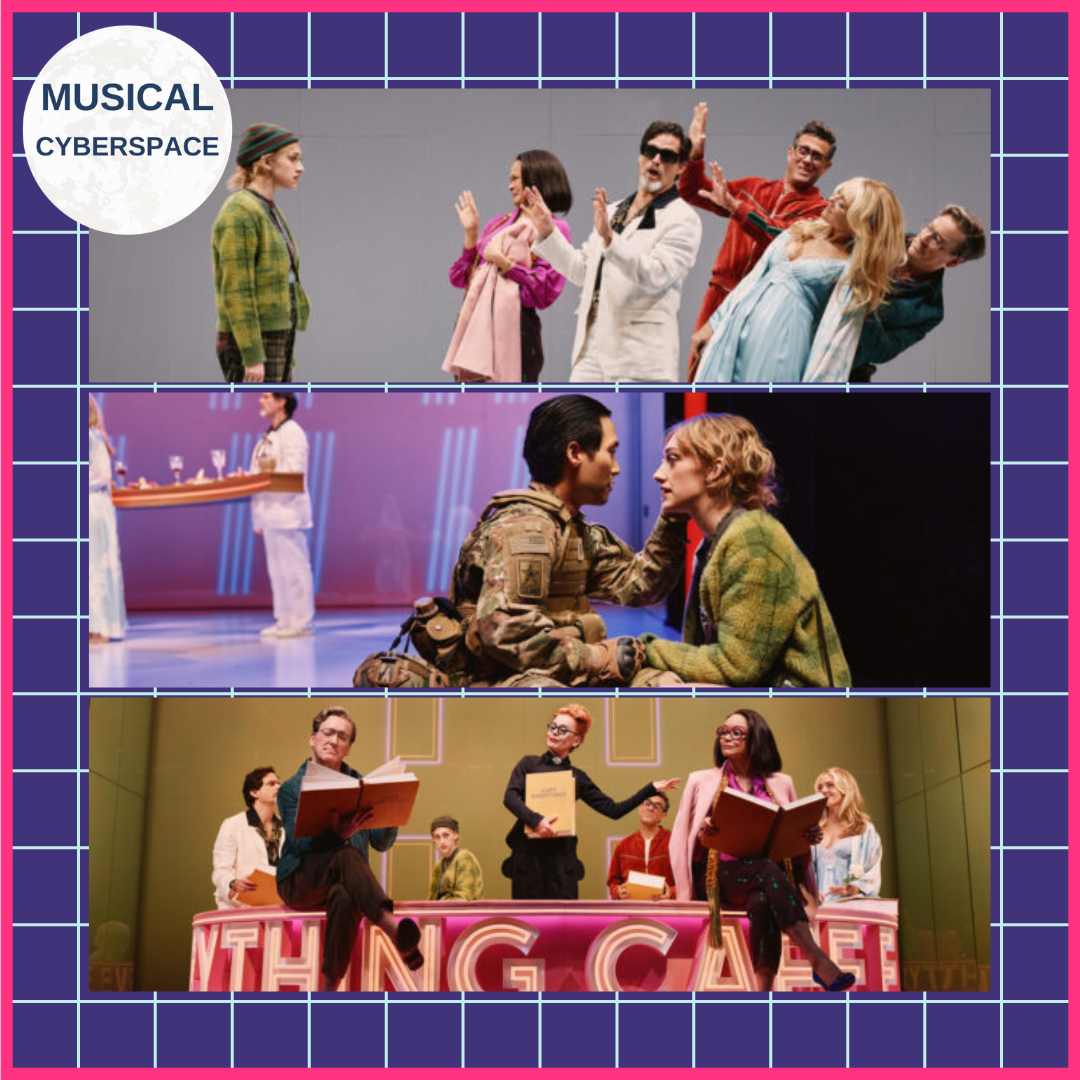
    The original cast of HERE WE ARE  in action.
    The original cast of Here We Are in action.

    Later on, Sondheim and Ives play with metatheatricality in “The Soldier’s Dream.” If the message that something is very odd in the world of the play hasn’t reached us yet, this song leaves us with no doubt. Where are these people? In our world? Are we in theirs? Is this soldier’s dream more real than the characters’ reality? Or ours? What are we meant to think when the house lights bump up mid-song and the actor playing Paul proclaims ‘I don’t know my lines’? As we start seeing the world of the characters unravel and their uncertainties become clearer in terms of our own experience, suddenly we’re complicit in their view of the world. We can see ourselves in them, and them in us and hang on – weren’t we judging them all for their behaviour just minutes before? It’s a bold move that changes our investment in this particular ritual of theatrical performance.

    The second act also has some highlights, including “Shine,” where Sondheim couches a criticism of Marianne’s attitudes in a way we can relate to all too well. First:

    I like things to shine —
    Shoot me.
    I like things to glow.
    Why can’t I be free
    To like what I see
    And not what I know?

    and then

    I want things to shine —
    Hit me.
    Is that so bizarre?
    I want things to gleam.
    To be what they seem,
    And not what they are.

    Don’t we all, sometimes? It’s the definition of superficiality, but isn’t it something we’ve all thought about in moments when everything seems so tiring and the world and its complexities just don’t let up?

    Act 2 also offers us a new Sondheim anti-love song in “Double Duet” and the delicate and meandering “Interlude1: Marianne and the Bear,” two pieces that highlight perhaps the two strongest aspects of Sondheim’s work in Here We Are, both of which are prominent throughout his body of work. The first is his sense of collaboration as a composer and lyricist with the writers of the books of his shows. In these sequences, music and drama are one, and Ives’s contribution can’t be underestimated. The other is Sondheims’ capability to make his characters sound individualised and human. This is evident not only in these numbers but also throughout the score. In a contemporary musical theatre landscape where so many characters sound like each other, written to show off vocal styling rather than character-specific voices, Sondheim’s work here reminds us how much music can characterise, something the best musical theatre theatre-makers who are carrying the torch into the future haven’t forgotten.

    2. A Sense of Story

    Everyone has a favourite story, right? Mine is probably The Wizard of Oz. All of this goes back to the idea that there are only a handful of unique stories in the world that we keep on retelling in our own way to suit our own time and our own needs, which means we see the same patterns – overcoming the monster, the quest, voyage and return, rebirth and so on – playing out again and again. And some of these patterns resonate more than the rest in a profoundly personal way with each of us. There’s a definite sense of universality through specificity in Here We Are.

    In many ways, Here We Are was like a reinvention of The Wizard of Oz for me. Marianne and her pals follow a road that takes them away from home and back again. While Dorothy makes new friends, Marianne and her various Totos discover new places – three of them, Café Everything with its apologetic waiter, Bistro à la Mode with its distraught waitress and Osteria Zeno with its poetic soldier – before heading off to a veritable Emerald City at the Embassy, where they encounter a Wizard in the form of a Bishop, and are transported to the horror of a Wicked Witch’s castle when the Embassy transforms into a luxuriously hellish prison in the second act. We even get a speech from the Bishop of the ilk that both Professor Marvel and the Wizard himself give Dorothy and her friends in Kansas and Oz respectively, words that frame the themes of the show as a whole in “Interlude 3: Snow.” There’s even a more straightforward allusion to The Wizard of Oz when the Soldier talks about his dream and says, ‘And you and you were there, And you and you and you’ – a moment that defines the real world from Dorothy’s dream in the MGM version of her story, but which here pushes us out of the dream the characters are presenting as their reality.

    Why reflect on this? Is it relevant? Maybe. I think I was worried that Here We Are was going to be difficult to access and understand. I don’t know why. Perhaps it was the idea that the show is based on two quite heady surrealist films. I should have remembered that Sondheim’s craft (as he expressed it in Finishing the Hat) has always focused on

    Content Dictates Form

    Less is More

    God is in the Details

    all in the service of

    Clarity

    without which nothing else matters.

    That’s what Here We Are delivers: clarity – all in the form of an age-old story, transformed by a master for us and the world in which we live.

    1. A Sense of Conversation

    Listening to this show, I deeply felt its connections to Sondheim’s body of work. There are catchphrases, ideas, motifs, rhythms of speech and song – all reminding us of Sondheim’s distinctive approach, his unbounded and personal brand of making theatrical art. Listening to the piece I felt it was in the same family of shows as Assassins. I’ve already mentioned the show’s seamless weaving in and out of music, and shifts from lyric to dialogue and back again, reminded me of the unity of Passion, an ideal to which Sondheim strove. In “The Road 1 – Part 3,”
    Fritz asks the other characters, “Can’t you hear the sound of that distant drumming?” That moment is a pure echo of “There Won’t Be Trumpets.” Fritz, like Nurse Apple, is shaking up the world around her. I felt the weight of Follies in the lightness of touch seen in Here We Are. Marianne isn’t going to tragically proclaim, as Sally does, “Oh dear God, it is tomorrow.’ She simply reflects on where they are and says, ‘Perfect . Now where do we want to eat?’ When Paul delivers an expletive to complete a triple rhyme started in “Waiter’s Song” (‘Right, who had the duck? You’re out of luck…’), we’re taken all the way back to Sondheim’s original intentions for the final line of “Gee, Officer Krupke” in West Side Story. And overall, I had such a great sense of Dot’s philosophy: ‘Just keep moving on. Anything you do, let it come from you – then it will be new.’ Sondheim gave us more to see.

    Final Thoughts

    Even when it seems you have everything, you still can’t always find what you want. This becomes evident through the characters’ journey in Here We Are. While some have been qualified in expressing their feelings about this final show, I’m going to go out on a limb and say that for me, Here We Are is a perfect swansong for this master craftsman of story through song. Sondheim leaves us in the only place we can be, here: hesitant to move forward, caught looking back at his masterworks, running faster and faster all the time as the world swirls around us and hoping to catch a glimpse of something that helps us to make sense of it all. At this point, we have everything Sondheim gave us over his incomparable career and ironically, if we explore the worlds he created, there is everything we could ever want from the greatest musical theatre works: complexity, passion, heart, thought – everything that it takes to fill a blank page, or finish a hat.

    Posted in The Saturday List | Tagged , , , , , , , , , , , , , , , , , , , , , , , , , , , , | 4 Comments

    The Saturday List: Art Isn’t Easy – and Artists are Bizarre!


    Musicals about artists and their artworks can be fascinating. When vibrant canvases meet soaring melodies, there’s a huge amount of creative potential – even if success in this subgenre of musical theatre is as elusive as a perfect brushstroke. Broadway’s latest musical about an artist’s life and work is Lempicka, which also happens to be the first casualty of the season following the announcement of the 2024 Tony Awards. Lempicka scored three nods, for Eden Espinosa and Amber Iman’s performances and the show’s scenic design, but did not earn nominations in the big writing categories or for Best Musical of the season. A show that has sharply divided critics and general audiences, Lempicka will play its final Broadway performance on 19 May. As it bids farewell, let’s look at how it measures up against similar musicals about great artists. Grab your palettes – and let’s go!

    Jake Gyllenhaal in SUNDAY IN THE PARK WITH GEORGE, Tyler Peck and Kyle Harris in LITTLE DANCER and Amber Iman and Eden Espinosa in LEMPICKA.
    Jake Gyllenhaal in Sunday in the Park with George, Tyler Peck and Kyle Harris in Little Dancer and Amber Iman and Eden Espinosa in Lempicka.

    5. Goya: A Life in Song

    Has Goya ever really been developed enough for it to be considered a full-scale musical? Perhaps not, but there’s always cause to include a score by Maury Yeston on a list like this. Plácido Domingo, who was a fan of Yeston’s work for Nine, instigated the idea of a musical about Spanish painter Francisco de Goya. The most significant Spanish artist of his time, Goya is often considered to be a transitional figure between the so-called “Old Masters” of art and modern artists. His work, which deals with war, politics, religious corruption and mental health, offers fascinating insights into the world in which he lived and continues to meet our modern eyes with questions and challenges. Goya ended up as a concept album due to Domingo’s schedule and spawned one hit song, “Till I Loved You,” which was released as a single by Barbra Streisand and Don Johnson ahead of the concept album’s release, as well as in two versions with Domingo and Jennifer Rush and Dionne Warwick respectively. Domingo also recorded two further versions of the song, one in Spanish with Gloria Estefan titled “Hasta amarte” and another in Portuguese, “Apaixonou,” with Simone Bittencourt de Oliveira, as well as a full Spanish version of the album itself, titled Goya: Una vida hecha canción. So where does that leave us? Well, there is a fair deal of attractive raw material in Goya from which a musical can be fashioned, but it’s just not quite there. One can envision it as a concert piece and perhaps that is all it will ever be; as such, it makes for a great listen you give the concept album a spin: a musical of the mind.

    4. Little Dancer

    While not yet attaining its full potential and reach as a musical, Little Dancer still offers a compelling exploration of art and its impact on life. With music by Stephen Flaherty and libretto by Lynn Ahrens, this musical draws inspiration from the iconic Edgar Degas sculpture, Little Dancer of Fourteen Years. Premiering at the Kennedy Center in 2014, the show follows the story of Marie van Goethem, the young ballerina who posed for Degas. Marie’s journey, one of family poverty, her debt to Degas and the allure of wealth, reflects the timeless struggle between life and art. Ahrens and Flaherty, known for their work on Anastasia, deliver memorable tunes like the simply gorgeous “Musicians and Dancers and Fools,” the catchy opening number, “C’est le Ballet,” and a reflective soliloquy for Degas titled “Marie,” which points to the ineffable complexity of his muse. Indeed, it is stylistically more like Anastasia, an accessible and intimate historiographic metafiction, rather than an epic meditation on society like Ahrens and Flaherty’s masterwork, Ragtime. Nonetheless, it remains a poignant exploration of the complexities of creativity and the human spirit and will hopefully find a fully realised place alongside the rest of this formidable musical theatre team’s creations.

    3. Lempicka

    In one of the first-act songs from Lempicka, “Perfection,” a lyric proclaims ‘we need art that speaks to where we live now.’ That’s clearly what this show, the most recent Broadway musical about a real-life artist, Tamara de Lempicka, a bisexual icon most famous for her stylised portraits, often nudes and often of women, aims to provide to musical theatre audiences of today. The most obvious nod to this ideal is the use of a pop score to tell a story that happens in the past, reaching all the way back to the Russian Revolution, moving through the Art Deco scene of post-war Paris to moments later in the artist’s life that offer a framework to the narrative. It’s an easy choice to force the connection between a story from the last century and today; it is also one that sets up the busy theatrical language seen in the original Broadway production, making a lot of noise through which co-creators Matt Gould and Carson Kreitzer’s words and music have to cut. It’s in moments where the fantastic projection design by Peter Nigrini and the less fantastic choreography by Raja Feather Kelly let the material breathe that the show really has the opportunity to say something, to make a point about being “Unseen” or consider what it means to “Stay.” This show has a lot of valuable things to say, but there seems to be an awful lot in the way of it getting said. Ultimately, speaking to a generation through an artwork takes more focus. While Lempicka certainly has a passionate fanbase, its Main Stem production seems not to have enabled its meaning to transcend toward the universal.

    2. The Highest Yellow

    If Lempicka attempts to speak to a generation, The Highest Yellow aims to speak to a very specific target audience: its early, defining lyric is ‘You need the dark to make the light lighter; you need the scream to make the quiet hurt.’ With a book by John Strand and a score by Michael John LaChuisa, anyone who isn’t expecting a complex and sophisticated experience might be bewildered by this show, which premiered two decades ago at Arlington’s Signature Theatre under the direction of Eric Schaeffer. The Highest Yellow finds LaChiusa more in the mode of Marie Christine than The Wild Party as it tries to capture in music the kind of brilliance Vincent van Gogh captured in his art. Set in the period after Van Gogh cut off his ear, the piece also observes the world around the artist, dramatising a fictionalised set of circumstances that would lead, in real life, to the painting of (among others) Portrait of Félix Rey. Rey, the medical trainee who treated Van Gogh. In this story, Van Gogh presents the ear to a sex worker named Rachel and a complicated love triangle develops between the three characters. The three roles were played in the original production by Marc Kudisch (Van Gogh), Jason Danieley (Rey) and Judy Kuhn (Rachel), making for a starry, starry night in musical theatre terms. There are some gems in the score, including the title song and Rachel’s “His Heart,” but The Highest Yellow is by no means a show for the masses. Rarely produced, it is a show that deserves more exposure, but sadly, there’s not even a cast recording to lead new ears to engage with it.

    1. Sunday in the Park with George

    When it comes to musicals about art and artists, the Pulitzer Prize-winning Sunday in the Park with George is the gold standard. In this dazzlingly beautiful musical, Stephen Sondheim and James Lapine piece together the story that could have inspired one of the world’s most famous paintings, Georges Seurat’s A Sunday Afternoon on the Island of La Grand Jatte. Following the first act’s juxtaposition of the rocky relationship between George and a model, Dot, with the painting of the artwork from ‘white. A blank page or canvas’ to its completion through ‘design, composition, tension, balance, light and harmony,’ the second act shifts in time and space to examine similar issues related to art and love in our more recent history, in which George and Dot’s fictional great-grandson, also named George, considers the value of his own art and legacy. In a small conversation with his grandmother, Marie, we see that a world in which people ostensibly ‘do not belong together’ is the same world in which they ‘will always belong together.’ There is so much in this show that is moving and nothing more so than “Sunday”, the song that brings both the first act and later, the show to a close. What makes Sunday in the Park with George so successful is not simply the emotional journey of the characters, its astute observations about art and life or a series of memorable songs; it’s that every element knits together seamlessly. As Sondheim himself believed, ‘content dictates form’ and ‘God is in the details.’

    Final Thoughts

    And there you have it: our journey through some of the most memorable musicals about artists and their masterpieces is at an end. Through stirring songs and captivating narratives, each musical offers a unique and enchanting glimpse into the world of creativity and passion. And although its time is coming to an end, let’s not forget to celebrate the Broadway production of Lempicka. If you find yourself in New York City before its closing next weekend, be sure to catch the show live on stage. Whether you’re a seasoned theatregoer or a newcomer to the world of art-themed musicals, let’s raise a toast to the power of art and the magic of musical theatre – may they continue to inspire and enchant audiences for generations to come!

    Posted in The Saturday List | Tagged , , , , , , , , , , , , , , , , , , , , , , , , , , , , , , , , , , , , , , , , , , | Leave a comment

    The Saturday List: Top Tony Award Award-winning Roles – Ranked!

    Want to win a Tony Award? Well, as with anything else in life, there are no guarantees – but if you play one of the roles featured in today’s Saturday List, your odds will improve considerably. Some characters are like magnets for Tony Awards and today we’re ranking the roles that have won two or more actors this most prestigious of theatre accoldates – just as the current Tony Awards season kicks into high gear. Let’s jump right in!

    Multiple Tony Award-winning roles include Rose in Gypsy (played here by Angela Lansbury), Emile in South Pacific (Paulo Szot alongside Kelli O'Hara) and the Emcee in Cabaret (Alan Cumming).
    Multiple Tony Award-winning roles include Rose in Gypsy (played here by Angela Lansbury), Emile in South Pacific (Paulo Szot alongside Kelli O’Hara) and the Emcee in Cabaret (Alan Cumming).

    13. Marge MacDougall from Promises, Promises

    Winning Tony Awards for Marian Mercer and Katie Finneran, Marge MacDougall in Promises, Promises is a fantastic supporting role for an actor with fabulous comedic timing and musical talents. At the top of the second act, leading man Chuck Baxter is drinking away his troubles at a bar on Christmas Eve, when he meets Marge, who is also tipsy and, like Chuck, a member of the Lonely Hearts Club. Together, in “A Fact Can Be a Beautiful Thing,” they decide that ‘Christmas (is) not the time to be alone with memories’ and to ‘throw a little joy’ each other’s way. They head off to Chuck’s apartment, which leads to a discovery that ignites the show’s second act. Marge is a character that actors love to play because of her wit, charm, and relatability. Quirky and endearing, she brings humour to the story and gives its heart a more layered perspective.

    12. J. Pierrepont Finch from How to Succeed in Business Without Really Trying

    While the second Broadway revival offered a host of younger actors like Daniel Radcliffe, Darren Criss and Nick Jonas in the central role of How to Succeed in Business Without Really Trying, it is the two older actors who played the role, Robert Morse and Matthew Broderick, in the first two Main Stem productions that walked away with a Tony Award for the role. The show details Finch’s ambitious journey as he climbs the corporate ladder at the World Wide Wicket Company, starting as a window washer and ending up as chairman of the board. En route, he sings a hilarious paean to himself, “I Believe in You” and leads the company in the show’s thrilling finale, “Brotherhood of Man.” There’s a fair deal for actors to do with the role, with Finch having to weigh up his choices against his moral compass, all the while keeping the audience on his side thanks to his wit and dynamism.

    11. The Leading Player from Pippin

    The Leading Player from Pippin is a role that has won awards in two different categories – Best Performance by a Leading Actor and Actress in a Musical respectively. Ben Vereen won his trophy when he originated the role, and Patina Miller followed in his footsteps when the show was revived. Complex and charismatic, The Leading Player is more than just the narrator of Pippin; Pippin himself is charmed and manipulated into his choices by this enigmatic and mysterious figure. The role is gifted with one of the great opening numbers in musical theatre, “Magic to Do,” so things start off iconic and build from there. The depth and ambiguity of the role make it a fascinating challenge for actors to portray, and the compelling results are ripe for recognition by critics and awards bodies alike.

    10. Celie Harris-Johnson in The Color Purple

    LaChanze wowed audiences as Celie in The Color Purple when the show first premiered on Broadway and when it was revived, Cynthia Erivo wowed them again. A host of other actresses have delivered impressive performances in this musical too, including Fantasia Barrino, who also played the role in the recent film adaptation of the show. With the whole show building up to Celie’s incredible climactic number, “I’m Here,” everyone leaves the show reflecting on the many challenges she has faced to get to this point in her life. Celie’s story is profoundly moving. It resonates deeply with us because of its universal themes of love, forgiveness, and the human spirit’s capacity to overcome hardship. Celie’s resilience, vulnerability, and ultimate triumph over adversity challenge actors to explore every emotional state under the sun, from pain and suffering to love and redemption. It’s a marathon.

    9. Pseudolus from A Funny Thing Happened on the Way to the Forum

    There are a lot of moving parts in A Funny Thing Happened on the Way to the Forum and at the centre of them all, is Pseudolus. From the moment Pseudolus leads the company in the rip-roaringly rambunctious opening number, “Comedy Tonight,” everyone knows they’re in for a good time. This role has won Tony Awards for Zero Mostel, Phil Silvers and Nathan Lane, each of whom brought their own brand of flair to the enslaved Roman whose heart is set on freedom and who will do just about anything to get it. This is a great role for an actor who is blessed with comedic genius, showcasing not only the skills of comic timing and improvisation, but also an ability to execute physical comedy as Pseudolus executes his fast-paced dialogue and the hilarious antics that get him in and out of the series of delightful complications that makes p the plot of this fast-paced show.

    8. Carrie Pipperidge from Carousel

    For this role’s award winners, it’s revivals all round! Audra McDonald won a Tony Award playing Carrie Pipperidge in the 1990s revival of Carousel, while Lindsay Mendez followed suit in the more recent one. Carrie is a great foil for leading lady Julie Jordan, who ends up in a difficult marriage with Billy Bigelow. While Carrie’s marriage to Enoch Snow (who we hear quite a bit about in “Mr Snow”) seems much happier and her story is played for comedy, Carrie’s entrapment in an upwardly mobile coupling has a few hidden challenges. For one thing, there’s not as much joy “When the Children Are Alseep” when there are nine of them! Even so, Carrie is a loveable and spunky character that allows actors to show off their vocal talents, comedic timing and even some emotional depth, with her genuine sincerity and unwavering loyalty making her someone that audiences adore.

    7. Dolly Gallagher Levi from Hello, Dolly!

    Two high profile actors, Carol Channing and Bette Midler have won Tony Awards playing Dolly Gallagher Levi, with so many others also having put their own stamp on this beloved matchmaker from New York, who finds love for herself and a number of the show’s other characters before the curtain ends and “Before the Parade Passes By!” (Pearl Baily, Etherl Merman, Betty White, Mary Martin, Bernadette Peters and Betty Buckley are just some of the divine divas who’ve played the role on Broadway or in productions around the USA and even the world!) Dolly’s larger-than-life personality, wit, and charm are all a part of the appeal for both the actors who play the role as well as the critics who review them – and that’s before you even get to the iconic musical numbers and show-stopping moments built around her. Once you’ve fallen on love with Dolly, there’s no saying “So Long, Dearie!”

    6. Albin from La Cage aux Folles

    George Hearn and Douglas Hodge both won Tony Awards for playing Albin, also known as Zaza, the star performer at a drag nightclub in Saint-Tropez. Life for Albin and his spouse, Georges, is thrown into chaos when Georges’s son announces his engagement to the daughter of the conservative deputy general of the Tradition, Family, and Morality Party. Albin’s journey involves embracing his true self while confronting societal prejudices and expectations. The role lets actors showcase their dramatic range and vocal talents, through several poignant scenes and powerful musical numbers, including “I Am What I Am,” “The Best of Times” and “A Little More Mascara.” The character’s combination of humour and humanity make it a standout role in musical theatre, earning accolades and recognition for actors who have delivered nuanced performances in the role.

    5. Desiree Armfeldt from A Little Night Music

    Desiree Armfeldt probably sings a little less than the average character on this list, but when everything you do on stage leads up to the incomparable “Send in the Clowns,” it goes without saying that it takes a masterful actor to play the part. As Desiree navigates the intricacies of love, desire and regret with poise and wit, with the end goal of winning back her lost love, Frederik Egerman, she has to be both captivating and vulnerable. Glynis Johns and Catherine Zeta-Jones both delivered the necessary complexity, sophistication and depth of emotion required by this role to nab the Tony Award – and Judi Dench did the same across the pond, winning the Oliver Award in a 1990s revival of the show. Desiree may be living “The Glamorous Life” as an actress in turn-of-the-century Sweden, but she might not have had the skill to play the role herself “Now,” “Soon,” or Later!”

    4. Anna Leonowens from The King and I

    Anna Leonowens in The King and I is a role that both actors and audiences are drawn to because of her strength and intelligence. She’s a pioneering woman who is ahead of her time, negotiating cultural differences and challenging social norms while maintaining her integrity and dignity. The character’s journey involves not only her interactions with the King of Siam, but also her own personal growth and transformation as she learns from and teaches those around her. Anna’s iconic songs, such as “Hello, Young Lovers” and “Shall We Dance,” provide actors like Gertrude Lawrence, Donna Murphy and Kelli O’Hara, all of whom won Tony Awards for their performances, with powerful moments to showcase their vocal and acting abilities. The role’s blend of wit, warmth, and resilience makes Anna both challenging and rewarding to portray.

    3. Emile from South Pacific

    Emile de Becque is a French plantation owner living on a South Pacific island during World War II. The character embodies a blend of strength, vulnerability, integrity and a whole lot of romantic appeal. His tender love for Nellie Forbush comes into conflict with the prejudices she holds about his past, specifically about his relationship with a Polynesian woman and their two children. Sadly as compelling and emotionally resonant a story today as it was in the 1940s, South Pacific leaves a lasting impact on audiences. Emile’s iconic songs, such as “Some Enchanted Evening” and “This Nearly Was Mine,” provide actors like Tony Award winners Ezio Pinza and Paulo Szot with powerful moments to showcase their vocal prowess and emotional depth. Portraying Emile requires a balance of sensitivity and strength and an actor can really layer their work as he steers his way through complex relationships and moral dilemmas.

    2. The Emcee from Cabaret

    The Emcee in Cabaret is a role that actors are drawn to because of its electrifying energy, dark allure, and complex character dynamics. The Emcee serves as the master of ceremonies at the Kit Kat Klub in Berlin during the rise of the Nazi regime, embodying the hedonism, decadence and moral decay of pre-war Germany. Actors who portray the Emcee need to bring to life a multifaceted character that blurs the lines between entertainer, provocateur and commentator on society. Unforgettable songs like “Willkommen,” “If You Could See Her” and (in the revivals) “I Don’t Care Much” balance a good deal of razzle dazzle alongside a chilling reminder of the looming political and social upheaval to come. Joel Grey won a Tony Award for Best Performance by a Featured Actor in a Musical ; in a theatrical twist of events, Alan Cumming would take home the Tony in the Leading Actor category.

    1. Rose from Gypsy

    Here she is, boys! Here she is, world! Here’s Rose! Rose in Gypsy is a possibly the greatest character in all of musical theatre, with layers of complexity that actors relish portraying. She undergoes a profound transformation throughout the story, evolving from a determined stage mother to a woman grappling with her ambitions, regrets and sense of identity. Angela Lansbury, Tyne Daly and Patti LuPone all won Tony Awards as they explored the character’s wide range of emotions, her fierce determination and relentless drive as well as her vulnerability and heartache. Additionally, Rose’s iconic musical numbers, such as “Some People,” “Everything’s Coming Up Roses” and “Rose’s Turn,” first introduced on stage by Ethel Merman, give Rose a dynamic character arc and an emotional depth second to none.

    Final Thoughts

    As the 77th Tony Awards draw near, two additional roles stand a chance of joining these characters in as multiple Tony Award winners. Both are from Cabaret: Sally Bowles, played by Gayle Rankin, and Herr Schultz, played by Steven Skybell. Moreover, the Emcee could rise up in the ranks if Eddie Redmayne takes home the prize for his work in the role. I’m rooting for Kelli O’Hara, Daniel Radcliffe and Jonathan Groff in those categories though. Whoever you’re rooting for, let’s keep celebrating the incredible talent and artistry showcased on Broadway stages as well as those closer to home. Whether it’s the dazzling performances of leading actors or the show-stopping turns of supporting players you love, each of the award-winning roles we’ve ranked today represents a shining moment in the history of musical theatre. Here’s to the magic of musicals and all of the unforgettable performances yet to come!

    Posted in The Saturday List | Tagged , , , , , , , , , , , , , , , , , , , , , , , , , , , , , , , , , , , , , , , , , , , , , , , , , , , , , , , | Leave a comment

    The Saturday List: Five Fair Features That Make MY FAIR LADY an Enduring Classic

    Following Pieter Toerien Productions and Cape Town Opera’s announcement this week of a brand new South African production of My Fair Lady for the end of the year, this seems like an apt time to reflect on some of the reasons why My Fair Lady is one of the world’s most loved musicals. The production will be directed by Steven Stead and choreographed by Duane Alexander, with musical direction by Kevin Kraak and scenic design by Greg King. Adapted from George Bernard Shaw’s play Pygmalion, and particularly the 1938 film version of that play, My Fair Lady, with book and lyrics by Alan Jay Lerner and music by Frederick Loewe, tells the story of Eliza Doolittle, a Cockney flower girl who takes speech lessons from Professor Henry Higgins, a phonetician, so that she may pass as a lady in the elite society scene of London a couple of years before World War I. The original production opened on Broadway in 1956 went on to win six Tony Awards, including Best Musical, and ran for 2 717 performances, the longest the longest-running musical in Broadway history until Fiddler on the Roof came along. Today, it remains the 23rd longest-running production in Broadway history – which is no mean feat for a show that premiered almost seven decades ago. While South Africa readies itself to fall in love with Eliza all over again, let’s consider some of the things that keep bringing us back to her compelling story.

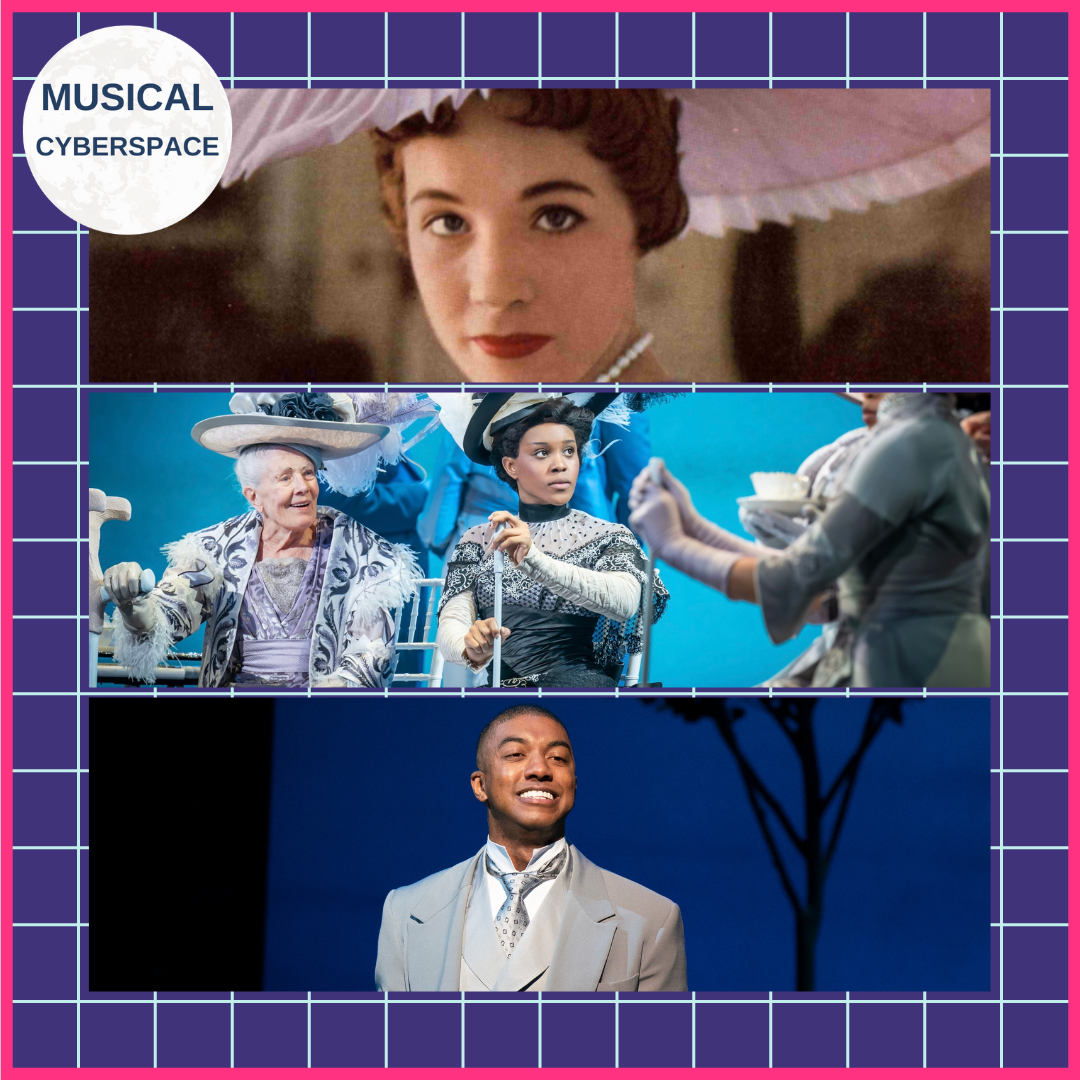
    Julie Andrews (top), starred as Eliza Doolittle in the original production of My Fair Lady, while Amara Okereke (middle) appeared in a recent West End revival alongside Vanessa Redgrave. Christian Dante White played Freddy Eynsford-Hill in the earlier Broadway production of that revival.
    Julie Andrews (top), starred as Eliza Doolittle in the original production of My Fair Lady, while Amara Okereke (middle) appeared in a recent West End revival alongside Vanessa Redgrave. Christian Dante White played Freddy Eynsford-Hill in the earlier Broadway production of that revival.

    1. My Fair Lady Tells a Tale That Transcends the Ages.

    In the 1950s, audiences were enchanted by the Cinderella-esque tale of Eliza’s metamorphosis from a modest flower girl to a refined lady, mirroring the aspirations of post-war society. Today, while the essence of Eliza’s journey remains captivating, our perspective has evolved and My Fair Lady continues to reveal aspects of our very different contemporary world. Today’s audiences observe that Eliza is a multifaceted character yearning for autonomy and agency. Her desire for comfort and security, symbolised by the simple grandeur of a warm and spacious ‘room somewhere’ precedes any mention of ‘someone’s head resting on (her) knee,’ enabling contemporary productions to focus on Eliza’s quest for self-fulfilment and what that means by the time Higgins utters his final words, ‘Where the devil are my slippers?’ In previous decades, ambiguity shrouded Eliza’s fate, leaving her future with Higgins uncertain, even though using “I Could Have Danced All Night” as underscoring seems to indicate a bias on Lerner and Loewe’s part towards the romantic. On the other hand, the most recent Broadway revival (directed by Bartlett Sher) boldly portrayed Eliza’s departure from Higgins and his confining world in this final moment, a choice reminiscent of Nora’s liberation in Henrik Ibsen’s A Doll’s House – one that resonates most profoundly with modern audiences’ desire for empowered female characters. At least, it resonated with some modern audiences; others were shocked by the audacity of it all. Nonetheless, My Fair Lady offers the audiences of today timeless storytelling, interrogating themes of transformation, empowerment and self-discovery in ways that can speak to audiences across generations by inviting us to reimagine and reinterpret its enduring magic.

    2. The Iconic Score of My Fair Lady is a Testament to the Brilliance of Broadway Musicals.

    From its opening notes, the show draws in its audiences with an overture that fans often cite as one of the finest examples in the Broadway canon, perfectly setting the stage for the drama that unfolds in the show. What truly cements the enduring popularity of My Fair Lady are its unforgettable songs, each crafted by the legendary duo of Lerner and Loewe. “I Could Have Danced All Night” and “The Rain in Spain” are just two musical gems that have transcended the confines of the stage to become ingrained in popular culture. Along with the other songs in the score, these numbers boast infectious melodies and resonant lyrics that have entertained audiences for over six decades. Yes, it’s true that Lerner may have forgotten that ‘rather’ and ‘bother’ don’t rhyme and that curtains are hung while criminals are hanged – but generally speaking, the depth of storytelling woven into each musical number distinguishes My Fair Lady from other musicals of the era that can only lay claim to the catchiness of their tunes. The staggering number of recordings My Fair Lady has inspired further solidifies the musical’s place in history. With over 150 recordings ranging from the original Broadway and London cast albums featuring Julie Andrews and Rex Harrison to jazz and instrumental interpretations, parodies, and even a note-complete recording, My Fair Lady has left an indelible mark on musical theatre history. Each rendition pays homage to Lerner and Loewe’s glorious songs, ensuring the show continues to echo through the years.

    3. My Fair Lady Has a Cast of Strong Characters That Audiences Love.

    The characters in My Fair Lady brim with their own distinct traits and intricacies, quirks that audiences have adored as the decades have gone by. Eliza, with her fierce determination and unwavering spirit, embodies the essence of resilience, while Higgins, the brilliant yet socially oblivious linguistics expert, offers a complex blend of intellect and insensitivity. Alfred P. Doolittle, Eliza’s charismatic father, injects humor and irony into the proceedings with his unapologetic wit and opportunism. In his idealism and youthful fervour, Freddy Eynsford-Hill, the hopeless romantic smitten by Eliza, offers a charming contrast to Alfred’s cynicism. Even Mrs Pearce, Higgins’s steadfast housekeeper, gets us on her side with her pragmatism and compassion, serving as a grounding force in this whirlwind of personalities. Together, these characters provide a showcase of human experience, resonating with audiences through their sheer relatability.

    Promotional artwork for the upcoming South African production of MY FAIR LADY
    Promotional artwork for the upcoming South African production of My Fair Lady

    4. New Productions of Classic Texts Allow for Diverse Casting and New Perspectives.

    In the latter part of the previous century, colourblind casting sought to promote equality and provide opportunities for actors of all backgrounds. The casting of, say, Disney’s 1997 television adaptation of Cinderella, with Brandy Norwood as Cinderella, Paolo Montalban has her prince and Victor Garber and Whoopi Goldberg as his parents cast these roles without considering the race or ethnicity of the actors. Since then, there has been a shift towards colour-conscious casting, which acknowledges the importance of race and ethnicity in storytelling and considers how casting choices can contribute to a narrative of diverse human experiences. Amara Okereke, the first black Eliza in a West End production of My Fair Lady, the 2022 revival, reflected on her casting:

    I’d watched clips of Julie Andrews in the original since I was a child. I felt like I knew the part inside out. I can appreciate the seriousness of being the first black person to ever play a role and appreciate the seriousness of telling people’s stories, but I still need to see the thing as a whole. Musicals are meant to bring people joy.

    Christian Dante White, who was a replacement Freddy in the earlier Broadway production of that same revival stage noted in interviews how privileged he felt to be among the first black actors in My Fair Lady, having taken over the role from another black actor, Jordan Donica. He was also open about the pressures that went along with that privilege.

    I’m not only going out there as an actor. I’m going out there as a ‘black actor.’ So it is an added pressure. When I started in My Fair Lady, I started getting all these amazing messages from these young people of color, a lot of them in school, saying, ‘It was so good to see me up there. You made it seem possible.’

    The reward of being able to open up a show like My Fair Lady to people of colour is twofold. While opening up opportunities for actors in the industry, it opens up dreams for those who dream of what a future in the theatre could be.

    5. My Fair Lady Still Mirrors Contemporary Social Issues.

    We would all love to live in a world where the social problems of the early 20th century have been solved, but in reality, we don’t. Just as Eliza Doolittle grapples with her identity and societal position, people today navigate similar struggles with the debates on gender equality, social mobility and identity politics growing more and more complex by the day. Consider the ongoing discourse around privilege, wealth inequality and systemic injustices: all three are seen in My Fair Lady, in the way Higgins and his crony, Colonel Pickering relate to the world around them, in Alfred’s subversive delight at how his lower social rank affords him the ability to avoid any kind of morality and in Freddy’s shallow understanding of Eliza’s differences as pure whimsy. The power dynamics depicted in the musical parallel modern-day discussions on entrenched hierarchies both at home and in the workplace. Moreover, Eliza’s quest for a voice and access to self-determination echoes through in current movements advocating for marginalised communities. It’s not only flower girls who dream of a fair chance in life.

    Final Thoughts

    After diving into the timeless charm and enduring relevance of My Fair Lady, it’s clear why this beloved musical continues to capture the hearts of theatre enthusiasts worldwide. From its memorable characters to its exceptional songs, My Fair Lady proves that true classics never go out of style. So, whether you’re a seasoned theatergoer or a first-time attendee, don’t miss any opportunity to experience the magic of My Fair Lady live on stage. Keep an eye out for upcoming productions in theaters near you (in South Africa, you can book here for the Cape Town run and here for the Johannesburg season) and immerse yourself in the enchanting world of Eliza Doolitte and Henry Higgins. Trust us – it’s an experience you won’t soon forget!

    Posted in The Saturday List | Tagged , , , , , , , , , , , , , , , , , , , , , , , , , | Leave a comment

    The Saturday List: Five SISTER ACT moments that are “Fabulous, Baby!” and Five that “Haven’t Got a Prayer”

    Thirteen years ago today, the revised Broadway production of Sister Act (book by Bill and Cheri Steinkellner, lyrics by Glenn Slater and music by Alan Menken) opened at the Broadway Theatre in New York. The show had previously had a West End run as well as earlier developmental runs in Pasadena and Atlanta. This new version aimed to address some of the criticisms made of the show, which had received a mixed reaction, with reviews often indicating that the show alternated moments of brilliance with cringe-worthy missteps. This strange remained true even after the revisions were interpolated into the show and in today’s Saturday List, we’re unpacking which moments of the show are “Fabulous, Baby!” alongside a few others that “Haven’t Got a Prayer.” Let’s jump right in and look for a little salvation!

    The original Broadway Cast of SISTER ACT included Patina Miller as Deloris, Victoria Clark as Mother Superior and Marla Mindelle as Sister Mary Robert.
    The original Broadway Cast of Sister Act included Patina Miller as Deloris, Victoria Clark as Mother Superior and Marla Mindelle as Sister Mary Robert.

    HASN’T GOT A PRAYER: “When I Find My Baby”

    Heroes are only as good as their villains and Curtis, on paper, is as mean as they come. But weakly written men are par for the course in Sister Act and the show holds its punches in depicting this murderous gangster, preferring to laugh things up rather than making him truly threatening. There’s perhaps no greater failure in this show than “When I Find My Baby,” Curtis’s femicidal anti-love song, where he breaks down exactly what he will do to Deloris when he tracks her down. I have no problem when a song articulates a problematic character’s point of view. That’s life; it’s true in the world of the play. But this song just doesn’t land. It reaches for humour and irony that just isn’t there. The musical language is all wrong, it’s a bop rather than being menacing. This approach could be disturbing psychologically, but that’s not the kind of musical Sister Act is. In the kind of musical Sister Act is trying to be, Curtis shouldn’t sing. But he does, and it hurts the show.

    FABULOUS BABY: “Sister Act”

    Poppy screen-to-stage musicals of the 2000s made as big a deal of including title songs as Jerry Herman did in his biggest hits. Whether it’s an incidental piece like “Hairspray” or a deeply felt transition for the leading character like “Legally Blonde,” this became a bit of a formulaic must-have in these musicals. “Sister Act” was in the tradition of “Legally Blonde,” a more introspective piece that shows the character’s journey as we head to the final curtain. Built on a series of short phrases, “Sister Act” gives the sense that Deloris is having a gradual revelation, realising just how far she has come since we heard “Fabulous, Baby!” early on in the show, which has also just been reprised. The number is stripped back at first, lacking the excesses of Deloris’s disco numbers, and then builds into a more typical pop musical number. This is when Deloris works out who she is, faults and all, set to a classic Menken musical hook that lingers once the song has ended.

    HASN’T GOT A PRAYER: “I Could Be That Guy”

    As intimated earlier in today’s column, the show’s weakest aspect is undoubtedly its characterisation of its male characters. Perhaps this isn’t a surprise in a show titled Sister Act, but there is a clear intention to give Eddie, the police officer in charge of protecting Deloris, more to do. A completely unnecessary romantic subplot is built around Eddie and Deloris, one that pads out the show without adding anything significant to it. His song, “I Could Be That Guy,” in which he expresses his desire to be cool and impress Deloris, just muddies the waters. It is a narrative approach that adds little value to a story about a woman discovering an identity independent of men. It might, if Deloris rejected Eddie in the end, but you know – it’s a musical. Sigh.

    FABULOUS BABY: “Raise Your Voice”

    This song is something everyone who knows the film is waiting for when they see the stage adaptation. It’s also one of the key events in the show even if you’re along for the ride for the first time. When the sisters learn to sing in Sister Act, on stage it’s as much about raising one’s voice as it is about finding it. Deloris has got where she is by raising her voice, and her experiences in the show’s narrative enable her to discover what she has to say – or sing, as it were. Fittingly, her transformation over the show is mirrored in “Raise Your Voice.” Set to a pulsating rhythm, this number is catchy and memorable. While we get some obvious singing lesson moments in the song, Menken takes things much further musically and Slater is in fine form with his lyrics here too. It’s no wonder this was the number the producers chose to showcase at the 2011 Tony Awards performance.

    HASN’T GOT A PRAYER: “Here Within These Walls”

    This is likely to be considered the hot take of today’s column. As far as I’m concerned, “Here Within These Walls” seems to get more love than it deserves. The song gains a lot of its reputation, I think, by generally being delivered by well-loved musical theatre stars who have more to offer than the song they’re singing. Dramatically, as a number that establishes the Mother Superior, this number reduces the character to a function of her setting, rather than the more nuanced human being played so brilliantly by Maggie Smith in the original film. In the movie, the Mother Superior’s main priority is to protect the nuns, their shared faith and their home. She’s not succeeding, but her intentions are clear. This song strips away that fundamental aspect of the Mother Superior’s character. She is now simply a foil for Deloris and her song highlights how sinful the world is compared with the life led at the Queen of Angels Cathedral. It highlights what a fish out of water Deloris is, but it doesn’t tell us much about the Mother Superior other than her disdain for sin. The most authentic conflict in the original Sister Act is between these two women and how they change each other through this shared experience. In the stage adaptation, that’s all but missing, so the piece feels emptier than it should by the time the curtain falls.

    FABULOUS BABY: “Sunday Morning Fever”

    There’s nothing quite like a musical scene, where all of the dramatic content of an entire segment of a show is set to music and where the end of the sequence takes us to a very different place from where we started. Menken had delivered such a scene in collaboration with Howard Ashman in “The Meek Shall Inherit” in Little Shop of Horrors. He creates another satisfying scene in Sister Act with “Sunday Morning Fever,” which tracks the growing popularity of the church choir, the increased danger Deloris puts herself in due to her appearances in the local press, and the deepening concerns of the Mother Superior. By the end of the number, everything is in place for the show to move towards its climax. The best moments of the song proper are those when Slater exercises self-control in creating lyrics for the nuns to sing. Alas, for every

    Praise the Lord! Join the flock!
    Party ’til you make the cloister rock!

    and

    Fill the church! Pass the plate!
    Everybody – transubstantiate!

    there’s a

    Bump that thing in praise of Christ the King
    Until you pull your pelvic muscle!

    In the end, the number is bigger than a few bum lyrics. The sum is greater than the parts and “Sunday Morning Fever” weaves together the various narrative strands of the show and gives Sister Act the focus it needs to get through its second act.

    SISTER ACT has been performed all around the world. Here is the South African cast in action, led by Candida Mosoma and Kate Normington.
    Sister Act has been performed all around the world. Here is the South African cast in action, led by Candida Mosoma and Kate Normington.

    HASN’T GOT A PRAYER: “It’s Good to Be a Nun”

    A nun walks into a bar…. is one way to start a lazy joke. One of the things that made Sister Act work as a film is that within the comic worldview of the piece, the nuns weren’t a punchline. They gave the piece heart and soul, each being a flawed human being whose life is impacted by their unlikely adventure with Deloris. When Sister Act opened in London, audiences had the misfortune of being introduced to Sisters Mary Patrick, Mary Lazarus, Mary Robert and the gang in “How I Got the Calling,” which undermines the characters by turning them into a bunch of clowns. The song was replaced in the Broadway version of the show by “It’s Good to Be a Nun,” which is a little better – but not much. While the nuns are now depicted with more credulity, Slater still hasn’t found these women’s voices in his lyrics. Instead, we get a little list of what he thinks people find funny about nuns – and the worst part is, we’ve heard it all before.

    FABULOUS BABY: “The Life I Never Led”

    This remarkable little number is sung by the timid Sister Mary Robert when she really comes into her own, gaining the strength to reveal to Mother Superior the truths that her guardian has been unable to see. It’s a number that turns Sister Act on its head a little, in that it shows the old guard of the musical theatre tradition in tension with the “new musical theatre” voice that the composers and lyricists of the early 2000s were experimenting with post-RENT. This number could so easily have been written by Benj Pasek and Justin Paul for something like their debut work, Edges, or by Adam Gwon for a show like Ordinary Days. The whole approach to defining the character, couching it in insecurities and questions, feels very different from the more traditional approach of “Here Within These Walls” or “Fabulous, Baby!” which deal more with a character’s absolute convictions. Replacing the overt pastiche that is a key element of the score of Sister Act with a more contemporary sound, “The Life I Never Led” is a clear stepping stone in the development of pieces like Dear Evan Hansen and Fun Home – a moment where the show stops and connects with something bigger.

    HASN’T GOT A PRAYER: “Take Me to Heaven”

    One of the most memorable aspects of the original film was how some of the songs in its opening, “The Lounge Medley,” pop up later in religiously styled reprises. The sisters’ retooling of “My Guy” as “My God” is one step on their journey to fame, much to the Reverend Mother’s chagrin; their ultimate success is seen in “I Will Follow Him,” which receives the Pope’s approval. The whole bit is the transformation of something familiar into something new. Without access to the pop songs used in the film, Menken and Slater had to reverse engineer things and write an original song that is ostensibly a pop song in the world of the play, which is then performed by Deloris in her night club act at the top of the show and reprised when the nuns’ choir has finally found its voice under Deloris’s leadership. Thus, “Take Me to Heaven” was born. One of the big problems here is that everything is too on the nose. Setting up a gag is one thing, but giving away the punchline is something else altogether. Slater’s lyrics are filled with puns and ambiguous phrases that are so obviously geared towards the song’s reprise as a church song that by the time it comes along, there’s no surprise and no joy to be had. All you get is a cheap laugh. It’s so unsatisfying.

    FABULOUS BABY: “Fabulous, Baby!”

    “Fabulous, Baby!” is the first non-diegetic song in Sister Act, a feisty little piece that establishes Deloris’s character and simultaneously serves as the show’s “I Want” song. This song is exactly the kind of thing you want to see in an adaptation of a film or play, something that takes the dramatic situation in the source material and takes it to the next level. In this song, it’s clear that Menken and Slater understand who Deloris is and what makes her tick. They let her tell us who she is in the verse and then show us what she’s really like in the chorus. Despite her circumstances, we can see that the big thing holding Deloris back is Deloris herself. And while it seems that what she wants is, in her words, to be ‘on display’ and ‘dressed to the nintey-nines,’ it’s clear there are not enough sequins in the world to make her vision come true – because what she really wants is to be seen. Like some of Menken’s best work, “Fabulous, Baby!” uses a pastiche of pop music styles from the second half of the twentieth century to thrilling dramatic effect. It’s the kind of thing where one can see Menken’s genius at work. A less-skilled composer might accomplish the pastiche, but capture less of the character’s journey in the number – and besides the sick beat and the engaging lyrics, that’s what makes this song truly fabulous, baby.

    Final Thoughts

    If anything is clear about the stage adaptation of Sister Act, it’s the idea that the show’s creators wanted to create a musical that expanded on the film. While the show was not always successful in its execution of its sometimes audacious ideas, there was no lack of creativity in bringing this show to the stage. Ultimately, there is probably a really great 100-minute musical in this 2½-hour extravaganza. I’d even be tempted to say that there might be a totally brilliant 90-minute single-act show here that would blow everyone away. Nonetheless, there’s enough in Sister Act in its current form to make for an evening of fun entertainment, including some memorable songs. With the right cast putting across the material, it might not take you to heaven, but you’ll still be dancing your way out of the theatre, inspired to “Spread the Love Around!”

    Posted in The Saturday List | Tagged , , , , , , , , , , , , , , , , , , , , , , , , , , , , | Leave a comment

    The Saturday List: My Junk is SPRING AWAKENING

    Get ready to journey back to the groundbreaking world of Spring Awakening, a modern musical where the show tunes are as haunting as the themes are daring! Since its debut, this Tony Award-winning musical has captivated audiences with its raw portrayal of adolescent angst, sexuality and rebellion against societal norms. But beyond the powerful storytelling and unforgettable songs lies a series of creative moments that have left an indelible mark on the landscape of musical theatre. Bold artistic choices and innovative staging ideas enabled Spring Awakening to move beyond the boundaries of the genre in ways that continue to resonate with audiences today. In today’s Saturday List, we revisit just five of the most creative ideas that helped to solidify this show’s place in musical theatre history.

    Jonathan Groff starred as Melchior in the original Broadway production of SPRING AWAKENING along with and Lea Michele as Wendla (top and bottom), John Gallagher Jr as Mortiz (middle and bottom). Groff and Gallagher Jr are joined by Jonathan B. Wright as Hanschen, Skylar Astin as George and Gideon Glick as Ernst in the middle image.
    Jonathan Groff starred as Melchior in the original Broadway production of Spring Awakening along with and Lea Michele as Wendla (top and bottom), John Gallagher Jr as Mortiz (middle and bottom). Groff and Gallagher Jr are joined by Jonathan B. Wright as Hanschen, Skylar Astin as George and Gideon Glick as Ernst in the middle image.

    1. Origin Story, or “[Frank Wedekind] who Bore Me

    The play upon which the musical adaptation of Spring Awakening is based was completed by Frank Wedekind in 1891. Frühlings Erwachen was not, however, performed until 1906, when Max Reinhardt staged it at the Deutsches Theatre in Berlin. Set against the backdrop of the sexually oppressive nineteenth century, the play follows a group of teenagers – primarily Melchior Gabor, Wendla Gabor and Moritz Stiefel – whose journey through puberty leads them to experiences of sexuality, physical and sexual abuse, suicide, pregnancy and abortion. The first English performance of the play was in 1917, at which time New York City’s Commissioner of Licenses through its edgy content and approach pushed the boundaries too far. Everyone headed to court, where an injunction allowed the production to be staged. While the play’s brilliance in its original German form was recognised by critics, the first English production was criticised for its poor translation. Since then, the play has been translated several times; my favourite version is the 1995 Royal Shakespeare Company-commissioned version by Ted Hughes. Almost three decades later, the Hughes translation is still a great introduction to the play for anyone who has no experience of it, or for fans of the musical who want to see just what inspired composer Duncan Sheik and librettist Steven Sater to put their own spin on the story.

    2. Anticipating Expressionism, or “All That’s Known

    Frühlings Erwachen anticipated the Expressionist theatre movement that would reach the height of its popularity during World War I. I would never say that Spring Awakening is a work of Expressionism. What I would say, is that Wedekind’s foreshadowing of the movement in his work in general means that some of the movement’s conventions have their foundations in his practice. This makes a basic knowledge of Expressionism in the theatre useful to understand the play and its musical adaptation. Back in the day when the online musical theatre forums reigned supreme, the glory days of which were already in their decline when Spring Awakening made its musical theatre bow in 2006, the pearl-clutching generation of musical theatre superfans lamented what they perceived to be poorly developed characters, thematic ideas that went nowhere and emblematic characters that should have been fleshed out. I vividly remember one regular poster on the forums referring to the show as pop trash. They simply didn’t get it. Perhaps they were never going to get it. To them, Spring Awakening was innovation without substance; to those of us who loved the show, it was innovation that meant something. People who loved the show understood that musicals could be built in ways that challenged the Rodgers and Hammerstein II model, by drawing on an array of other theatrical influences, just as Stephen Sondheim had done in Company and Follies and theatre-makers of the next generation, like Sheik and Sater, were doing in Spring Awakening.

    3. A Fever Dream, or “The Bitch of Living”

    The musical adaptation of Spring Awakening is like a fever dream. While it is broadly linear chronologically, its episodic structure and the sometimes casual relationship between the scenes make it feel like a collage with Sater’s book carrying us from song to song. It’s the perfect structure for a play about a group of teenagers who are ‘tossing, turning without rest.’ One of the aspects of Expressionism that Wedekind prefigured was its distorted representation of reality to communicate inner feelings. Sheik and Sater picked up on these impulses: Spring Awakening is less about creating a conventional narrative journey than creating states of being. The songs are like rabbit holes that take us deep into each character’s personal Wonderland, landscapes full of beauty and horror. We learn about “The Song of Purple Summer” and “The Mirror-Blue Mind,” about “The Dark I Know Well” and “The Word of Your Body,” and every moment gives us insight into a particular character’s experience of a situation. In its avoidance of traditional character development over the show, Spring Awakening acknowledges that in life, experiences are fragmented in the context of a single life and of a community. The show proposes that we should see a story about people who are ‘broken inside’ in a broken way and in this way, delivers to us a key we can use to unlock our own souls.

    Dylan Janse van Rensburg as Melchior (top and bottom) along with Scarlett Pay as Wendla (top) and Johnathan Conrad as Moritz (middle and bottom) in LAMTA's South African production of SPRING AWAKENING.
    Dylan Janse van Rensburg as Melchior (top and bottom) along with Scarlett Pay as Wendla (top) and Johnathan Conrad as Moritz (middle and bottom) in LAMTA’s South African production of Spring Awakening,

    4. Microphones and Stereos, or “My Junk”

    One of the most controversial staging choices in the original production of Spring Awakening was the use of hand-held microphones, an anachronous prop in a nineteenth-century setting. The show’s most eager critics decried how random this appeared and chalked it up as an empty nod to pop culture and a shallow way of making the show’s issues feel relevant today. There’s just more to it than that. In Expressionist drama, the action is seen through the eyes of the characters and, therefore, seems distorted or even dreamlike. Wedekind’s use of this technique was another way he preempted the genre, evident in Spring Awakening through a narrative constructed from the collective perspectives of Melchoir, Wendla, Moritz and the gang. Combined with a bit of Freudian theory, we can then begin to understand the use of hand-held microphones as well as the mention of other contemporary objects in the show. Freud’s theory states that our psychological makeup includes the “id” (the fully unconscious part of our mind that contains the drives related to things like sex and aggression and other things repressed by consciousness), the “ego” (the mostly conscious part of our mind that allows us to deal with the world in which we exist), and the “superego” (the partly conscious part of our mind that informs our moral judgments). In Spring Awakening, we see certain songs delving into the characters’ respective ids. These moments are highlighted through the appearance of hand-held microphones and the mention of other contemporary objects. It’s not just about making the issues of “then” seem relevant “now.” There is a central and binding metaphor at work here, in which the teenagers view themselves (in their “id”) as rock stars: free and able to perform with agency. The whole point is that the microphones are incongruent with the reality of the historical period. We are caught in the middle of a fantastical imagining of a world that never was and never can be, that this group of teenagers will never fully attain.

    4. Left to Their Own Devices, or “The Guilty Ones”

    Teen stories, whether their creators tell them in writing, on film or television or on stage, rely on one central conceit: the adults are notably absent or superficially drawn so that the teens may be left to their own devices. Spring Awakening takes this one step further, with Wedekind in the original play (once again moulding ideas that would feature in Expressionism) and Sheik and Sater in the musical using this technique to couch their critical view of controlling societal structures like the family, education and the church. The adult characters in Spring Awakening are purposeful caricatures, subjectively seen through the eyes of the teenagers and as such, are uniformly punitive, heatless or clueless. It’s a masterstroke to have them all played by the same two actors in the musical and adds to the “us and them” opposition that informs the play’s action: “we, the teenagers are individuals; they, the adults, are all the same”.

    Closing Thoughts

    It’s time to whisper our way out of our all-too-brief behind-the-scenes exploration of Spring Awakening, a show that has carved out a unique place in the annals of musical theatre history. It’s clear that this musical is a force to be reckoned with as it continues to challenge and inspire audiences with its raw honesty and unapologetic creativity almost two decades after its first performances!

    Posted in Commentary, In Depth Analysis, The Saturday List, Theatremaking, Theory and Practice | Tagged , , , , , , , , , , , , , , , , , , , , , , , , , , , , | Leave a comment

    The Saturday List: Five Fascinating Facts from the First Tony Awards

    David Wayne, pictured top in FINIAN'S RAINBOW, won the first Tony Award for a performance in a musical. It would have been an engraved gold bill clip, like the one pictured centre, or a cigarette lighter along with a scroll. Women, like Agnes de Mille, who won for her choreography for BRIGADOON, pictured at the bottom, were presented with a silver compact case.
    David Wayne, pictured top in Finian’s Rainbow, won the first Tony Award for a performance in a musical. It would have been an engraved gold bill clip, like the one pictured centre, or a cigarette lighter along with a scroll. Women, like Agnes de Mille, who won for her choreography for Brigadoon, pictured at the bottom, were presented with a silver compact case.

    Today, 6 April, is the anniversary of the very first Tony Awards ceremony – a mindboggling 77 years ago! The inaugural ceremony looked quite different from the events we know and love today. For instance, there was no public announcement of any nominees, and the awards were presented to theatre practitioners who had made outstanding contributions in their respective fields rather than in any set categories. Here’s a run-down of some of the highlights of that ceremony, with a particular focus on the magical musical theatre moments of the night.

    1. Groundbreaking Beginnings

    The American Theatre Wing’s Tony Awards were named for Antoinette Perry, an actress, director, and producer who had led the American Theatre Wing through the challenges of World War II. following Perry’s fatal heart attack in June 1946, Brock Pemberton, one of her contemporaries, proposed the idea of an awards platform to honour her. When he handed out the first award at the 1947 ceremony, he called it a Tony, christening what remains the most prestigious theatre award three-quarters of a century later. The first Tony Awards host was Vera Allen, Perry’s successor as chairwoman of the American Theatre Wing, and while certain elements of the proceedings are instantly recognisable to use today, the inclusion of a dinner – with a menu comprising lobster bisque, salted nuts, breast of chicken Montmorency in black cherry sauce, croquettes of brown rice, asparagus tips Polonaise, and frozen soufflé Alaska with strawberry sauce, petit fours and a demitasse – with the presentation of the awards starting at midnight might be surprising! The cost of a ticket to the ceremony was $7.

    2. Stars on Stage

    The tradition of including performances at the ceremony was established at this first event, with performances from The Chocolate Solider, Street Scene, Brigadoon, Oklahoma!, Call Me Mister, Sweethearts, Carousel and Finian’s Rainbow on the bill. The performers and presenters included Harold (soon known professionally as Howard) Keel and Ethel Waters, alongside Mickey Rooney, Sheila Bond, David Wayne and a host of other singers, actors and dancers. The programme doesn’t indicate what numbers were performed from these shows, but we could make some educated guesses.

    • Keith Andes, Billy Gilbert and Frances McCann who performed the except from The Chocolate Solider, respectively played Bumerli, Popoff and Nadina in the production. One of the more popular numbers from the show was likely performed, so one could guess that “The Chocolate Soldier” or “Sympathy,” two of Bumerli and Nadina’s duets from the show. How did Gilbert fit in? Popff is involved in some of the dialogue running into the numbers, so perhaps that’s it. Maybe he just introduced the number. It’s a mystery.
    • in Street Scene, Shiela Bond, Norman Cordon, Danny Daniels and Brian Sullivan played Mae, Frank, Dick and Sam. Mae and Dick had one big number in the show, “Moon-Faced, Starry-Eyed” – so it’s likely that Bond and Daniels performed it here. Frank and Sam had significant solo pieces in the shows, so Codron likely performed “A Boy Like You” and Sullivan, “Lonely House.”
    • Brigadoon was probably represented by two of the big solos from the show, Charlie’s “Come to Me, Bend to Me” performed by Lee Sullivan, with David Brooks performing Tommy’s “There But For You Go I.”
    • Mary Hatcher and Harold Keel were both Laurey and Curly replacements, so it is most likely that the audience heard “People Will Say We’re in Love from Oklahoma! at the first Tony Awards.
    • The cast members from Sweethearts who performed at the ceremony were June Knight and Robert Shackleton. As Liane and Lt Karl, they probably sang “I Might Be Your Once-in-a-While.”
    • Finally, the performance from Carousel was almost certainly “If I Loved You,” presented by Henry Michiel and Ivy Withers who had taken up the roles of Billy and Julie.

    With music provided by Meyer Davis and his orchestra, it must have been a good night’s entertainment!

    From top to bottom: OG Tony Award winners Agnes de Mille, Michael Kidd and Kurt Weill
    From top to bottom: OG Tony Award winners Agnes de Mille, Michael Kidd and Kurt Weill

    3. Behind the Scenes

    Several artists were awarded in craft categories for their work behind the scenes. Elia Kazan was recognised for his outstanding direction of All My Sons, while Arthur Miller’s script for the play was celebrated with a special award. Kurt Weill’s work on the opera, Street Scene, saw him honoured as an outstanding composer. Then, in what can only be viewed now as an incredible fashion flashback, Lucinda Ballard was presented a Tony Award for her costume designs for no fewer than five shows: Happy Birthday, Another Part of the Forest, Street Scene, John Loves Mary and The Chocolate Soldier. P. A. MacDonald’s ‘intricate construction’ work for the musical, If the Shoe Fits, was also acknowledged. Special awards were also presented for a range of skill sets and support of the performing arms industry, specifically to:

    • Dora Chamberlain, for her work as the treasurer of the Martin Beck Theatre;
    • Mr and Mrs Ira Katzenberg, for their enthusiastic support of the theatre as regular first-night attendees;
    • Jules Leventhal, for his prolific work as a producer of the 1946-1947 season;
    • Burns Mantle, for his annual Best Plays publication; and
    • Vincent Sardi Sr, for his establishment of Sardis, which had, at that stage, been a haven for theatre folk for two decades.

    4. Dancing into History

    The 1940s was a decade that saw Broadway choreographers raise the bar when it came to storytelling through dance in musical theatre. It’s no surprise that both Agnes de Mille and Michael Kidd were recognised at the first Tony Awards ceremony for their work on Brigadoon and Finian’s Rainbow respectively.

    De Mille had been responsible for a great deal of the move toward choreographic storytelling on Broadway through her work in both Oklahoma! and Carousel, having also staged the dances in Swingin’ The Dream, a transposition of A Midsummer Night’s Dream into an 1890s New Orleans setting, before her groundbreaking work in the two Richard Rodgers and Oscar Hammerstein shows. She also chalked up credits in One Touch of Venus and Bloomer Girl before moving to Brigadoon. Along with her advocacy for women dancers, De Mille is remembered for using choreography to flesh out the emotional dimension of musical theatre characters in addition to focusing on the technique required to execute the steps.

    Kidd is remembered today for his athletic and exciting choreography. Finian’s Rainbow was his Broadway debut as a musical theatre choreographer and there’s more to his choreography than its vigour. One of his innovations was building choreography from the vocabulary of a character’s ordinary movements, heightening and stylising how a character moved to the nth degree. This helped elevate the emotional arc of the character and the show as a whole because there was a more seamless transition from movement into dance, in the same way that the best musicals move out of dialogue and into song gracefully and joyfully.

    5. The Outstanding Performers of the Season

    The outstanding performers named at the inaugural Tony Awards were mostly from plays from the previous season, including José Ferrer in Cyrano de Bergerac, Fredric March in Years Ago, Ingrid Bergman in Joan of Lorraine and Helen Hayes in Happy Birthday. Patricia Neal was also singled out as an Outstanding Newcomer for her role in Another Part of the Forest. Only one award was presented to an actor from a musical: David Wayne in Finian’s Rainbow. Wayne played Og, a leprechaun whose pot of gold has been stolen by Finian McLonergan. To grow his treasure by burying it near Fort Knox, Finian emigrates to the United States of America with his daughter, Sharon. Og pursues them, as he will be turned permanently into a human if he cannot recover it. Many years later, Wayne would perform one of his character-defining numbers at the 1971 Tony Awards in a salute to a quarter century of musical theatre hits. His charm in putting over “When I’m Not Near the Girl I Love” is just a small reminder of the vitality that earned him the first Tony Award ever presented to a musical theatre actor.

    David Wayne sings “When I’m Not Near the Girl I Love” from Finian’s Rainbow

    Looking Ahead

    As we eagerly anticipate this year’s Tony Awards ceremony, set to honour the best of the 2023-2024 Broadway season, the legacy of shows like Finian’s Rainbow and Brigadoon reminds us of the enduring magic and impact of theatre. As the nominations roll in on 30 April and the awards ceremony, to be hosted by the talented Ariana DeBose, follows two months later on 30 June, theatre enthusiasts everywhere will be on the edge of their seats, awaiting the announcement of this year’s winners. Recognising both classic revivals and groundbreaking new productions, the Tony Awards continue to celebrate the artistry and innovation of Broadway, ensuring that the legacy of exceptional theatre lives on for generations to come. So mark your calendars, set your reminders, and join us as we tune in to witness the next chapter in Broadway history unfold.

    Posted in The Saturday List | Tagged , , , , , , , , , , , , , , , , , , , , , , , , , , , , , , , , , , , , , , , , , , , , , , , , , , , , , , , , , , , | 4 Comments

    The Saturday List: Which OG OKLAHOMA! Recordings are More Than Just OK?

    The original Broadway cast of OKLAHOMA! featuring, Joan Roberts as Laurey, Joseph Buloff as Ali Hakim, Betty Garde as Aunt Eller, Celeste Holm as Ado Annie, Jane Lawrence Smith as Gertie and Alfred Drake as Curly
    The original Broadway cast of Oklahoma! featuring, Joan Roberts as Laurey, Joseph Buloff as Ali Hakim, Betty Garde as Aunt Eller, Celeste Holm as Ado Annie, Jane Lawrence Smith as Gertie and Alfred Drake as Curly

    It’s hard to believe that the perennial Richard Rodgers and Oscar Hammerstein II musical, Oklahoma! premiered 81 years ago this weekend! The first major musical collaboration between these two musical theatre titans, Oklahoma! was based on Green Grow the Lilacs, a play by Lynn Riggs that included some traditional folk songs, which had been produced by the Theatre Guild in in 1931. A little more than a decade later, the musical adaptation was a Hail Mary for the Theatre Guild, which found itself in a financially precarious situation thanks to the outbreak of World War II.

    The rest, as they say, is history. Oklahoma! was a smash success and ran for 2 212 performances, setting a record that would be broken more than a decade later by Alan Jay Lerner and Frederick Loewe’s My Fair Lady. The songs became so popular it was as though they had always existed. It took less than six months for Frank Sinatra to release recordings of “People Will Say We’re In Love” and “Oh What A Beautiful Morning.” Rodgers’s score was also highlighted in a delightful 1944 recording by the Philharmonic Orchestra of Los Angeles, which condenses the score and (with apologies to Hammerstein) lets the melodies ripple out like a whispered song you can listen to over and over. Rodgers and Hammerstein would go on to write some of the most revered American musical theatre classics, most of which were filmed for the big screen, including Oklahoma!, which was released in 1955.

    To celebrate tomorrow’s anniversary of this Broadway classic’s opening, we are counting down the early cast recordings of the show, from the original Broadway cast album through the film’s soundtrack – just a handful among a myriad of recordings from different productions and studios around the world. Which is your favourite?

    5. 1944 Studio Cast

    The album cover for the 1944 Studio Cast Recording of OKLAHOMA!

    A show as popular as Oklahoma! was bound to spurn a studio cast recording sooner rather than later. This first appeared the year after the show’s premiere and comprised six of the show’s most popular tunes. The recording is something of a novelty and offers some moments of interest to the hardcore Oklahoma! fan, including some new arrangements of the songs – gilding the lily, more often than not – and some alternative lyrics, such as those that pop up in “Out of My Dreams.”

    Won’t have to make up any more stories – you’ll be there!
    Think of the bright midsummer night glories we can share.
    Won’t have to go on kissing a daydream – I’ll have you;
    You’ll be real, real as the white moon lighting the blue

    The performances, with James Melton singing Curly and Eleanor Steber singing Laurey, are less characterful than those of the original Broadway cast, which were the only others on record at this stage, aside from Sinatra’s two pop recordings. Melton and Streber tend to add more sentimental flourishes to the songs than needed, particularly in the ballads. “The Surrey with the Fringe on Top” is also slowed down in a way that dials down the song’s inherent charms. There’s a little more life in John Charles Thomas and the ensemble’s blustery “Kansas City;” “Oklahoma,” on the other hand, sounds too sedate. This is very much a supplementary recording for completists. It doesn’t offer much for the casual listener and is too truncated to provide a real impression of the show.

    4. 1947 Original London Cast Recording

    The cover of the Original London Cast Recording of OKLAHOMA!

    The original London cast recording isn’t much better than the 1944 studio cast recording. It offers more of the show’s score, but most of the tracks run through only a verse and chorus before coming to a sudden end.

    Starring Howard Keel as Curly and Betty Jane Watson as Laurey, there is nothing wrong with the cast, per se; they just don’t equal their original Broadway counterparts. Keel gives an endearing reading as Curly and Watson is sweet – if a little pitchy – as Laurey. Dorothea MacFarland gives a typically fashioned old-school comic reading of Ado Annie, but she is unable to banish the memory of Celeste Holm, who offers a definitive performance of the songs on the original Broadway cast recording.

    This isn’t the recording to get if you really want to experience what Oklahoma! has to offer: the original cast recording, the soundtrack or one of the earlier revivals are better options. This one is a triviality for hardcore fans of the show.

    3. The 1952 Studio Cast Recording

    The second studio cast recording of Oklahoma! featured Nelson Eddy as Curly. While the top-billed Eddy himself offers some delightfully acted moments as Curly, the rest of the singers’ success in the roles is mixed. Wilton Clary is a more full-voiced, but less characterful Will Parker than Lee Dixon’s original take on the character. Lee Cass, who plays Jud Fry, sets up some great expectations for his “Lonely Room” in his performance in “Poor Jud is Daid” and his take on the song is just as unsettling as it should be.

    As Ado Annie, Kaye Ballard is reminiscent of Celeste Holm but less effective. The least successful of the leads is Virginia Haskins as Laurey, whose vocal delivery is just too heavy. This makes her sound, perhaps, the most likely of all early Laureys to be related to Aunt Eller, who is given a spirited voice in Portia Nelson’s reading of the role. David Morris is similarly lively as Ali Hakim. The ensemble also deserves a shoutout for their investment into what might otherwise be considered a superfluous addition to a studio recording of this time, as evidenced in the 1994 studio recording.

    In the final analysis, this is actually a very good early recording of the show. It offers more music than the two original cast recordings and while the acting might not be as good, everyone certainly gives it a good go. There’s a level of care evident in this recording, even with its missteps taken into account.

    2. The 1955 Soundtrack Recording

    The cover of the 1955 Soundtrack of OKLAHOMA!

    Next up is the soundtrack of the 1955 film version, which starred Gordon MacRae and Shirley Jones as Curly and Laurey. Both typify the kind of romantic leads that Rodgers and Hammerstein had in mind for the show during the 1940s and 1950s: a dapper, charming and confident young cowboy and a romantic, somewhat highly-strung young woman. Both fill the roles quite nicely and the leading cast is rounded out quite well by Gloria Grahame, a typically character-voiced Ado Annie, and Gene Nelson, who is a charming Will Parker – possibly the best to portray the role on record in the first two decades of the score’s existence.

    It’s also interesting to hear a different “Overture”, one clearly capitalising on the most popular numbers of the score rather than on the tunes chosen to set the mood for the stage show, the earlier of the two being the more successful in that regard to my mind. Later releases of the soundtrack supplemented the original pressing with several tracks, including the full “Out of My Dreams” ballet. While it was not the only number cut from the film, “Lonely Room” is perhaps the most glaring omission. Essential to the show, it was excluded from the film and is excluded here – and it is sorely missed.

    1. The 1943 Original Broadway Cast Recording

    The cover of the Original Broadway Cast Recording of OKLAHOMA!

    The original Broadway cast recording is a landmark recording. Originally released in two volumes that can now be heard on one CD or in a single streaming album, the recording includes all of the major songs, predictable skipping only the “Dream Ballet”, the “Entr’acte” and the reprise of “People Will Say We’re in Love”, with several of the other numbers trimmed internally.

    The superb cast is led by Alfred Drake and Joan Roberts as Curly and Laurey. Although some may feel that Drake, in particular, is rooted somewhat too much in the operetta tradition from which Oklahoma! itself springs, their performances are thrilling. With a uniformly excellent supporting cast, every song is a treat. Celeste Holm is absolutely brilliant as Ado Annie, while Lee Dixon is a personable Will Parker, the twinkle in his eye carrying through beautifully in his vocals.

    If there’s one disappointment, it is Drake doing double duty, singing “Lonely Room” instead of Howard Da Silva, who played Jud on stage. Nonetheless, there is an energy that penetrates every moment of this recording, making it immediately accessible and always enjoyable, even upon repeat listens. It is an essential recording for fans of the show and of musical theatre in general.

    Honourable Mention

    Sharp-eyed Oklahoma! fans might spot one recording missing from this parade. That one, as they say, is a horse of a different colour. The Music from Oklahoma!, interpreted by Nelson Riddle and his Orchestra, is an almost totally instrumental look at the work. I say almost because there are vocals used to add musical colour to the tracks rather than to sing the lyrics; indeed, a soprano reminiscent of the Star Trek theme’s theremin pops up in songs like “Oh, What a Beautiful Mornin'” and “People Will Say We’re in Love,” lending these standard a touch of camp irony. Released as an ancillary marketing product for the film, this album was Riddle’s first solo studio affair, and it makes for very entertaining listening. If you haven’t given it a spin, you should.

    Final Thoughts

    As the years continued to go by, other great recordings of Oklahoma! have been released, including the 1980 Broadway revival’s cast recording and the 1998 cast album of the Royal National Theatre’s production. The most recent revival brilliantly brought the show into the contemporary musical theatre age and that cast recording is also a must-have in any Oklahoma! enthusiast’s collection. More reviews are up on our Oklahoma! show page, along with all essential information about the show itself. We very much are spoiled for choice when selecting a recording to celebrate this classic show: as Golden Age musicals go, Oklahoma! is a surrey with a fringe on the top!

    Posted in The Saturday List | Tagged , , , , , , , , , , , , , , , , , , , , , , , , , , , , , , , | Leave a comment

    The Saturday List: 5 Enchanting AIDA Songs That Aren’t Just Passing Through

    The stars of the original Broadway production of AIDA: Heather Headley (top and centre) as Aida, Adam Pascal (centre) as Radames and Sherie Rene Scott (bottom) as Amneris.
    The stars of the original Broadway production of Aida: Heather Headley (top and centre) as Aida, Adam Pascal (centre) as Radames and Sherie Rene Scott (bottom) as Amneris.

    Today is the anniversary of the opening of Disney’s Aida, the House of Mouse’s third Broadway musical, following Beauty and the Beast and The Lion King, and the first not to be based on an animated feature film. Making its bow at the Palace Theatre in 2000, Aida starred Heather Headley as the eponymous Nubian princess, with Adam Pascal as her Egyptian captor, Radames, and Sherie Rene Scott as Pharaoh elect, Amneris. 2000 was a weird year at the Tony Awards thanks to the nomination and eventual win of a dance show, Contact, in the Best Musical category, so Aida was shut out of the top category. Even so, Elton John and Tim Rice were nominated and won the award for Best Score. (Both prizes should have gone to Michael John LaChiusa and George C. Wolfe’s The Wild Party, but what can you do?) The score for Aida was eclectic, with a solid foundation in John’s pop style, infused with reggae, gospel and soul as well as cultural influences from Africa, the Middle East and India. In today’s Saturday List, we’re taking a look at the five best songs in the score, those that give audiences more than a sense of “Enchantment Passing Through.”

    5. “Dance of the Robe”

    Knowing that John set Rice’s lyrics to music when writing Aida is just one of the things that makes this song so fascinating. The overall drive of Rice’s lyrics for “this song “Dance of the Robe” is clear, but on a granular level, there are so many slight variations in metre, starting in the second line of the song, that ultimately indicate a slip in his craftsmanship. Compare

    It’s knowing what they want of me that scares me.
    It’s knowing having followed that I must lead.

    with

    You robe should be golden, your robe should be perfect
    Instead of this ragged concoction of thread…

    and you’ll see what I mean. His phrases are also incredibly long. Take the latter quote above, for example, which continues:

    … But may you be moved by its desperate beauty
    To give us new life for we’d rather be dead
    Than live in the squalor and shame of the slave –
    To the dance, to the dance!

    This number is a huge dramatic moment in the show and it has to achieve a significant turning point in Aida’s arc, the moment when she takes responsibility for the actions that led to her and the other women’s capture and when she takes on the mantle of leadership. John sets the lyrics to a restless 6/8 rhythm, giving it enough momentum for both the singer and the audience to follow the line of the lyric.

    Heather Headley performs "Dance of the Robe" with the ensemble of AIDA in the show's original production.
    Heather Headley performs “Dance of the Robe” with the ensemble of Aida in the show’s original production.

    There’s also enough movement in the line for the song to build from a quiet individual reflection into a frenzied ensemble dance, in which the underlying unease of the situation and the Nubian’s call for agency gain direction and passion. It’s brilliantly theatrical and in some ways, it’s better theatre than songwriting – but this is a perfect example of how musicals can propel a dramatic moment to the next level.

    4. “Enchantment Passing Through”

    “Enchantment Passing Through” is one of the songs in Aida that has had a more transformative journey than most. Originally, it was a solo song for Radames expressing his frustration and anger about the life that awaited him upon return to Egypt, a life in which he felt trapped. The original-ish version can be heard on the concept album in an odd cover version by the R&B group, Dru Hill. The song’s original iteration didn’t play for a couple of reasons. Firstly, it’s a song that places Radames at the heart of the story and ultimately, Aida isn’t about him. His entrapment is also not comparable to Aida’s enslavement, a point that was made clearly in the book scene inserted midway into the new version of the song, which became a duet between Radames and Aida:

    AIDA
    You talk as though you’ve been enslaved.

    RADAMES
    Not with chains, maybe, but with a marriage promise. (AIDA begins dabbing her eyes with her dress.) What is that for?

    AIDA
    To dry my weeping eyes. Forced to marry a princess? Oh, what hardships. I know – you want to go to lands where people have been living for centuries and say that you “discovered” them. But instead, you’re being thrust onto the Pharaoh’s throne. It is a great tragedy.

    RADAMES
    You go too far.

    AIDA
    No! You go too far. If you don’t like your fate, change it. You are your own master. There are no shackles on you. So don’t expect any pity or understanding from this humble palace slave.

    Secondly, the writers, which originally included Linda Woolverton as the writer of its book ahead of numerous revisions by Robert Falls and David Henry Hwang alongside Rice and John, also struggled with a key problem during the creation of this show: how to make the audience believe that an enslaved woman could fall in love with the man that enslaved her. Giving Aida a voice in this song enabled them to point out common ground between them, not in the characters’ circumstances, but in some of the ways they saw the world around them. Indeed, the song really takes flight as it modulates into Aida’s verse:

    If I could leave this place then I’d be sailing
    To corners of my land where there would be
    Sweet southern winds of liberty prevailing
    The beauty so majestic and so free.

    Sherie Rene Scott as Amneris sings "My Strongest Suit" in the original production of AIDA.
    Sherie Rene Scott as Amneris sings “My Strongest Suit” – a song which possibly deserves an honourable mention in this list or memorable songs from Aida. It’s a real bop in the concept album version performed by the Spice Girls.

    If there is any flaw left in the song from that original version, it is in giving its ending exclusively to Radames. Rice’s silencing of Aida’s voice in these final moments holds back the show’s storytelling. It would be great to see this addressed should there ever be a major revival of the show.

    3. “Written in the Stars”

    Stylistically, “Written in the Stars” is one of the most Elton John-like songs in the score. That much is more obvious in the version he recorded with the country and crossover darling of the late 1990s, LeeAnn Rimes, on the concept album for Aida, but the sound carries through into the show itself. The song connects so well with audiences thanks to the much-loved trope of star-crossed lovers who are destined by fate and their circumstances never to find love in a tragic world. What makes the song more layered, though, is how different Radames and Aida’s views of the gods who have decided their fate are. Radames is still caught up in romance, somewhat selfishly, and viewing this as a personal loss. Perhaps I’m being a little unfair, as Radames isn’t yet aware that Aida is the king of Nubia’s daughter, so he’s not working with the full deck of cards. There’s no such dramatic irony when it comes to Aida’s view of things. She’s fully aware of the irony that the gods have provided her with a solution to her country’s colonisation in the form of a man she truly loves but cannot marry. Radames, after all, can only influence Amneris’ political decisions as her consort. In contrast to Radames, she finds a purpose greater than herself in the gods’ actions:

    Nothing can be altered, there is nothing to decide –
    No escape, no change of heart, nor any place to hide.

    This song seems to end with the lovers’ acceptance that this is the way things need to be. Radames decides to send Aida back to Nubia and the story would play out very differently if not for one small thing: Amneris has been watching all of this from the shadows and their fate now transfers from the gods’ hands into hers.

    2. The Gods Love Nubia”

    “The Gods Love Nubia” was written for the first workshop of Aida, a gospel-flavoured anthem to Aida’s homeland. It’s been said that the song in the final version of the show is very similar to the one heard back then. The cut on the concept album, sung by American gospel singer Kelly Price, supports this idea, although we know this song was originally in Act 2 before finding its final spot as the Act 1 finale. Storywise, the Egyptians have just captured Amonasro, the King of Nubia and Aida’s father, just as Aida has declared her love for Radames. Radames senses the personal significance this political act has for Aida, although he does not yet know that Amonasro is her father. Aida leaves him to return to the Nubian camp and the show heads towards the end of its first act. Joined by Nehebka, Mereb and the Nubians, Aida considers their nation’s fate in its darkest moment, stating that ‘Nubia will never die! Whether we are enslaved or whether we are far from our native soil, Nubia lives in our hearts. And therefore, it lives.’ “The Gods Love Nubia” follows, a passionate tribute to everything Nubia represents: ‘the beautiful, the golden, the radiant, the fertile, the gentle and the blessed.’ The song calls attention to itself, in one of the opening verses, as Aida searches for hope in the Nubians’ current tragedy:

    In the sway of somber music
    I shall never, never understand,
    Let me slip into the sweeter
    Chorus of that other land.

    This duality is further highlighted as the song continues, working towards the image of ‘(t)he spirit always burning though the flesh is torn apart.’ It’s moving stuff on its own terms, but what really makes the song continue to resonate are statements like ‘(t)he pain of Nubia is only for the moment: the desolate, the suffering, the plundered, the oppressed’ and ‘the tears of Nubia, a passing aberration, they wash into the river and are never cried again,’ when they are considered alongside the history of Africa as a whole. A continent wealthy in its culture, ecology and resources, the countries of which have been subject to the worst kinds of socio-political terrorism throughout history, Africa is home to people passionate about what the continent and their individual countries represent and have to offer.

    Heather Headley and Adam Pascal consider the consequences of "Elaborate Lives" in the original production of AIDA.
    Heather Headley and Adam Pascal consider the consequences of “Elaborate Lives” in the original production of Aida.

    1. “Elaborate Lives”

    “Elaborate Lives” is John’s favourite song in the score of Aida and his musical trademarks are all over it, in its chords, rhythms and overall structure. It would not be out of place among his best pop ballads and it is the unqualified highlight of the show’s score. Originally a solo for Aida, and preserved as such on the concept album where it is performed by Heather Headley, the song was adapted into a duet with Radames by the time of the show’s premiere. The first time it is heard, the song is started by Radames; in its reprise, Aida begins the song. What really makes the song work is how stripped back it is, allowing the lyrics to come to the foreground. Perhaps this song resonates so strongly because Rice was absolutely authentic in what he had to say with it, saying that

    “Elaborate Lives” is very much based on what I really feel, which is a rare chance in a show because for many of the songs I write for musicals, I’m writing only from the character’s point of view. This is one of the few songs where I actualy sat and wrote what I feel: ‘We all lead such elaborate lives.’

    It’s no accident that the original title of the show was Elaborate Lives. This show revolves around the themes the song introduces. In John’s words:

    What you wind up seeing are three characters in the process of maturing because of their love for one another. And being willing to give up everything for love changes you forever.

    The original production of Aida closed in 2004 with 1 852 performances under its belt. Currently, it is the 40th longest-running show in Broadway history, at least until Harry Potter and the Cursed Child, Hadestown, Moulin Rouge and Six – the productions currently running with more than 1000 performances – catch up to it. It’s true that the show is far from perfect and that it would likely be a much better rock opera than a book musical, given the eclecticism of its score. Nonetheless, it is a show that captured the imagination of Broadway audiences at the turn of the century, earning it a place in the musical theatre history books.

    Posted in The Saturday List | Tagged , , , , , , , , , , , , , , , , , , , , , | Leave a comment