
Six years ago I delivered a seminar at the University of Cape Town entitled “Musical Theatre Practice: a consideration of genre, form and the festival of renewal”. In that seminar, I set out to explore the major forms of musical theatre, how the genre functions as a displaced festival of renewal and what these frameworks offered to both theatre-makers and viewers of musical theatre. I feel that it’s time to revisit the topic now, because I’d like to expand the field of my exploration, particularly that around the idea of genre and musical theatre forms. This post is the departure point for that journey and I hope that, in some ways, it becomes a dialogue between readers of this blog and myself in our appreciation of this wonderfully eclectic, multi-modal theatrical form.
I think a good place to start might be in an exploration of the word “genre”, which seems to have a variety of meanings. The first place I I looked for a definition was in A Glossary of Literary Terms. What resonated most for me in the entry on “genre”, was an idea that has endured since the days of Plato and Aristotle:
There has been an enduring division of the overall literary domain into three large generic classes, in terms of who speaks in the work: lyric (uttered throughout in the first person), epic or narrative (in which the narrator speaks in the first person, then lets his characters speak for themselves); and drama (in which the characters do all the talking).
Do we have a tripartite division in musical theatre that aligns with that broadest of definitions of genre? Let’s start by having a look at the first of these three genres for now.
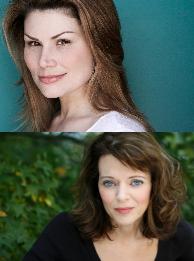 One-person musicals are a rare thing, so do we have a case for “lyric” musical theatre? I think we do, but perhaps these musicals represent the minority of musical theatre and perhaps theatre-makers have yet to make the most of what a “lyric” musical theatre can offer. Look, for example, at the kinds of musicals being created as a part of the Inner Voices: Solo Musicals presentation. Certainly, cabaret-style presentations like Bea Arthur’s Just Between Friends or Elaine Stritch at Liberty fall into this category, but shows like Mosaic and Whida Peru: Resurrection Tangle (which will be performed by Heidi Blickenstaff and Judith Blazer, pictured right) take us into the realm of original narrative musical theatre, which is my particular realm of interest.
Any other suggestions of musicals that might be categorised as “lyric”? Head over to the comments box.


SONDHEIM ON SONDHEIM Photographs
Sondheim on Sondheim is the Roundabout Theatre’s new musical revue that aims to give the audience “an intimate portrait of the famed composer in his own words… and music”, using exclusive interview footage to gain an inside look at Sondheim’s personal life and artistic process. Here are the first official production photographs, taken by Richard Termine.
Conceived and directed by James Lapine, the production features Barbara Cook, Vanessa Williams, Tom Wopat, Leslie Kritzer, Norm Lewis, Euan Morton, Erin Mackey and Matthew Scott.
As followers of this blog might know, I haven’t been a punter of this show, despite being a fan of Sondheim’s work. I’m still not enamored by the idea of it all. Roundabout’s marketing of the show, first as an original musical – it’s not, it’s a revue and as such doesn’t deserve a nod in the “Best Musical” category or in any of the acting categories, for that matter – and now as an evening that is unique in its intent when it’s basically an updated Side by Side by Sondheim from a slightly different perspective with a bigger technical budget, hasn’t help to win me over either. The most intriguing part of the whole thing is the video material featuring the Sondheim interviews. I wouldn’t mind seeing those interviews ported onto DVD, but let’s lose the revue performances and replace them with archival performances from the actual shows or, when that kind of material isn’t available, with filmed reproductions of the songs as they were originally seen in their original productions. As they were meant to be seen.