NEWSFLASH: Carly Rae Jepsen to Star in CINDERELLA on Broadway

Carly Rae Jepsen

Above: Carly Rae Jepsen

BroadwayWorld has just reported that Carly Rae Jepsen, the singer of the catchy pop hit “Call Me Maybe”, will take over the role of Ella in the current Broadway production of Cinderella, the new take on the classic Rodgers and Hammerstein television musical which features a book by Douglas Carter Bean.

Personally, I’m pretty excited about this news. I loved “Call Me Maybe” and also Jepsen’s collaboration with Owl City, “Good Time”. And it seems she has a musical theatre background too, with Jepsen saying that she has musical theater training in singing, dancing and acting.

Jepsen’s tweets over the past couple of hours have captured her excitement about being cast as Ella. One of the most recent features a shout-out to the current Ella, Laura Osnes:

Dear @LauraOsnes I think you are truly lovely. Big shoes to fill! It’s an honor to try on the Cindy shoes! Xoxox

Now I’m certain there will be a lot of backlash on the Internet, just as there was for Carrie Underwood when she was cast as Maria in The Sound of Music Live. But for better or worse, I’m in Jepsen’s corner on this one. I hope that she’ll be great, and I’ve got a feeling she will be. I’m looking forward to hearing her sing those wonderful Rodgers and Hammerstein tunes like “In My Own Little Corner”, “Ten Minutes Ago” and “A Lovely Night”.

Posted in Newsflash | Tagged , , , , , , | Leave a comment

High School Musicals, or “Is Show X Appropriate for My Students?”

RENT Article

Above: A newspaper article about a controversial high school production of RENT

This question of which shows are appropriate for high school productions is a popular one on musical theatre forums and in Facebook groups about musicals, and has even been the subject of a few stories that have captured the attention of the press and websites. There are many debates to be had about whether Legally Blonde, RENT or Gypsy is an appropriate choice for a high school play, about who should have the power to choose the production and about who should shoulder the responsibility when something goes wrong. Cutting across all of those arguments is one that supersedes them all, and it has to do with the reason why a musical is selected for production at a school.

The root of the problem is when high schools, the audiences who visit high school productions and critics of high school shows, whether in the form of local reporters, bloggers or community members, forget that the primary function of a school production is to educate. That goes for people who are directly involved in the life of the school too.

This is the reason why shows that are beyond a high school student’s abilities get produced, why we see young performers copying the performances of Broadway stars gesture for gesture and inflection for inflection and why people feel that a teenager tackling a complex role should embody that role in all its complexity when – barring the occasional exception – there is some aspect of almost every role that is beyond a high school student’s abilities.

This is also the reason why certain people view junior shows or school editions with snobbish disdain, when the motivation for these shows is to make particularly difficult shows accessible in particular production contexts. The primary purpose of high school productions is to educate the students who attend that high school.

So the question to be asked is: is there a context where a production of Next to Normal, Spring Awakening or whatever production is being considered will be a means to fulfilling the mandate of a school to provide an holistic learning experience for its students? And if the answer is no, or if the show’s content or demands will compromise that environment, then perhaps the selection of the show needs to be scrutinized more closely.

Posted in Commentary | Tagged , , , , , , | Leave a comment

THE SATURDAY LIST: My Favourite TITANIC Songs

TITANIC

Above: The playbill for the original Broadway production of TITANIC

People often ask what one’s favourite song from a show is. When it comes to Maury Yeston and Peter Stone’s Titanic, this is a really difficult topic because so much of the score is wonderful, so I’ll cheat a little and answer it this way…

1. Favourite Song i.t.o. Lyrics

“There She Is”: What I love about this lyric is how it manages to create an image of the ship through words. It’s more than just the choice of words though; it’s about the the choice of words with specific vowel and consonant sounds that help to establish not only the size of the ship but also the feeling of seeing it, without anyone actually seeing it at all. This short piece in the mammoth opening sequence is more effective than any of the establishing shots of the same ship in a certain film that premiered around the same time as this show….

2. Favourite Song i.t.o. Tracks on the OBCR

“Hymn/The Latest Rag:The build in this number is invigorating; the contrast between the hymn and the rag is so much fun; and the counterpoint in the later section of the rag is thrilling.

3. Favourite Song i.t.o. Character Definition

“The Proposal/The Night Was Alive”: While the former section further extends the character of Barret, the latter section draws such a vivid picture of Harold Bride that he becomes one of the most memorable characters in the show.

4. Favourite Song i.t.o. Marriage of Lyric to Music

“No Moon”: I think this song captures the contradictory restless-calm mood of the sequence in which it appears perfectly.

5. Favourite Song i.t.o. Music

“The Collision”: I love how such an understated piece of music communicates such a monumental moment in the narrative. The effect is chilling.

6. Favourite Song i.t.o. Scene Structure

The “To the Lifeboats” sequence from “Getting in the Lifeboat” through “We’ll Meet Tomorrow”: I love how this zooms in and out of the chorus and from character to character, bringing to the fore some of the musical themes from earlier in the show and ending in a unified anthem that makes everyone on the ship equal, at least in terms of the experience in the midst of which they are all caught.

That’s about as close as I am going to get to choosing a favourite song in this show! These days, I find myself returning to my cast album of the stage score -snippets of which you can hear in the playlist below – rather than the film. It’s a moving piece of musical theatre, from the opening sequence to the haunting contra-punctual duet mentioned above “The Proposal/The Night Was Alive”, from the exquisitely structured sequence at the end of the first act (where the ship hits the iceberg) to the chilling lifeboat sequence that climaxes with the stirring anthem, “We’ll Meet Tomorrow”. And any of these is many times better than “My Heart Will Go On”…

Posted in The Saturday List | Tagged , , | 6 Comments

Not the Very Model of a Gilbert and Sullivan Fan

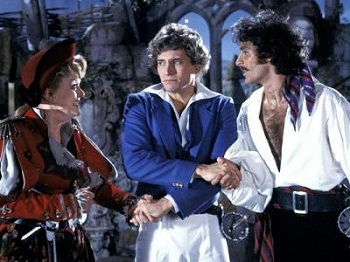
THE PIRATES OF PENZANCE

Above: The Joe Papp production of THE PIRATES OF PENZANCE

I was browsing through the MTI catalogue on their website today and stumbled upon the licensing page for the Joe Papp/Public Theatre version of The Pirates of Penzance. This made me think once again about the much revered comic operas of Victorian-era librettist and composer W. S. Gilbert and Arthur Sullivan and about why they’ve never become favourites of mine.

Look, I’ll be the first to admit that I’m no Gilbert and Sullivan expert, but I find I can only manage their work in small doses. I appreciate the popular songs (“I’m Called Little Buttercup”, “Poor Wand’ring One”, “I am the Very Model of a Modern Major-General” and so on)as well as the big trios and other ensemble numbers of assorted sizes (like “Three Little Maids from School are We”, “Come, friends, who Plough the Sea” and “We Sail the Ocean Blue”). I understand the importance of their work in relationship to the development of musical theatre. I completely get the significance of Patience when it comes to the issue of gay representation in musical theatre. And I loved the “HMS Yakko”, the Animaniacs short that parodied the HMS Pinafore and The Pirates of Penzance.

But put on a cast recording or DVD of one of the complete shows and I’ll struggle to get through it. I can’t even sit through the cast album of The Hot Mikado without becoming restless. And despite several opportunities to see amateur productions of a few of the shows, I’ve not managed to gather together enough motivation to buy a ticket and get myself there. Perhaps I need to force myself to do so when the next one comes along.

In the meantime, it might be a good idea to go and find the video recording of the Joe Papp version of The Pirates of Penzance in all its bastardised glory and see if I can find a way into the Gilbert and Sullican oeuvre that way. Most of what I’ve read about this version of the show is positive, with an appreciation for its broader, more musical theatre style of comedy, adapted orchestrations, key changes and interpolations. After all, I think it is the style against which I’m grating.

If I do, perhaps I’ll post my reactions as things go along. Properly getting to grips with Gilbert and Sullivan seems like a noble resolution for 2014. Maybe it will prove to be ‘idle chatter of a transcendental kind’.

Posted in Commentary | Tagged , , , , , , , , | Leave a comment

TITANIC vs RAGTIME…

Titanic

Above: The original Broadway cast of TITANIC

Maury Yeston and Peter Stone’s Titanic features one of the best musical theatre scores of the 1990s – but so does Terrence McNally, Lynn Ahrens and Stephen Flaherty’s Ragtime. Off the top of my head, I’d find it difficult to compare the two right now, merely because I haven’t spend an comparable amounts of time listening to both scores recently, so my ear is likely to favour Titanic because that’s the show I’ve listened to most, most recently. It’s also tough for me to look at the two musicals objectively, because I know that I have a personal preference for Titanic, because of its subject matter. But let’s try and get past that for now and see what’s cracking beneath the surface.

Both shows represent the best work of each respective creative team. The two shows are brilliantly evocative of period music and Ragtime has just as many musical highlights as Titanic: moving ballads like “Your Daddy’s Son” in the former and “In Every Age” in the latter; stirring character driven moments (“Coalhouse’s Soliloquy” and and “The Proposal/The Night was Alive”; a touching marriage of music and lyrics in songs (“New Music” and the “Autumn”/”No Moon” sequence); and at least one evocative love song each in “Sarah Brown Eyes” and “Still”.

RAGTIME

Above: Audra McDonald in the original cast of RAGTIME

At the same time, neither score is absolutely perfect in every way. Both have flaws, different kinds of flaws to be sure, but they’re there all the same. So I’m not sure that either edges out the other in the final analysis when it comes to the scores alone, but – if it were on the table – I’d happily agree that both of them have scores that are better than that of Parade, which is set during a similar time period in history and shares some musical vocabulary with Titanic and Ragtime. (Isn’t it interesting to note the overlapping timelines of these three prominent musical theatre scores from the 1990s, along with Assassins and Floyd Collins? I think that this kind of overlap is a natural phenomenon in musical theatre. Something about a particular show really appears to resonate with an audience and then a run of shows that are set in similar time periods appears. In the 1940s, there was a yen for “historic” Americana-styled musicals, like Oklahoma!, Carousel, Annie Get Your Gun, Bloomer Girl and so on. From the end of the 1970s into the 1980s, there began a run of musicals set in 19th Century Europe with their roots in operetta, like Sweeney Todd, Les Miserables and The Phantom of the Opera. In the 1990s, things converged around this turn of the century setting.)

Ultimately, I’d say Titanic and Ragtime probably on par with one another, although their styles and intentions are so divergent that it does become complicated to look at the two side by side, despite some of the similarities between the two. Still, such a comparison might make for interesting reading….

Posted in Commentary, Theatremaking | Tagged , , , , , , , , , , , , , , , , , , | 1 Comment

EVITA: the “Montage”

Angela Kilian as EVITA in South Africa

Above: Angela Kilian as EVITA in South Africa

I’ve been listening to recordings of the classic Andrew Lloyd Webber-Tim Rice musical recently and as usual, I’m left wondering whether the “Montage” that takes us from Eva’s final collapse through to her deathbed is really a satisfying moment dramatically. No doubt that it can be, as it was conceived in Hal Prince’s original production, as a kind of coup de théâtre bridging “Eva’s Final Broadcast” with the “Lament”, but what does it really accomplish dramatically?

Andrew Lloyd Webber and Tim Rice faced a similar problem in their earlier musical, Jesus Christ Superstar, when they wanted to contrive a moment in which the audience could question whether Jesus’ sacrifice was a worthwhile one. They put the words into Judas’ mouth, writing the song “Superstar”, which achieved that intention in an innovative manner. In contrast, the “Montage” in Evita is lazy, lazy dramaturgy: it is a shortcut and plays as nothing more, despite what Harold Prince was able to do with it in his staging. It is Prince’s staging and that of those who follow in his footsteps that makes the number work; the number doesn’t really contribute much based solely on its own merits.

The film dispensed with the “Montage” and did not feel incomplete without it. Is it perhaps this great show’s greatest flaw?

Posted in Commentary, Theatremaking | Tagged , , , , , , | Leave a comment

TITANIC Lyrics: Some Thoughts

Titanic

Above: The original Broadway cast of TITANIC

Although I’m a fan of the show, Maury Yeston and Peter Stone’s Titantic has its critics. One of the most common criticisms I’ve heard in regard to the show has to do with its lyrics. So I thought I’d give the cast album another listen with this particular focus at an entry point.

Generally speaking, I don’t find the lyrics to be bothersome, although there are a few instances – fewer than a dozen, I’d say – where the lyrics certainly pull you out of the drama long enough to do a double take, merely because of something that doesn’t sit quite as well on the music as it should, because of a scansion that doesn’t work itself out properly, because of something grammatical that isn’t quite right or because of other little problems that get in the way of the expression of the thought in the lyrical line. But they’re fairly minor, isolated moments for the most part – for example, this misstep in the lyric for “Mr. Andrews’ Vision” in this section of the song:

And then it filled to the top
Our separate watertight compartments
And began to overflow…
Because the walls in-between the compartments
Are too low!
She’s only sinking because these buildings
Stop a deck too low!

There’s a problem with the scansion here as well as with the way the lyric sits on the music. It’s awkward and self-conscious and pulls you out of the drama when you’re listening to that part of the song because you’re aware that something is not right, even if you’re technically not aware of what it is.

TITANIC

Above: The original cast of the Broadway musical, TITANIC

Going into specifics about the more troublesome spots, there are two songs that I feel don’t get where they want to go, lyrically or musically and one that doesn’t quite work insofar as the music is concerned. The two songs are “I Have Danced” and “Still”, and the third piece is “The Blame”.

The problem with “I Have Danced” is that the lyrics veer sharply between overly conversational phrases and somewhat overstated bombast, placed over music that, while lovely, neither supports the shift between these two very different modes nor marries particularly well with what’s going on dramatically. The song almost gets it right by striking a balance between the two towards the end of the number, but ultimately it is an underwhelming piece of character work.

“Still” has similar problems, although here the dramatic statement is far clearer. The sentiment behind the song is a touching one: simple, straightforward and about as emotionally honest as you can get. But Yeston tries to play around with the words too much, losing the simplicity of the thought and undermining the emotional truth of the moment by doing so, and the music sounds strained when it should soar and allow the characters transcend their doomed reality. The song begins to go where it needs to in the bridge; if only the rest of the song could get there too, it would be a perfect number.

“The Blame” get the lyrics right and much of the song’s musical composition supports what is going on – but it’s ultimately not specific enough throughout when it comes to the music. Because the song tries to stick too tightly to a structural pattern, each character ends up repeating blocks of melody established by another character. This could be used to great effect, but in this case it remains a proposal that hasn’t really been fleshed out in the song itself. It’s as if dialogue that existed between the characters was planted onto an established composition, without any thought as to whether the music matched up perfectly with what each specific character was saying and feeling in every moment in the song, so characters who are facing off in this scene sound like they’re agreeing at times or sound less connected emotionally than they should be. Basically, the music doesn’t completely fulfill its task in conveying what’s going on dramatically in the scene in a specific and complex fashion in certain parts of this song.

Other than that, I feel that Titanic remains, more than a decade later, a remarkable score with some memorable lyrics.

Posted in Commentary, Theatremaking | Tagged , , , | Leave a comment

Forgotten Musicals Friday: BABY

BABY

Above: The original production of BABY on Broadway

My sister is pregnant and we just found out she is going to have a little girl, so of course, the musical Baby has been on my mind this week.

Baby has a fantastic score – thank goodness for the cast album which showcases some great numbers (“The Story Goes On”, “The Ladies Singing Their Song”, “I Chose Right”, “Baby, Baby, Baby” – you could go on and on) – but the book of the show has always been a problem. I guess the show never decides if it’s going to be a concept musical or a book musical and flounders somewhere in between, never fully serving the characters it presents or the drama inherent in the process of pregnancy and childbirth. The score of the show is the main reason why the show has remained popular over the years; indeed, the publication of the vocal selections has seen the show’s songs work in many a cabaret setting, which is where David Shire and Richard Maltby Jr’s work seems to play best. The original 1983 book is something you have to deal with to make the show work.

Of course, the show has gone through a process of revision during several workshops during the last fifteen years. The first of these, which took place in the Roundabout rehearsal studios in 1999, made the following changes, as documented by Sean McGrath and Kenneth Jones on Playbill:

Unlike the original production, the workshop script has the older of the three women (Arlene, played by Cass Morgan) losing her baby to a miscarriage and shows the couple (the husband, Alan, is played by Richard Muenz) struggling with the loss.

The score has not changed considerably, but some lyrics have been altered. Reprises of “Fatherhood Blues” and “I Chose Right”, and a restructuring of “Two People in Love”, were added in rehearsals. Arlene’s searching ballad, “Patterns”, cut in Broadway previews but recorded on the cast album, has been reinstated. The number, heard in Maltby and Shire’s revue, Closer Than Ever, is generally considered one of Maltby’s strongest and most character-rich lyrics.

Another workshop was done with LaChanze in 2002 and there were rumours of the show appearing in the 2003-2004 Roundabout season and that version of the show (billed as the 20th Anniversary Production) played the Paper Mill Playhouse in 2004. Another reading was done for Roundabout, this time with Victoria Clark and Michael Rupert and a concert with Faith Prince, Alice Ripley and Kerry Butler was produced in LA last year. In 2006, Maltby also mentioned another reading of the show with Clark and Anika Noni Rose on Playbill:

We [recently] did a reading with Victoria Clark and Anika Noni Rose, and it looked liked the Roundabout was going to do it, but it didn’t work out.

As it turned out, Clark did yet another reading of Baby, this time a staged reading at CAP 21.

All this has me wondering how the revised version of the show plays. Did anyone here see any of the revised productions? What do all of you think about the show? I’d love to hear what you think!

Posted in Forgotten Musicals Friday | Tagged , , , , , , , , , , , , , , , , , , | Leave a comment

CHARLIE AND THE CHOCOLATE FACTORY: 2013 OCR Track by Track – Part 1

While Marc Shaiman and Scott Wittman were hoping for a golden ticket with their new musical based on Roald Dahl’s Charlie and the Chocolate Factory, not everything has turned out as well as expected in Willy Wonka-land, with the show drawing mixed reviews from London critics and unfavourable comparisons with the beloved but almost universally overpraised film musical, Willy Wonka and the Chocolate Factory. The original cast recording of the musical has just been released and what follows here is an in-depth, track-by-track discussion of the original cast recording, focusing on what the score has to offer. I have not seen the show in its West End production, so I shall be basing my overview on what is represented on the recording, working with a synopsis to gain some sense of the dramaturgical contributions made by the music and lyrics to the show.

Those who do not know the story of Charlie and the Chocolate Factory at all should be able to make sense of things as this analysis continues, but you might find it useful to read the original book by Roald Dahl or watch one of the two films, either Willy Wonka and the Chocolate Factory or Charlie and the Chocolate Factory, to familiarise yourself with the story. Although some of the specifics differ from version to version, you’ll get the gist of what’s going on as the main thrust of the story is generally the same. Here is what you need to know to get started: the show tells the story of a little boy named Charlie Bucket, who lives in the UK with his family, who are not very well off. When famous chocolatier, Willy Wonka, launches a competition for five children to visit his factory, Charlie’s life is changed forever.

You will notice a series of numbers in blocks at the bottom of this article. These can be used to navigate between the different sections of this review.

1. “Opening”

Charlie and the Chocolate Factory opens with a musical motif that seems destined to appear in the trailers of splashy fantasy films, but which will actually turn out to be the melody for the singing of Willy Wonka’s name when the children all arrive at the chocolate factory near the end of the first act. The short scene that follows is underscored with a music box styled waltz variation on the melody for “A Little Me”, one of the songs in the second act. In that scene, a tramp speaks to Charlie about the way that people litter, setting up the number which will introduce and establish Charlie to the audience in just a few moments. The tramp is played by Douglas Hodge, so one must conclude that he is meant to be Willy Wonka in disguise, which implies that Willy Wonka has been watching Charlie for some time with the idea of him taking over the factory. This idea – one not taken from the book – is reinforced later on during the first act, but is it an effective one? If Willy Wonka has pre-selected Charlie to take over the factory because he already knows his character because of incidents like this, then why go through the exercise that makes up the narrative of the story at all? Because it’s – as the show says later on – ‘simply second nature’ for him to make life interesting? That’s not a good enough reason to water down the dramatic tension of the plot right at the start nor is it a great moment of character definition, only serving to make the slightly creepy Willy Wonka appear a little bit more sadistic than he already is and not leaving Charlie anywhere to develop as a character, because he doesn’t prove his worth to take over the chocolate factory during the show, but is completely ready right at the start.

2. “Almost Perfect”

“Almost Perfect” is a song used to introduce Charlie to the audience and define the character in terms of the way that he views the world. It is his imaginative approach to things that catches Willy Wonka’s eye and this song spins the old saying that one man’s trash is another’s treasure to show how Charlie (sung on the recording with über-cute vocals by Jack Costello) sees things.

The song follows a typical AABA structure, which can be broken down as follows:

  • A B C D (Two verses with a variation in line 4 of the second verse and a chorus, with an extension)
  • A B C D (Two verses and a chorus, with the extension being instrumental this time)
  • E (A bridge, working with the same meter used for the verse)
  • A B C D (Two verses, with the second one developed, and extension used as a button)

Shaiman and Wittman play fairly freely with the structure, popping in extra syllables as it suits them, which makes the true developments and variations on the structure less noticeable and thus less effective as a medium for storytelling. In other words, the structure of the song as a scene is compromised by their lack of meticulous craftsmanship in this song. Some of their distracting deviations include the addition of the word “but” at the end of line 2 in the first B section and that of “it’s” at the start of the second C section.

In the second ABCD chunk, the A and B verses are varied. This indicates a growth in the complexity of the imaginative games Charlie is playing with the rubbish in the dump. He has moved on from being practical, to using the odds and ends he has found in symbolic ways. The first variation occurs in the second line of the A section and it is a pity that structural variation isn’t carried through into the second line of the B section as this is an effective storytelling technique. The second variation is a build in the line leading into the C section, an accumulation of syllables that supports Charlie’s growing excitement.

The bridge makes use of a similar metrical pattern to the verses, but employs a new melody that pushes Charlie’s symbolic games into full on imaginative role-play as he imagines the ending to the ‘book with missing pages’. It’s at this point where Shaiman and Wittman introduce the idea of chocolate in a song lyric for the first time, as a kind of measure for Charlie’s ultimate happiness. This builds up to the idea used in the final ABCD chunk, where Wonka chocolate bars appear falling from the stars. There’s something a little forced about all these mentions of chocolate, just as the idea of a roving sweet stall in a rubbish dump and the focus on chocolate wrappers amongst all the other waste in the dump were in the first scene, an indicated rather than organic piece of storytelling.

The final verse incorporates one of the things that bothers me quite a bit when Charlie sings that ‘Mr Wonka shall decree every candy shall be free.’ American lyricists tend to think that British people say shall instead of will. The rule is not that simple and can be summed up in the little chant, ‘I shall, we shall, all the rest will.’ So Oscar Hammerstein had it right when he wrote ‘shall we dance’ and ‘shall we fly’, but then errs with ‘shall you be my new romance’. Shaiman and Wittman make that same mistake here. A counterargument for this criticism is that characters don’t necessarily have to speak or sing using correct grammar, which is absolutely correct, with the proviso that a character’s diction is an important tool for characterisation. Having a character use incorrect grammar is as much a choice as using correct grammar. In both of these cases the choice of words is to help define or deepen the audience’s sense of the character’s nationality, so it is an error for me. (And “Wonka will” would sing better than ‘Wonka shall’ too!)

While we’re on the subject of diction, I must raise the question of whether the word ‘connoisseur’ a little earlier in the song is too complex a word for young Charlie or whether it’s just a handy word to use as an internal rhyme for ‘pure’. Come to think of it, is the word ‘pure’ appropriate to describe sweets? I’ve never heard anyone judge the quality of candy by its purity.

The final chorus and uses a variation to bring Charlie’s role play to a climax and then pull him out of it when the whistle blows, smartly reversing the ‘how d’ja do’ and ‘goodbye’. This takes Charlie home to the one-room shack where he lives with his parents and grandparents on a diet of cabbage soup.

Posted in Features, In Depth Analysis, Track by Track | Tagged , , , , , , , , | Leave a comment

The Saturday List: 6 Sweet Musicals of the 1960s

Ready to take five, dude? This is a list of 6 of my favourite musicals of the 1960s, with slang courtesy of Fifties Web. Click on the title of each musical to scope out other blogs on Musical Cyberspace about each show.

6. Oliver!

I have a bit of a soft spot for Lionel Bart’s Oliver! and my love for the material grows every time I see the film. Some say the show whitewashes its Dickensian source material, but that doesn’t bother me too much in this case. There’s no firm requirement for the intentions of an adaptation to align with the intentions of the source material anyway. My first exposure to the show was through playbills, looking at pictures of different productions, but other than that Oliver! wasn’t a big part of my childhood in the way that The Sound of Music, My Fair Lady or South Pacific were. That’s because my grandmother never had an LP of the cast recording or soundtrack and it was when I was set down for naps that I was first played albums of show tunes. Although things are a bit hazy, I think I learned some of the songs from sheet music before hearing them for the first time, first on what I remember as a rather square recording from JAY/TER (perhaps it deserves another listen), and then on the Original London Cast Recording, with Ron Moody and the fabulous Georgia Brown, which won me over completely. But it is the film that impresses me the most when it comes to Oliver!; its excellence almost catches me off guard each time I watch it. The key moment that shifts the film into a higher gear is when “Oom-Pah-Pah”, which in the show is a simple diegetic song that opens the second act in a jovial fashion for no other reason than to provide and emotional contrast to the upcoming “My Name”. In the film, the song underscores a vital piece of plotting and is used to thrown Sikes and Fagin off Oliver’s trail. Moments like that, along with the fantastic cinematography, some wonderful musical staging and a fantastic cast, are what make Oliver! a killer adaptation of a gas of a show.

5. Hair

Hair is a show that has be done properly, otherwise one is just left wondering why the show had any sort of impact in its original run. Either that, or you’re left thinking that the 1960s really was all show and no go. Wondering how the show plays to contemporary audiences has been an idea with which I’ve flirted ever sing I saw a revival of Hair in Cape Town in 2007, directed by Paul Warwick Griffin. I felt that his production didn’t quite work, due to an attempt to mould the show into a more conventional narrative storytelling mode with a very overt link to the then-current wars being fought by America in the Middle East. I don’t think its a viable choice to try and shift the form of the show as its written – although that was certainly a major adaptation technique used when the film was made, but that was an adapatation of the material not simply a new production of it – and I think that adding stage business that links the show current wars simply comes off as a contrived was of justifying a production of the show in the 21st century. It is a choice that dilutes the power of metaphor in the theatre. The best way to do the show, in my opinion, is to play it straight and let it all hang out – pretty much like we see in the clip below, which was a performance at the Tony Awards of the 2009 Broadway revival of the show. The energy is spot on. I’m also convinced that this isn’t a show that fits within the bounds of a traditional proscenium arch stage. Moving into the audience like we see in the clip is great, but ideally I think the respective stage and audience spaces need to be physically merged into one where audience and cast are all celebrating the Age of Aquarius together, as one, as part of the great big hippie spirit in the sky.

4. Camelot

While it is Alan Jay Lerner and Frederick Loewe’s most deeply emotional show, Camelot is doomed to be something of a flawed masterpiece. Due to its complicated production history,the show has never really found a definitive form. At first, audience struggled to pinpoint the emotional throughline of the show. They can’t be blamed. How does one reconcile “How to Handle a Woman?” with the silly Morgan Le Fey subplot anyway? A prologue, added later, helped audiences to reconcile the tone of the start of the show with its ending. If only, somewhere on the troubled road to its initial production, someone had pruned away the excesses that haunt Camelot even today, especially given that the delightful “Then You May Take Me to the Fair” managed to be cut during the run of the original production instead, then the show might been a truly ace show. Instead – and I suppose it isn’t the worst compromise – Camelot is an incredibly moving musical that has come to define an era in American politics, one that we all know is riddled with imperfections, but which we love anyway.

Posted in The Saturday List | Tagged , , , , , , , , , , , , , , , , , , , , , , , , | Leave a comment