
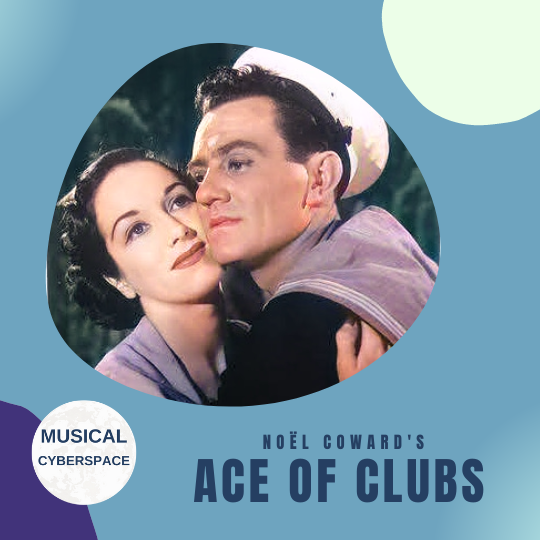
Ace of Clubs must have surprised audiences in 1950 when this show opened in London on this night so many years ago. Following tryouts in Manchester, Liverpool and Birmingham, the show formally debuted in the Cambridge Theatre for a 211-performance run. At the time, Noël Coward was known for his satirical upper-class comedies, but Ace of Clubs was about showgirls and sailors caught up in a heist at a nightclub in Soho. There are those, I suppose, who think that’s why the show had little impact in the mid-century British musical theatre scene, why it never travelled and why it is almost never revived. The fact is that despite some appealing songs, the show just isn’t all that great.
Ace of Clubs is set in 1949 in an eponymous London nightclub, where Pinkie Leroy, a singer, falls in love with a sailor, Harry Hornby. Pinkie and Harry get mixed up with some gangsters who are meant to intercept a package with a stolen diamond necklace at the club. The show plays out through a series of madcap encounters before an inevitable happy ending is reached.
When considering the show, musical theatre historians think that its big flex is that some of the songs were so great that they would be incorporated into Coward’s cabarets and even into other shows. That’s all fine, but it signifies the main problem with Ace of Clubs. The songs feel like they’re from a different show from the one described above, as though they are respites from the plot rather than extensions of it. Listening to the cast recording alone, for example, might leave one mystified, something that can’t be said of Oklahoma!, which was still going strong in London at the time and to which it was compared in some reviews. Indeed, a little digging reveals that the score had been created for a different show known at various points as Over the Garden Wall, Hoi Polloi and Come Out to Play. Coward had failed to sell this earlier show to a producer, so one wonders whether the marriage between the book and score had been any better when he originally conceived them.
Nonetheless, if there is any reason to remember Ace of Clubs, it is for a handful of standout songs. There is the enduring “Sail Away,” which would eventually become the title song of its own show, at least one gorgeous ballad in “I’ll Never Never Know,” and several cute comic ditties like “Napoleon” and “Chase Me, Charlie” – Pinkie’s nightclub numbers – and “Three Juvenile Delinquents” – a number that poked fun at the modern judicial system. The recordings of the original cast are also quite delightful, especially Pat Kirkwood and Graham Payn’s performances of their numbers.
Ace of Clubs is an undemanding historical footnote in musical theatre history. It’s not first-rate Coward, but it is a first-rate lesson in what happens when the different elements of a show just don’t come together.


It was revived with a student cast in Oxford in about 1983.