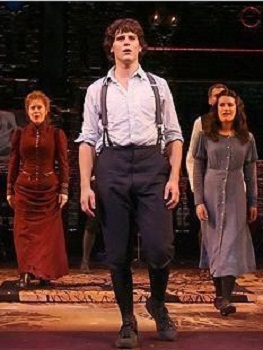
SPRING AWAKENING on Broadway
With the Broadway transfer of Duncan Sheik and Steven Sater’s
Spring Awakening having opened last weekend and the cast recording having been released earlier in the week, now seems an apt time to have a look at some of the changes that have been made in the show between its Off-Broadway run in August and now. One of the these is a revision of the lyrics of “The Song of Purple Summer”.
The new lyrics are tighter in that they are more clearly connected to the narrative of the show and allow the song to offer a more satisfying resolution. That said, I miss the “butterfly” verse, which offers such lovely imagery and communicates the idea of how something small and apparently ineffectual, like a child, can actually have a great impact on the world that surrounds it. Still, the introductory verse compensates for that somewhat:
Listen to what’s in the heart of a child
A song so big in one so small
Soon you will hear where beauty lies
You’ll hear and you’ll recall
The sadness, the doubt, all the loss, the grief
Will belong to some play from the past
As the child leads the way to a dream of belief
A time of hope through the land
A summer’s day
A mother sings
A song of purple summer
Through the heart of everything
And heaven waits
So close it seems
To show her child the wonders
Of a world beyond her dreams
The earth will wave with corn
The day so wide, so warm
And mares will neigh
With stallions that they mate
Foals they’ve borne
And all shall know the wonder
Of purple summer
And so I wait
The swallow brings
A song of what’s to follow
The glory of the spring
The fences sway
The porches swing
The clouds begin to thunder
Crickets wander, murmuring
The earth will wave with corn
The day so white, so warm
And mares will neigh
With stallions that they mate
Foals they’ve borne
And all shall know the wonder
I will sing the song of purple summer
All shall know the wonder
I will sing the song of purple summer
And all shall know the wonder
Of purple summer
Of course, the choice to use colours in Spring Awakening in an evocative, expressionist manner is always so interesting to think about. I really enjoyed listening to all three versions of this song (the demo, the first show version and the subsequent revised version) and pondering on why the summer that is to come is purple. Purple is a colour that is, of course, connected with death in some cultures, but it also is commonly used to evoke a sense of shared wisdom, of friendship, of passion and sexuality, and of contrition and sympathy. Lovely things to consider while listening to the song.
I am less convinced by the staging of the song in the production currently seen on Broadway: although the song is a moral song, like “Children Will Listen” in Into the Woods, the stand still and sing out to the audience staging doesn’t quite work here. The shift in placing mid-way through and the tentative gestures and connections between the actors seems to be an acknowledgment of that sense. This song is about making connections, about a time when everything comes together, and the staging does not reflect that well enough for me and therefore dilutes the song’s power on stage.

 Variety has run with an interesting article on the re-integration of musicals into popular culture. The full article is available


 Musical Cyberspace
LITTLE WOMEN: a Missed Opportunity?
LITTLE WOMEN
I was giving the cast album of Little Women, a show that has not made much of an impact on me in the past, another spin in the CD player recently and was, as ever, frustrated by what Mindi Dickstein and Jason Howland brought to the score of their adaptation of this much-beloved classic. I have a soft spot for the novel and have always thought that the novel had the potential to be a great musical, but this is not it.
During this listen, I wondered what the reviews of the Broadway production were like and found this evaluation of the show in Time. The overall tone of the review is positive, but the piece ends with a decidedly unambiguous slating of the score:
Calling Little Women the most adult new musical of the season is damning the show with faint praise, considering that the only other new musicals that had opened by the time that Little Women premiered were Dracula and Brooklyn. The truly worthwhile new musicals of that season all opened after that. Of course, Zoglin didn’t have the advantage of knowing that when he wrote his review – but it does make me chuckle to think that his statement in this case really only holds true if you don’t know the context of the season in which Little Women was produced.
Oh well, the novel is in the public domain, so perhaps someone will take another shot at some point. Of that much, Louisa May Alcott’s stories about Meg, Jo, Beth and Amy are most certainly worthy…