CHARLIE AND THE CHOCOLATE FACTORY: 2013 OCR Track by Track – Part 1

While Marc Shaiman and Scott Wittman were hoping for a golden ticket with their new musical based on Roald Dahl’s Charlie and the Chocolate Factory, not everything has turned out as well as expected in Willy Wonka-land, with the show drawing mixed reviews from London critics and unfavourable comparisons with the beloved but almost universally overpraised film musical, Willy Wonka and the Chocolate Factory. The original cast recording of the musical has just been released and what follows here is an in-depth, track-by-track discussion of the original cast recording, focusing on what the score has to offer. I have not seen the show in its West End production, so I shall be basing my overview on what is represented on the recording, working with a synopsis to gain some sense of the dramaturgical contributions made by the music and lyrics to the show.

Those who do not know the story of Charlie and the Chocolate Factory at all should be able to make sense of things as this analysis continues, but you might find it useful to read the original book by Roald Dahl or watch one of the two films, either Willy Wonka and the Chocolate Factory or Charlie and the Chocolate Factory, to familiarise yourself with the story. Although some of the specifics differ from version to version, you’ll get the gist of what’s going on as the main thrust of the story is generally the same. Here is what you need to know to get started: the show tells the story of a little boy named Charlie Bucket, who lives in the UK with his family, who are not very well off. When famous chocolatier, Willy Wonka, launches a competition for five children to visit his factory, Charlie’s life is changed forever.

You will notice a series of numbers in blocks at the bottom of this article. These can be used to navigate between the different sections of this review.

1. “Opening”

Charlie and the Chocolate Factory opens with a musical motif that seems destined to appear in the trailers of splashy fantasy films, but which will actually turn out to be the melody for the singing of Willy Wonka’s name when the children all arrive at the chocolate factory near the end of the first act. The short scene that follows is underscored with a music box styled waltz variation on the melody for “A Little Me”, one of the songs in the second act. In that scene, a tramp speaks to Charlie about the way that people litter, setting up the number which will introduce and establish Charlie to the audience in just a few moments. The tramp is played by Douglas Hodge, so one must conclude that he is meant to be Willy Wonka in disguise, which implies that Willy Wonka has been watching Charlie for some time with the idea of him taking over the factory. This idea – one not taken from the book – is reinforced later on during the first act, but is it an effective one? If Willy Wonka has pre-selected Charlie to take over the factory because he already knows his character because of incidents like this, then why go through the exercise that makes up the narrative of the story at all? Because it’s – as the show says later on – ‘simply second nature’ for him to make life interesting? That’s not a good enough reason to water down the dramatic tension of the plot right at the start nor is it a great moment of character definition, only serving to make the slightly creepy Willy Wonka appear a little bit more sadistic than he already is and not leaving Charlie anywhere to develop as a character, because he doesn’t prove his worth to take over the chocolate factory during the show, but is completely ready right at the start.

2. “Almost Perfect”

“Almost Perfect” is a song used to introduce Charlie to the audience and define the character in terms of the way that he views the world. It is his imaginative approach to things that catches Willy Wonka’s eye and this song spins the old saying that one man’s trash is another’s treasure to show how Charlie (sung on the recording with über-cute vocals by Jack Costello) sees things.

The song follows a typical AABA structure, which can be broken down as follows:

  • A B C D (Two verses with a variation in line 4 of the second verse and a chorus, with an extension)
  • A B C D (Two verses and a chorus, with the extension being instrumental this time)
  • E (A bridge, working with the same meter used for the verse)
  • A B C D (Two verses, with the second one developed, and extension used as a button)

Shaiman and Wittman play fairly freely with the structure, popping in extra syllables as it suits them, which makes the true developments and variations on the structure less noticeable and thus less effective as a medium for storytelling. In other words, the structure of the song as a scene is compromised by their lack of meticulous craftsmanship in this song. Some of their distracting deviations include the addition of the word “but” at the end of line 2 in the first B section and that of “it’s” at the start of the second C section.

In the second ABCD chunk, the A and B verses are varied. This indicates a growth in the complexity of the imaginative games Charlie is playing with the rubbish in the dump. He has moved on from being practical, to using the odds and ends he has found in symbolic ways. The first variation occurs in the second line of the A section and it is a pity that structural variation isn’t carried through into the second line of the B section as this is an effective storytelling technique. The second variation is a build in the line leading into the C section, an accumulation of syllables that supports Charlie’s growing excitement.

The bridge makes use of a similar metrical pattern to the verses, but employs a new melody that pushes Charlie’s symbolic games into full on imaginative role-play as he imagines the ending to the ‘book with missing pages’. It’s at this point where Shaiman and Wittman introduce the idea of chocolate in a song lyric for the first time, as a kind of measure for Charlie’s ultimate happiness. This builds up to the idea used in the final ABCD chunk, where Wonka chocolate bars appear falling from the stars. There’s something a little forced about all these mentions of chocolate, just as the idea of a roving sweet stall in a rubbish dump and the focus on chocolate wrappers amongst all the other waste in the dump were in the first scene, an indicated rather than organic piece of storytelling.

The final verse incorporates one of the things that bothers me quite a bit when Charlie sings that ‘Mr Wonka shall decree every candy shall be free.’ American lyricists tend to think that British people say shall instead of will. The rule is not that simple and can be summed up in the little chant, ‘I shall, we shall, all the rest will.’ So Oscar Hammerstein had it right when he wrote ‘shall we dance’ and ‘shall we fly’, but then errs with ‘shall you be my new romance’. Shaiman and Wittman make that same mistake here. A counterargument for this criticism is that characters don’t necessarily have to speak or sing using correct grammar, which is absolutely correct, with the proviso that a character’s diction is an important tool for characterisation. Having a character use incorrect grammar is as much a choice as using correct grammar. In both of these cases the choice of words is to help define or deepen the audience’s sense of the character’s nationality, so it is an error for me. (And “Wonka will” would sing better than ‘Wonka shall’ too!)

While we’re on the subject of diction, I must raise the question of whether the word ‘connoisseur’ a little earlier in the song is too complex a word for young Charlie or whether it’s just a handy word to use as an internal rhyme for ‘pure’. Come to think of it, is the word ‘pure’ appropriate to describe sweets? I’ve never heard anyone judge the quality of candy by its purity.

The final chorus and uses a variation to bring Charlie’s role play to a climax and then pull him out of it when the whistle blows, smartly reversing the ‘how d’ja do’ and ‘goodbye’. This takes Charlie home to the one-room shack where he lives with his parents and grandparents on a diet of cabbage soup.
Posted in Features, In Depth Analysis, Track by Track | Tagged , , , , , , , , | Leave a comment

The Saturday List: 6 Sweet Musicals of the 1960s

Ready to take five, dude? This is a list of 6 of my favourite musicals of the 1960s, with slang courtesy of Fifties Web. Click on the title of each musical to scope out other blogs on Musical Cyberspace about each show.

6. Oliver!

I have a bit of a soft spot for Lionel Bart’s Oliver! and my love for the material grows every time I see the film. Some say the show whitewashes its Dickensian source material, but that doesn’t bother me too much in this case. There’s no firm requirement for the intentions of an adaptation to align with the intentions of the source material anyway. My first exposure to the show was through playbills, looking at pictures of different productions, but other than that Oliver! wasn’t a big part of my childhood in the way that The Sound of Music, My Fair Lady or South Pacific were. That’s because my grandmother never had an LP of the cast recording or soundtrack and it was when I was set down for naps that I was first played albums of show tunes. Although things are a bit hazy, I think I learned some of the songs from sheet music before hearing them for the first time, first on what I remember as a rather square recording from JAY/TER (perhaps it deserves another listen), and then on the Original London Cast Recording, with Ron Moody and the fabulous Georgia Brown, which won me over completely. But it is the film that impresses me the most when it comes to Oliver!; its excellence almost catches me off guard each time I watch it. The key moment that shifts the film into a higher gear is when “Oom-Pah-Pah”, which in the show is a simple diegetic song that opens the second act in a jovial fashion for no other reason than to provide and emotional contrast to the upcoming “My Name”. In the film, the song underscores a vital piece of plotting and is used to thrown Sikes and Fagin off Oliver’s trail. Moments like that, along with the fantastic cinematography, some wonderful musical staging and a fantastic cast, are what make Oliver! a killer adaptation of a gas of a show.

5. Hair

Hair is a show that has be done properly, otherwise one is just left wondering why the show had any sort of impact in its original run. Either that, or you’re left thinking that the 1960s really was all show and no go. Wondering how the show plays to contemporary audiences has been an idea with which I’ve flirted ever sing I saw a revival of Hair in Cape Town in 2007, directed by Paul Warwick Griffin. I felt that his production didn’t quite work, due to an attempt to mould the show into a more conventional narrative storytelling mode with a very overt link to the then-current wars being fought by America in the Middle East. I don’t think its a viable choice to try and shift the form of the show as its written – although that was certainly a major adaptation technique used when the film was made, but that was an adapatation of the material not simply a new production of it – and I think that adding stage business that links the show current wars simply comes off as a contrived was of justifying a production of the show in the 21st century. It is a choice that dilutes the power of metaphor in the theatre. The best way to do the show, in my opinion, is to play it straight and let it all hang out – pretty much like we see in the clip below, which was a performance at the Tony Awards of the 2009 Broadway revival of the show. The energy is spot on. I’m also convinced that this isn’t a show that fits within the bounds of a traditional proscenium arch stage. Moving into the audience like we see in the clip is great, but ideally I think the respective stage and audience spaces need to be physically merged into one where audience and cast are all celebrating the Age of Aquarius together, as one, as part of the great big hippie spirit in the sky.

4. Camelot

While it is Alan Jay Lerner and Frederick Loewe’s most deeply emotional show, Camelot is doomed to be something of a flawed masterpiece. Due to its complicated production history,the show has never really found a definitive form. At first, audience struggled to pinpoint the emotional throughline of the show. They can’t be blamed. How does one reconcile “How to Handle a Woman?” with the silly Morgan Le Fey subplot anyway? A prologue, added later, helped audiences to reconcile the tone of the start of the show with its ending. If only, somewhere on the troubled road to its initial production, someone had pruned away the excesses that haunt Camelot even today, especially given that the delightful “Then You May Take Me to the Fair” managed to be cut during the run of the original production instead, then the show might been a truly ace show. Instead – and I suppose it isn’t the worst compromise – Camelot is an incredibly moving musical that has come to define an era in American politics, one that we all know is riddled with imperfections, but which we love anyway.

Posted in The Saturday List | Tagged , , , , , , , , , , , , , , , , , , , , , , , , | Leave a comment

Lost Songs: “Warthog Rhapsody” from THE LION KING

THE LION KING

Before there was “Hakuna Matata”, there was “Warthog Rhapsody”. Thankfully, the song was replaced by the time The Lion King was released. The version in the clip below comes from a commercial spin-off album of music inspired by the film, Rhythm Of The Pride Lands.

There are several reasons why “Hakuna Matata” is a better song than “Warthog Rhapsody”. Let’s take a look at some of them.

“Warthog Rhapsody” is, simply put, second rate, both musically and lyrically. Musically, the number lacks the energy and momentum required by the song that would need to fill that particular spot in film at that point. Even worse, the song sounds like it was churned out by some kind of keyboard programme – formulaic and predictable – and the music overpowers the lyrics, which do not sit well on the melody at all. Not that it matters, because the lyrics sound like Tim Rice trying to force words into a programmed melody. The lyrics are not married well to the music at all. There are missed accents all over the place and some of the vocabulary used is so clearly inappropriate to these characters. The lyrics simply don’t sing, nor do they compel one to listen to what’s being said. They’re completely flaccid, incapable of moving the narrative along in the way they should.

THE LION KING

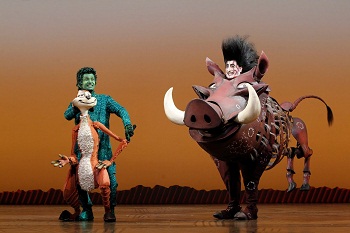
Nick Cordileone as Timon and Ben Lipitz as Pumbaa in the national tour of THE LION KING. Photo Credit: Joan Marcus.

This brings us to the second, more pressing difference between the numbers: “Warthog Rhapsody” focuses squarely on Pumba. One of the key differences between this song and “Hakuna Matata” is that the latter takes forward Simba’s story, which is really what matters here. After all, this is The Lion King, not “The Neverending Saga of Timon and Pumba.”

(Some people object to the fact that “Hakuna Matata” as heard in the final cut of the film doesn’t include the verse about Timon, which was eventually heard in The Lion King 1½. Again, the answer is simple: one does not need to find out about what happened to Timon for “Hakuna Matata” to function as a narrative building block of the film. The basic requirement of the song is that it needs to take the story forward. The version used in the film achieves this and would strain under the weight of an extra verse. Anyway, it is incorrect to say that “Hakuna Matata” focuses solely on Pumba. The song focuses primarily on Simba’s journey and the development of the character: Pumba’s story is merely a means to that end and Timon’s verse would simply be padding out a point that had already been made. The key thing in this song was to figure out how it related to Simba’s journey. What was included in “Hakuna Matata” was enough to do that and enough to take the story forward.)

It’s easy to see why “Hakuna Matata” is a better song for The Lion King than “Warthog Rhapsody” and why the song didn’t find a place in the stage show when it premiered in 1997. The stage show is padded with enough sub-par Elton John and Tim Rice songs as it as, none of which serves the show well at all. Like “Warthog Rhapsody”, they are neither as good as the other additions to the stage score nor are they on par with any of the songs originally heard in the film.

Posted in Features | Tagged , , , , , , | Leave a comment

Review Roundup: BLOOD BROTHERS in South Africa

bbposterDavid Kramer’s adaptation of Willy Russell’s Blood Brothers has opened in Cape Town, South Africa, and the reviews are in! Blood Brothers tells the tale of Mrs Johnstone, an impoverished woman who gives one of her twins to a wealthier woman, Mrs Lyons, in the hope that he will have a better life. Although the brothers are never supposed to know of each other’s existance, fate brings them together, eventually leading to a tragic outcome.

Tickets for the show, which will run at Theatre on the Bay in Cape Town, Montecasino in Johannesburg and the Fugard Theatre in Cape Town, are available through Computicket.

masksyes

Die Burger

“David Kramer het ’n goed ontwikkelde sin vir trefferpotensiaal. Sy jongste inisiatief, naamlik om die Brit Willy Russell se gewilde musiekblyspel Blood Brothers te verplaas van Liverpool in Engeland na ’n Kaapse konteks, spruit juis daaruit. En, as die openingsaand van Blood Brothers enigsins ’n aanduiding is, is hy wéér in die kol.”

Read the full review here.

Cape Argus

“A feat of note. Apart from the brilliance of Kramer’s adaptation, this production is memorable for the quality of its staging. The result is a show to engage its audience from the first bar of the overture to the final tableau.”

This review is not available online.

The Cape Times

“It’s refreshing to encounter a specifically adapted Cape Town story from the 1960’s and 1970’s which doesn’t deal blatantly with race. Examining the tensions between classes and familial bonds makes it a tale everyone can relate to.”

This review is not available online.

Sunday Independent

“Leaving the theatre, one is left feeling nothing but the utmost respect for David Kramer. A heart-rending and intensely unforgettable experience. An accomplished production by an ardent and compassionate creative team, Blood Brothers will appeal to anyone interested in heartfelt and substantial storytelling.”

This review is not available online.

masksno

BroadwayWorld

“The announcement that David Kramer would be adapting Willy Russell’s BLOOD BROTHERS was an exciting one…. Months later, the show is on stage at Theatre on the Bay, and the reality of what has been achieved in this adaptation belies the potential that this version of BLOOD BROTHERS held in its conception. While there are some moments that work beautifully, there are many where the shaky ideological foundation upon which this production is built calls the entire exercise into question.”

Read the full review here.

Posted in Features, Review Roundup | Tagged , , | Leave a comment

Musical Cyberspace: This Week’s Cover

MC Cover 10072013

Posted in Covers | Tagged , , | Leave a comment

The Saturday List: 5 Cookin’ Musicals of the 1950s

What’s buzzin, cuzzins? This is a list of 5 of my favourite musicals of the 1950s, with slang courtesy of Fifties Web. Click on the title of each musical to view other blogs on Musical Cyberspace about each show.

5. My Fair Lady

Some people will tell you that My Fair Lady is perfect. I hate to be the party pooper, but it isn’t. It’s almost perfect and is certainly excellent for the most part, but in the opening number Higgins says that people who use English badly should be hung. And with that one lyric, Alan Jay Lerner contradicts every given circumstance of the character. In, say, Paint Your Wagon the mistake might not matter, given the character in whose mouth the words might be put. But here it matters in spades. It’s not the only linguistic error given to Higgins either, but I suppose we should just remember that Lerner was the Tim Rice of his day and be done with it. (Take a look at “On the Street Where You Live”, where a number of different lyric-writing sins can be found, if you have any doubts.) After all, there is a great deal to appreciate in the show: one of the most joyous overtures ever created, a book that is literary in its quality (thanks to the source material, natch) and many great songs (“I’ve Grown Accustomed to Her Face”, “Wouldn’t It Be Loverly?”, “Show Me”, and the list goes on.) It’s a classic, and it deserves to be. But it’s not perfect.

4. Guys and Dolls

Guys and Dolls. One of the most popular musicals of all time; people go ape for it. Even I’ve been involved in two productions: in high school I played the drunk and the Hot Box MC and danced in “Havana” and “The Crap Shooter’s Ballet” and a few years ago I choreographed a high school production of the show. In the decade between, I’ve seen countless productions announced and produced. Generally, there’s a perception that it’s flop-proof, but I guess the most recent Broadway revival proved that theory wrong. People are ambivalent about the film and, while it’s not perfect, there’s much to enjoy: Brando as Sky, the stunning scene between Sarah and Sky in the mission, Michael Kidd’s choreography and so on. The show itself has a super book by Abe Burrows and the score is – in a word – fantastic. Every number is memorable. For a special treat, get yourself a copy of the African-American 1976 Broadway Revival’s. It’s super, and the numbers are reborn in their new disco and gospel influences arrangements. Of course this is a supplement to either the original Broadway cast recording or the excellent 1995 studio recording of the complete score – one that perhaps sets the standard for all Guys and Dolls recordings.

Posted in The Saturday List | Tagged , , , , , , , , , , , , , , , , | Leave a comment

Angela Lansbury: an Anna for the Ages?

Angela Lansbury

Angela Lansbury in THE KING AND I

Angela Lansbury in THE KING AND I

I’ve often thought about how much I would have loved to see Angela Lansbury in The King and I when she performed in the show opposite Michael Kermoyan on Broadway in 1978. Regular readers of this blog might know that, as far as I’m concerned, Lansbury is the ultimate musical theatre actress: the best Rose Hovick, an unmatchable Mame Dennis, a top class Nellie Lovett and a delightfully despicable Cora Hoover Hooper. She has also played Madame Armfeldt in A Little Night Music, Countess Aurelia in Dear World and the title role in the gigantic Boston flop, Prettybelle. In between all of that she squeezed in just three weeks of performances in The King and I as Anna Leonowens, a role created in 1951 by Gertrude Lawrence and immortalised on film by Deborah Kerr, with more than a little help from Marni Nixon.

The revival opened in 1977 with Yul Brynner and Constance Towers, and Lansbury was brought in for 24 performances while Brynner was out on holiday. Everything I’ve read about her in the role has led me to believe that she was excellent, as have conversations I have had with people who saw her during her brief stint as Anna. Some people rate Lansbury’s version of “Getting to Know You” as their favourite; her “Can I Tell You What I Think Of You?” was reportedly pretty fierce; her dynamic with Kermoyan incredibly effective, with the moment where he takes her waist in “Shall We Dance?” brimming with sexual tension; and her performance in the King’s death scene completely moving.

How I wish there was at least an official cast recording with Lansbury in the role! I say official as, of course, there are bootleg recordings of Lansbury’s Anna. These reveal some fascinating insights into her interpretation of the role.

Angela Lansbury and the children in THE KING AND I

Angela Lansbury and the children in THE KING AND I. Photo credit: Jack Mitchell.

Her take on “I Whistle a Happy Tune”, for instance, radiates sheer joy, the attitude of a woman who, in spite of the trepidation she feels starting out on this huge adventure, feels she has made the right choice, secure in the fact that the King will live up to every aspect of their agreement, which is a very comfortable one. It also shows just how the brave the face she is putting on for her son, Louis. Simply through playing into the emotional quality of the music, Lansbury has given Anna many layers and sets up the motivation for the anger and disappointment she feels in the next scene where the King reneges on his agreement to give her a house of her own. Most Annas play the song as a piece that sets up the whistling punch line to the scene, when Anna is confronted by the convey sent to take her to the palace, thus showing the whistle as an idea that quells her own fears as well as her son’s – which is fine and is supported by the text. Nonetheless, Lansbury’s approach increases the stakes and the complexity of what Anna is experiencing.

Lansbury biographers, Rob Edelman and Audrey Kupferberg, reported in Angela Lansbury: A Life on Stage and Screen that Lansbury felt that playing Anna was ‘the chance of a lifetime for me.’ The role fitted her like a glove and Lansbury used her special talents to restore the narrative balance of The King and I, which had become more about the King than Anna (who is, after all, the protagonist of the tale) owing to Yul Brynner’s electric performance and the way that the connection between him and the role was, at that time, a huge selling point of the show.

For her short spell as Anna, Lansbury was nominated for the 1978 Drama Desk Award for Outstanding Actress in a Musical. I am certain her performance was nothing less than magical.

Posted in Features | Tagged , , , , , , , , , , , , , | Leave a comment

Life of a Song: “Love Changes Everything”

ASPECTS OF LOVE LOGO“Love Changes Everything” is the most famous song from Andrew Lloyd Webber, Don Black and Charles Hart’s 1989 musical, Aspects of Love. Based on Aspects of Love by David Garnett, the show focuses on the romantic and sexual entanglements of a quintet of characters, at the centre of which are actress Rose Vibert and her young admirer, Alex Dillingham.

The song peaked at #2 on the UK singles charts, on which it was featured for 3½ months – no mean feat for a show tune at that point in time. Much of this can probably be attributed to the anthemic feel of the song and its three chord structure. Originally written in G major (around the chords G, C and D), before modulating up to A flat major, Andrew Lloyd Webber transposed the entire song up a key (A major, modulating up to B flat major) to showcase the crystal clear tenor voice of Michael Ball, who introduced the song to the musical theatre canon.

Ball’s stamp on the song is definitive and most male singers who tackle the song – from Michael Crawford to John Barrowman – follow the template laid by this actor-singer, who originated the role of Alex in the stage show. Before we take a look at some of the different cover versions of the song, let’s take a look at the single that was released by the Really Useful Company to promote the show in its original production.

Next: The Tony Awards and Sarah Brightman

Posted in Features | Tagged , , , , , , , , , , , , , , , , , , , , , , | Leave a comment

Musical Cyberspace: This Week’s Cover

MC Cover 09302013

Posted in Covers | Tagged , , | Leave a comment

Musical Theatre Sunday School: LIZA MINNELLI – BORN A STAR Readathon Part 1

This month in Musical Theatre Sunday School, we will have a readathon of Wendy Leigh’s Liza Minnelli biography, Born a Star. Although the book is out of print, you can pick up a fairly cheap copy from Amazon if you are keen to follow along. In the column, I’ll be discussing the sections of the book that deal with Minnelli’s involvement in musicals and – as always – I’d love to hear your thoughts, so head to the comment box below!

Liza Minnellia in BEST FOOT FORWARD

Liza Minnelli in BEST FOOT FORWARD

We all know that Minnelli made her debut in a musical in the movie, In the Good Old Summertime, as Veronica and Andrew’s daughter. Veronica was played by Minnelli’s own mother, Judy Garland. Minnelli’s father, Vincente, was an esteemed film director and the thesis of Leigh’s book is that Liza, having been born a star, could never have led a normal existence. Leigh makes a strong case for her argument in her depiction of Minnelli’s childhood, being shuttled between her mother and father’s respective households, never letting on how much she had to care for her mother in Garland’s darkest periods. While the book is not brilliantly written, with the imagery in Leigh’s prose jumping about all over the place, seemingly contradictory at times, one gets the idea as the book covers the first 16 years of Liza’s life in six quick chapters.

With that noted and this being a musical-themed site, let’s jump ahead to Minnelli’s first big musical, Best Foot Forward in Chapter Seven of the book. (She had appeared in summer stock productions of Wish You Were Here, Take Me Along and Flower Drum Song following her time at the High School of Performing Arts. See Chapter Five.) Best Foot Forward was written in 1941 by Hugh Martin and Ralph Blane, with book by John Cecil Holm and this revival of the high school comedy was mounted Off-Broadway in 1963.

Minnelli auditioned for the role and Arthur Whitelaw, who was producing the show, said that she was the only child from six show business families that auditioned for them that had any talent. I wonder what it must have been like to see Minnelli’s audition at that time. She is described in the book as having been very nervous, physically shaking and appearing quite vulnerable. By all accounts, she also worked very hard during that first period of her life, but it seems to me that Minnelli has always worked hard – even when she was partying just as hard in the 1970s. (Of course, then the partying took the toll on her ability to work hard, but I think the intention to work hard was always there. Just look at how even now Minnelli puts everything into what she does.) During rehearsals for Best Foot Forward, Minnelli fractured one of her feet and soldiered on until the rehearsal was over before going to hospital to have it examined.

BEST FOOT FORWARD

To purchase the Off-Broadway Cast Recording of BEST FOOT FORWARD with Liza Minnelli, click on the image above.

A moving story related to this time period in Minnelli’s life is the story of the opening night, which Garland did not attend. The line given was that Garland had done so purposefully so as not to overshadow Minnelli’s New York stage debut. But Leigh reports an overheard phone conversation in which it appears that Garland either forgot or that something more sinister – although not life threatening – had prevented her from coming. It seems to me, perhaps, that the lack of normality in Minnelli’s life had less to do with being “born a star” than it had to do with dealing with a parent who faced very real problems with addition.

The reviews for Minnelli were great, comparing the ‘haunting overtones’ of her voice to her mother’s (Richard Watts in the New York Post) and noting her appeal and sense of comedy. Minnelli was paid $45 a week for her work on the show.

This chapter closes off with an incident related to Minnelli’s subsequent appearance in the musical, Carnival. Minnelli had suffered a kidney stone attack and Garland tried to prevent her appearance in Carnival, claiming that she was worried about her daughter’s health. While it appears that Minnelli was highly anxious due to Garland’s interference in her career, she did the show anyway – a clear signal to her mother that she was on her own journey now.

That seems like a good place to end for today. More on Minnelli next week, folks. See you then! Happy reading!

Posted in Musical Theatre Sunday School | Tagged , , , , , , , , , , , , , , , , | Leave a comment