March 2022 at Musical Cyberspace is all about songs with people’s names in the title.
“Gigi,” a song about the titular character of the 1958 film of the same name, is a song I first heard when I picked up a piece of sheet music and played it on the piano as a child. By the time I saw the film and heard an orchestra accompany Louis Jourdan’s tentative delivery of Alan Jay Lerner’s lyrics and Frederick Loewe’s melody, I was already sold on the song. Perhaps the lyrics do get a bit overly poetic here and there, but Gaston is a Frenchman so perhaps it can be excused as an expression of character. Either way, I still love it.
As a song, “Gigi” has largely remained within the domain of the musical, on screen, on stage, in concert and in the recording studio, albeit with a couple of jazz covers on the side. Most recently, Corey Cott gave the song a more contemporary musical theatre sound in the flop Broadway revival of the stage adaptation of the film, which I’m not quite sure works for the material. It just doesn’t quite soar. Would someone like Jeremy Jordan or Aaron Tveit do better by the song in these times? Who can say?
That said, the show has never worked on stage and the earlier interpretations by Geoffrey Burridge and Daniel Massey don’t being things home either. Part of the challenge is the song, which basically asks performers to Henry Higgins the charm out of the verse, but then deliver a rich vocal on the more romantic chorus. It is perhaps Graham Bickley who finds the best balance between the two elements of the song on the JAY studio recording of the show. In the end, maybe one just has to return to the OG for Louis Jourdan’s intimate delivery of the song, which works beautifully in context.
Keen to share your thoughts on “Gigi”? Head on to the comment box at the end of this post.
Today we celebrate the birthday of one of the most well known leading ladies of the legit musical theatre era, Elaine Paige. Born Elaine Jill Bickerstaff, she changed her name at the start of her career at her acting teacher’s recommendation. Looking for inspiration, she then quite literally took a “page” from the phonebook and just added the “i”! Let’s take a look at this iconic West End lady’s shining career moments.
5. “With One Look” from Sunset Boulevard
Picking up the lead role of Norma Desmond in Sunset Boulevard with a two-and-a-half week rehearsal, Paige filled in for Betty Buckley who fell ill during the 1995 revival. Her brief appearance as this famous film diva on stage brought her great acclaim and gave us a very memorable rendition of the song “With One Look.” Even though Paige is a small lady (1.5m) she packed more than enough punch for this enigmatic and strong female lead, earning her the full-time role in the following year. Ms Paige is a true example of big explosives coming in small packages.
4. “Anything Goes” from Anything Goes
Paige saw the 1987 Broadway Production of Anything Goes starring Patti LuPone and knew she needed to bring the show to London. Co-producing it with Tim Rice, Paige secured her part in the role of Reno Sweeney and played opposite Howard McGillin. Looking at Paige’s performance of the titular song, one can easily understand why this show brought her a third Olivier Award nomination. With a glint in her eye, crisp and clear intentions and fire in her belly, Paige owns the stage and shows why she is one of the West End’s most beloved leading ladies.
3. “Don’t Cry For Me Argentina” from Evita
Earning the spot in the titular role of the first production of Sir Andrew Lloyd Webber and Tim Rice’s Evita, Elaine Paige, who was then still quite unknown, shot herself into the limelight. Receiving critical acclaim for her performance and her first Olivier Award, Paige was set on her journey of West End stardom. Her performance of “Don’t Cry For Me Argentina” will always remain her beautiful and impactful introduction to the West End.
2. “I Know Him So Well” from Chess
In 1984, Tim Rice and Abba’s Björn Ulvaeus and Benny Andersson created the concept album of the hit musical, Chess. Paige originated the role of Florence Vassy in this 80s rock musical singing opposite Barbara Dickson. The two of them recorded and released the duet “I Know Him So Well” which continued to hold the number one position in the British singles charts for four weeks! This not only speaks to the genius of the score of Chess but also the mastery in which Paige and Dickson sang this beautiful song.
1. “Memory” from Cats
Finally, we come to the pièce de résistance, “Memory” from Cats. Arguably the most memorable performance of Paige (pun most definitely intended) and one which touched the hearts of millions of people and makes you understand why she is known as “The First Lady of British Musical Theatre.” Paige, of course, originated the role of Grizabella in Sir Andrew Lloyd Webber’s Cats and has since remained the standard to which this role is upheld. Watching the 1998 recording of this song, you can’t help but embrace the tears that this beautiful ballad brings to your eyes and Paige’s truthful performance just seals the deal.
Elaine Paige had several other outstanding performances like Anna in The King and I, Mrs Lovett in Sweeney Todd, Carlotta in Follies and many more. She truly is the queen of the West End and has earned the title rightfully so.
Are you a fan of Elaine Paige and want to be heard? Share your most memorable moments from Ms Paige’s career in the comments section below.
Bob Bingham as Caiaphas in the film of Jesus Christ Superstar
March 2022 at Musical Cyberspace is all about songs with people’s names in the title.
“This Jesus Must Die”, from Andrew Lloyd Webber and Tim Rice’s Jesus Christ Superstar, is a creepy little song sung by creepy little men with voices on extreme opposites of the male vocal range. The choice works perfectly to dramatise the moment in which Jesus’ fate is sealed. What also makes sense in a powerful way are the political reasons why Jesus was to be killed. The Bible is very clear on the spiritual reasons, so the shift in perspective away from the traditional narrative offers new layers of understanding to the Christ story. It’s perhaps not the type of song one “enjoys,” but it works like gangbusters in the context of the show.
Given that it has such a specific plot function, “This Jesus Must Die” isn’t one that has a range of recordings outside of the various productions of the show. Thus, the playlist below offers a range of extracts from cast albums and productions of Jesus Christ Superstar.
Keen to share your thoughts on “This Jesus Must Die?” within the context of modern musical theatre classic? Head on to the comment box at the end of this post.
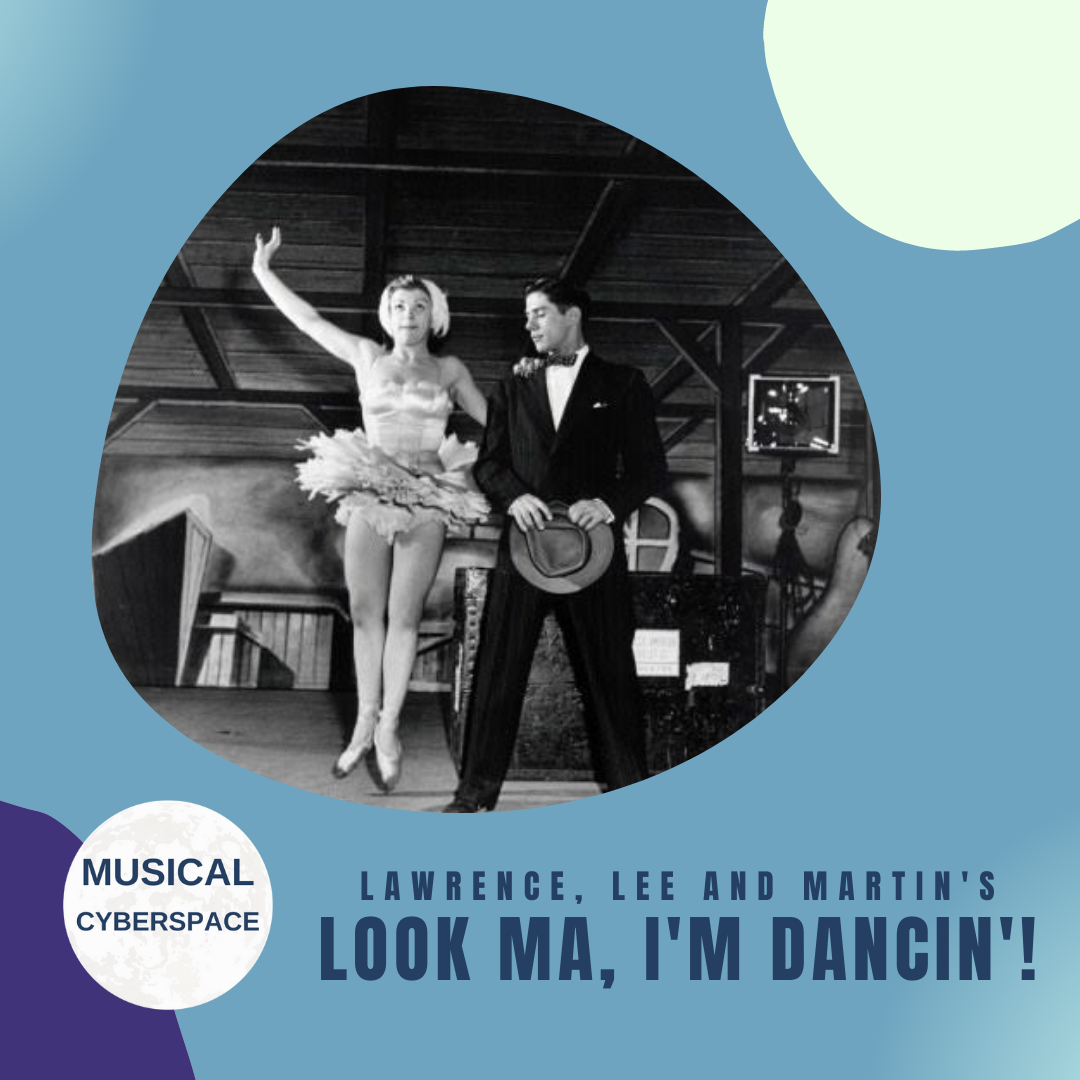
Nancy Walker and Harold Lang in Look Ma, I’m Dancin’!
Welcome back to the site! Why don’t you stay for the night? I could show you my favourite obsession…. Well, it isn’t The Rocky Horror Show. That’s not a forgotten musical. On the other hand, Look Ma, I’m Dancin’! is, one that is so charming that it would be churlish not to shine the spotlight on it here.
Look Ma, I’m Dancin’! is a show that is little more than a footnote on the careers of a whole bunch of entertainment industry legends. Composer-lyricist Hugh Martin had already been nominated for two Academy Awards for his contributions to Meet Me in St Louis and Good News. Book-writers Jerome Lawrence and Robert E. Lee would go on to write the Broadway classic, Mame. Producer-director George Abbott was in the middle of his extraordinary career, while co-director and choreographer Jerome Robbins would go on to help create a string of Broadway classics like West Side Story, Gypsy and Fiddler on the Roof, having already had significant success with On the Town.
While the show wasn’t a great hit, at least it didn’t flop. Although it closed within six months after 188 performances at the Adelphi Theatre in New York, it turned a small profit. Listening to the delightful cast recording makes one wonder why the show has slipped into obscurity because if it has nothing else, Look Ma, I’m Dancin’! has the most wonderful score. There are a number of high points: the characterful tour de force “Gotta Dance,” the hilarious novelty song “I’m the First Girl,” and the jaunty “Shauny O’Shay” among them. Every song is charming and the performances from Harold Lang, Nancy Walker, Sandra Deel and Bill Shirley are fantastic. And yet, Martin felt that the songs he wrote didn’t represent his best efforts and were – in his words – ‘OK.’ He attributed this to his knowledge that he had written some great tunes upfront and that he ‘relaxed a little’ when writing the rest. See the liner notes from the cast album for more details on that.
One also wonders how the Lawrence and Lee book landed? With some autobiographical elements contributed by Robbins, who had already pitched his original ideas to Arthur Laurents, the show follows the wacky misadventures of an heiress who uses the money from the Milwaukee brewery she has inherited to produce a ballet for herself. This puts her on a collision course with an egotistical dancer and choreographer, who is helping to shake up the ballet in his own way. It does recall the joyous comic nonsense of shows from the twenties, so were Lawrence and Lee not able to tailor the free-wheeling content to the taste of audiences in the late 1940s? Would Laurents have brought things together in a way that would have propelled Look Ma, I’m Dancin! to the status of other musical comedy classics? Or was Look Ma, I’m Dancin’ a casualty of the post-Oklahoma! push for integration?
Whatever the reason, it’s a pity this show hasn’t been rediscovered, even if only for a staged concert or something of that nature. If you haven’t listened to the score before, catch some of the highlights in the playlist below – then share your thoughts in the comments section. You won’t regret it!
Mirrors are powerful symbols in Tommy. Just what can he see in them?
March 2022 at Musical Cyberspace is all about songs with people’s names in the title.
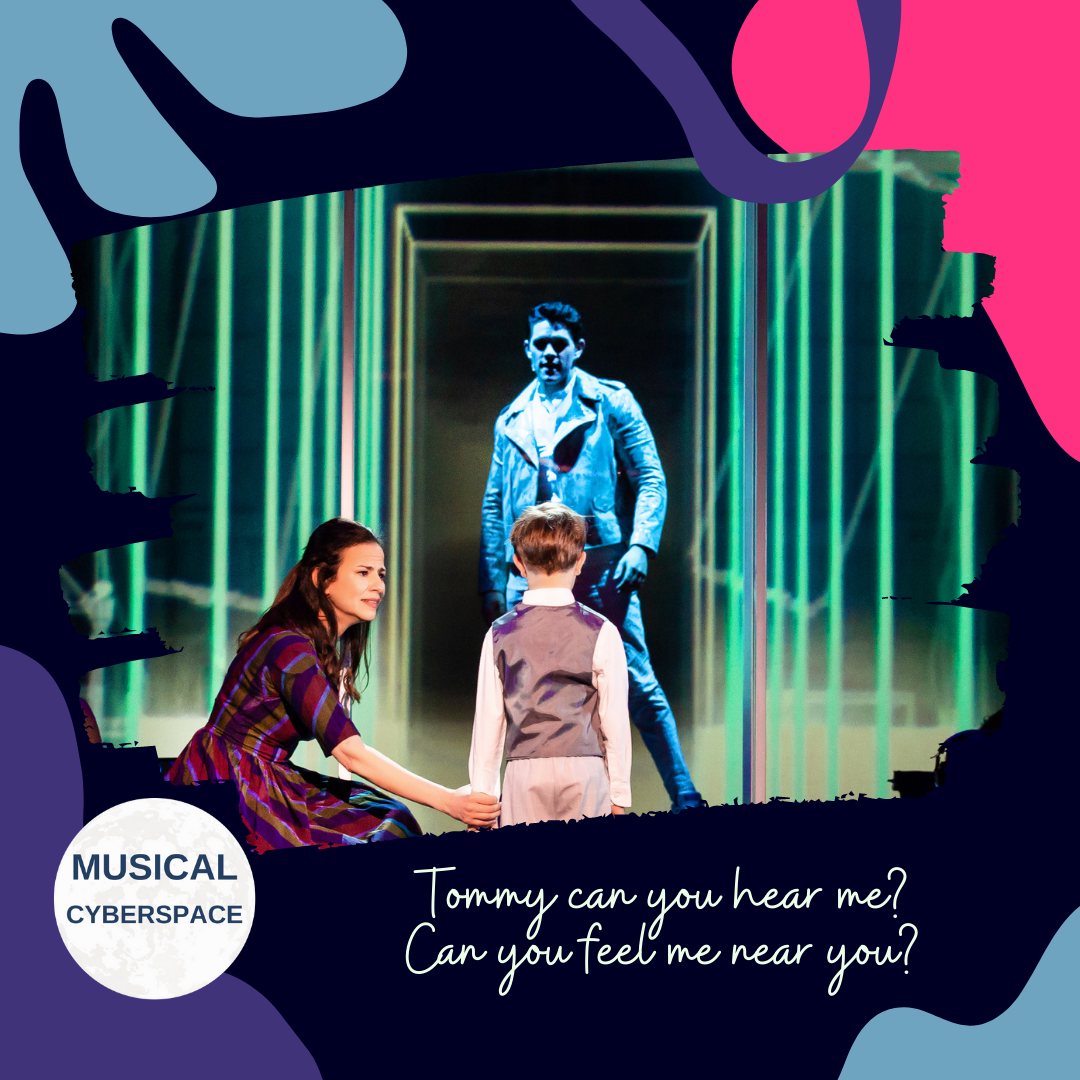
The Who’s Tommy features several name songs, but none is as simple and all the more interesting for that than “Tommy, Can You Hear Me?” This is especially true in The Who’s original version of the song, which transports its listeners to – please forgive me, Pete Townshend – the summer of ’69. Those guitars just take you back in time.
When it comes to the stage show from the 1990s, the song is sung by some local lads as they accompany Tommy back from the street to his home after a doctor’s appointment. The kicker comes when the 10-year-old Tommy appears in the mirror, echoing the calling of his name. It’s a super moment that pays off well theatrically. This is somewhat different from the rendition of the song in the 1975 film in which Ann-Margaret, who plays Tommy’s mother, shows just how willing she was to give it her all, even more so as the number escalates into “Smash the Mirror.”
If you’re keen to share your thoughts on “Tommy, Can You Hear Me?”, then head on to the comment box at the end of this post. Feel free to browse through the playlist of various versions of the number as you do!
Viviane Blaine and Sam Levene in the original Guys and Dolls.
March 2022 at Musical Cyberspace is all about songs with people’s names in the title.
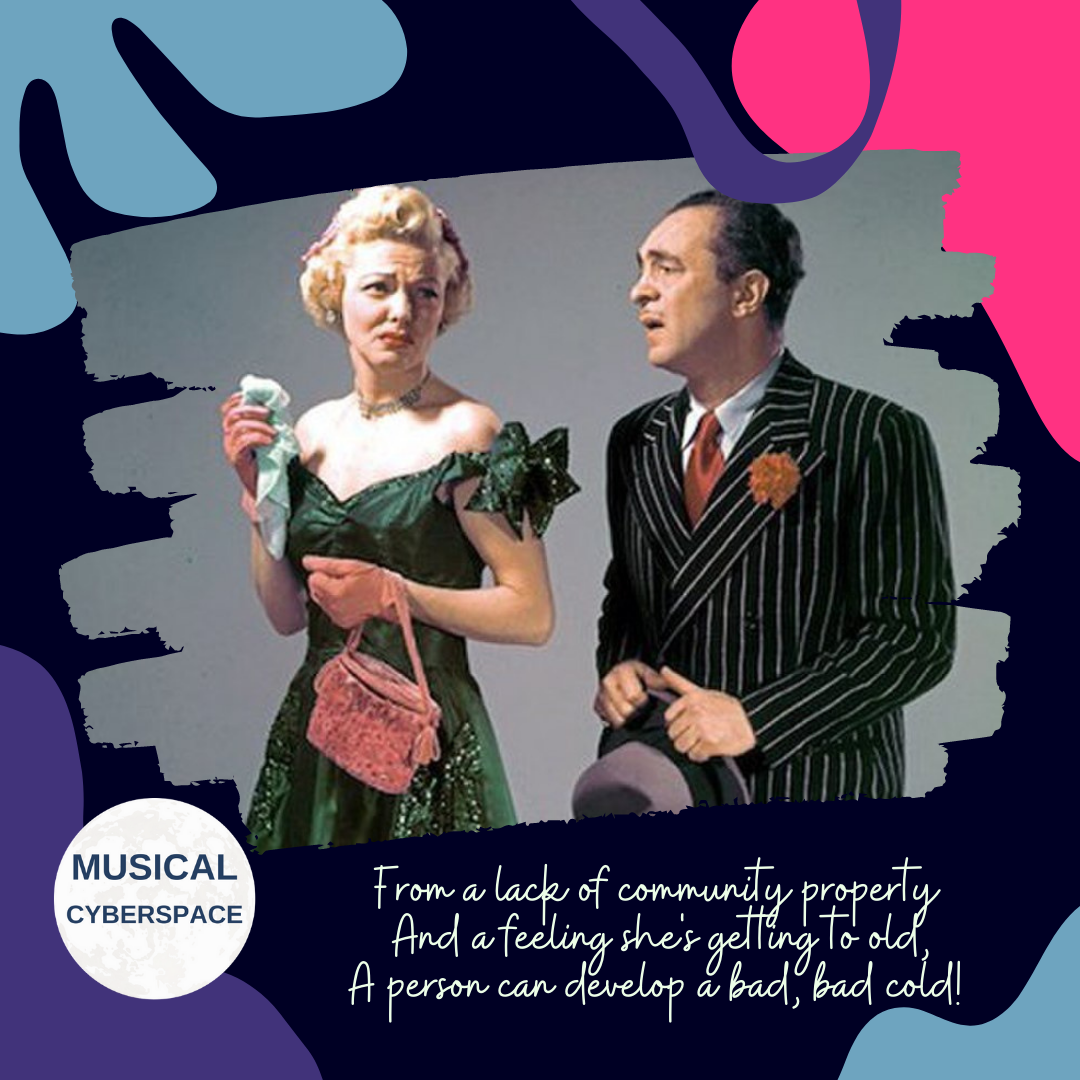
“Adelaide’s Lament” is a fantastic character piece. Crafted by Frank Loesser for the 1950 musical Guys and Dolls, the song helps to define precisely who the character is, an insecure, neurotic showgirl with pretensions to intellectualism, and it does so in a way that makes us simultaneously laugh and feel sympathetic for her. Vivian Blaine put an indelible stamp on the song as its original performer and, many recordings of the show later, it’s only Faith Prince that offers any real competition for a definitive reading of the song.
There is, of course, a range of takes on the song on studio albums, from concerts and on social media challenges, including performances by the likes of Barbra Streisand, Jessie Mueller and Megan Mullally. Check some of those out in the playlist below.
Keen to share your thoughts on “Adelaide’s Lament”? Is there a particular version to which you’re married? Head on to the comment box at the end of this post.
The original Broadway cast of Sweeney Todd. Attend their tale.
March 2022 at Musical Cyberspace is all about songs with people’s names in the title.
Written by Stephen Sondheim as the theme tune for Sweeney Todd, “The Ballad of Sweeney Todd” is a moody piece of work that establishes the milieu against which the action takes place. It’s also a great conceptual piece that tells the audience what the show will be about. While the song appears on most recordings of the show, the performance of the tune as captured by the original Broadway cast tops the bill. It’s truly effortless and organic and therefore, the one that is the most thrilling.
“The Ballad of Sweeney Todd” also has a number of reinterpretations, including Lea Delaria’s jazzy take on the number, Eleri Ward’s folk-indie interpretation and Dee Snyder’s thrilling metal adaptation of this piece. Take a scroll through the YouTube playlist below to enjoy a range of different iterations of the song.
Keen to share your thoughts on “The Ballad of Sweeney Todd?” What’s your favourite recording? Head on to the comment box at the end of this post.
Three iconic Jerome Robbins shows: Gypsy, West Side Story and Fiddler on the Roof
Today is the anniversary of the opening of Jerome Robbins’ Broadway, the great revue showcasing iconic numbers from shows that Jerome Robbins either directed or choreographed. Jerome Robbins’ Broadway won six Tony Awards, including a fifth Best Director nod for Robbins himself, and ran for 633 performances. To commemorate this anniversary, this week’s Saturday List takes a look at the five best Robbins shows, all of which were featured in this iconic production.
5. The King and I
The King and I is one of those classics that sits on the edge of a knife. In a world where we recognise the damage that colonialism has done to people in countries around the globe, a show that tells the story of a king who is resisting colonialism might seem like an easy win. The thing is that The King and I tells King Mongkut’s story from the perspective of Anna Leonowens, a British woman whose political influence makes it seem like she’s doing the job from the inside. Bartlett Sher did a fantastic job of walking the treacherous path of putting this show on in a twenty-first-century context, but it is difficult to get away from what is woven into the writing. Still, the score from Richard Rodgers and Oscar Hammerstein II gives us some classic Broadway songs, of which the choreography-driven showpiece “The Small House of Uncle Thomas” is seen in Jerome Robbins’ Broadway alongside “Shall We Dance?”
4. On the Town
On the surface, On the Town is what they call a bop, but it is a musical comedy from the 1940s that packs a punch even today in a world that continues to be torn apart by war. With Jerome Robbins’s own ballet Fancy Free serving as a basis, Leonard Bernstein, Betty Comden and Adolph Green fashioned a show that doesn’t show the audience any of the major events of World War II. Nobody dies. There isn’t a great battle on stage. And yet, the sense of the war permeates every second from the joyous “New York, New York” through the plaintive “Some Other Time,” both of which are showcased in Jerome Robbins’ Broadway. The way it reflects so much about the world through inference is pure genius.
3. Fiddler on The Roof
I’m sure there are some of you, dear readers, who will have qualms about Joseph Stein, Jerry Bock and Sheldon Harnick’s masterpiece ranking only third on this list, but what is a show queen to do when three such legendary shows as these appear in one body of work? Fiddler on The Roof is great because it just works anywhere and everywhere. It doesn’t matter whether you’re Jewish or not, because the story is universal and resonates beyond its cultural specifics because of the integrity with which it handles that very specificity. Jerome Robbins’ Broadway revisited some of the high points of this show in an extended sequence consisting of “Tradition,” “The Dream,” “Sunrise, Sunset” and the “Wedding Dance.”
2. West Side Story
West Side Story, which was showcased in an extended sequence in Jerome Robbins’ Broadway, is a landmark musical. It was a show that brought Broadway up to the minute in 1957 and even though we look at it now through a different lens, where we acknowledge its shortcomings in not being created with an authentic Puerto Rican perspective, it remains a piece of theatre that has a great deal to teach about prejudice and systemic racism. Beyond that, it is just so moving, with the marriage of Leonard Bernstein and Stephen Sondheim’s perfectly deepening moments set up in Arthur Laurents’s book. Is it possible today not to start weeping for Maria as soon as the opening bars of “Something’s Coming” strike up?
1. Gypsy
It’s not difficult to place a show in the top spot because Gypsy, quite simply put, is a perfect show. Arthur Laurents’s book perfectly crafts a legend around the story about ‘Madame Rose… and her daughter, Gypsy,’ while Jule Styne and Stephen Sondheim punctuate it with one of the greatest scores ever written for a musical, period. Every number achieves something in this show and it gave us both “Some People” and “Rose’s Turn!” In Jerome Robbins’ Broadway, we are treated to “You Gotta Get a Gimmick,” a great comic number in which Mazeppa, Electra and Tessie Tura teach Louise everything they know about stripping. Something wrong with stripping? Well, maybe there’s something wrong with your bumper!
Robbins was, of course, involved in many other shows that haven’t made this list. The Ethel Merman extravaganza Call Me Madam and the joyous Bells are Ringing. There are also several shows on which he worked, uncredited, as a show doctor and instances like The Pajama Game, which he co-directed, with George Abbott and Bob Fosse doing the heavy lifting. There’s also Peter Pan, perhaps more famous as a television production than a Broadway show, as well as the minor pieces, A Tree Grows in Brooklyn, High Button Shoes and Billion Dollar Baby. But if we’re really going for an honourable mention here, that goes to Look Ma, I’m Dancin’!, which offers one of the most charming forgotten scores of the 1940s. How about rediscovering that show for a revival today?
Any thoughts you’d like to share about Robbins’ work? Head on to the comments section and sound off!
This Friday I bring to you the forgotten musical; One Touch of Venus. When I stumbled on this little gem (looking for some comedic golden-age songs that I could sing), I was thoroughly entertained and amused while listening to the score and reading the libretto. I have definitely received a Touch of Venus and hope that you can too!
Very loosely based off of the myth of Pygmalion, One Touch of Venus, a romantic comedy of errors, was quite successful on Broadway with a run of 567 performances. Unfortunately for this musical debuting in 1943, it was largely overshadowed by a game-changing musical that also hit Broadway that year- Oklahoma!
With a script by Ogden Nash and S.J. Perelman, One Touch of Venus tells the story of a fairly normal barber named Rodney Hatch who is engaged to his domineering and cruel fiancé, Gloria. Rodney, visiting a local art museum, is overcome by the beauty of a statue of Venus that is on display. He slips his engagement ring onto the finger of the Venus statue and from that point, his life turns upside down. The statue of Venus turns into a real woman who immediately falls in love with Rodney. Rodney, being engaged, tries to lose Venus, but she does not give up without a fight. What follows is a series of comical events as Rodney ditches his fiancé of five years for Venus, Venus then magically sending Gloria to the North Pole and Rodney getting suspected of stealing the Venus statue and the murder of his wife. The script is refreshingly hilarious thanks to Nash, who was known for his light-hearted and humorous poetry at the time. The plot takes you on a wild ride of ups and downs and a bit of absurdity sprinkled in between; it reminded me a bit of the chaos of Mel Brooks’s The Producers.
Nash was also responsible for the lyrics and thus the songs are also a source of good chuckles as well as very clever and playful lyrics. A song where Nash’s playfulness really shines is “How Much I Love You,” where Rodney goes on a comparison spree to show how much he loves Gloria. The lyrics are accompanied by a score written by Kurt Weill, who was best known for his play with music, The Threepenny Opera. The sound of One Touch of Venus felt a bit more contemporary than I expected and gave me hints of Stephen Sondheim and even sometimes a bit of Alan Menken?! I can’t quite place my finger on it but either way, it was a hit with audiences back then. The big hit out of the show was the song “Speak Low,” which has since been covered by several famous singers including Barbara Streisand. Another song from this musical, “I’m A Stranger Here Myself,” was highlighted by a cover by Kristen Chenoweth.
The musical was adapted to film in 1948, where a couple of things were changed about the characters, story and score. This did not serve the movie well, however, and it was met with mediocre reviews. Since the film was made, One Touch of Venus has been restaged a couple of times but has largely been forgotten.
This musical is a small gem of a golden age musical theatre comedy that, with a bit of “TLC” and a contemporary lyric rewrite here and there, could easily see a successful revival on Broadway so that everyone could experience One Touch of Venus.
Have you listened to One Touch of Venus? What do you think? Share your ideas in the comment box below!
With Valentine’s Day that just passed the world is still in the afterglow of red hearts, flowers and decorations used to celebrate this love-filled day. For a lot of people, however, this day can be a cruel reminder of heartbreak, hurt and scorn. This list is for all those who have loved, lost and decided to shoot Cupid’s arrow right back at him.
1. “Burn” from Hamilton
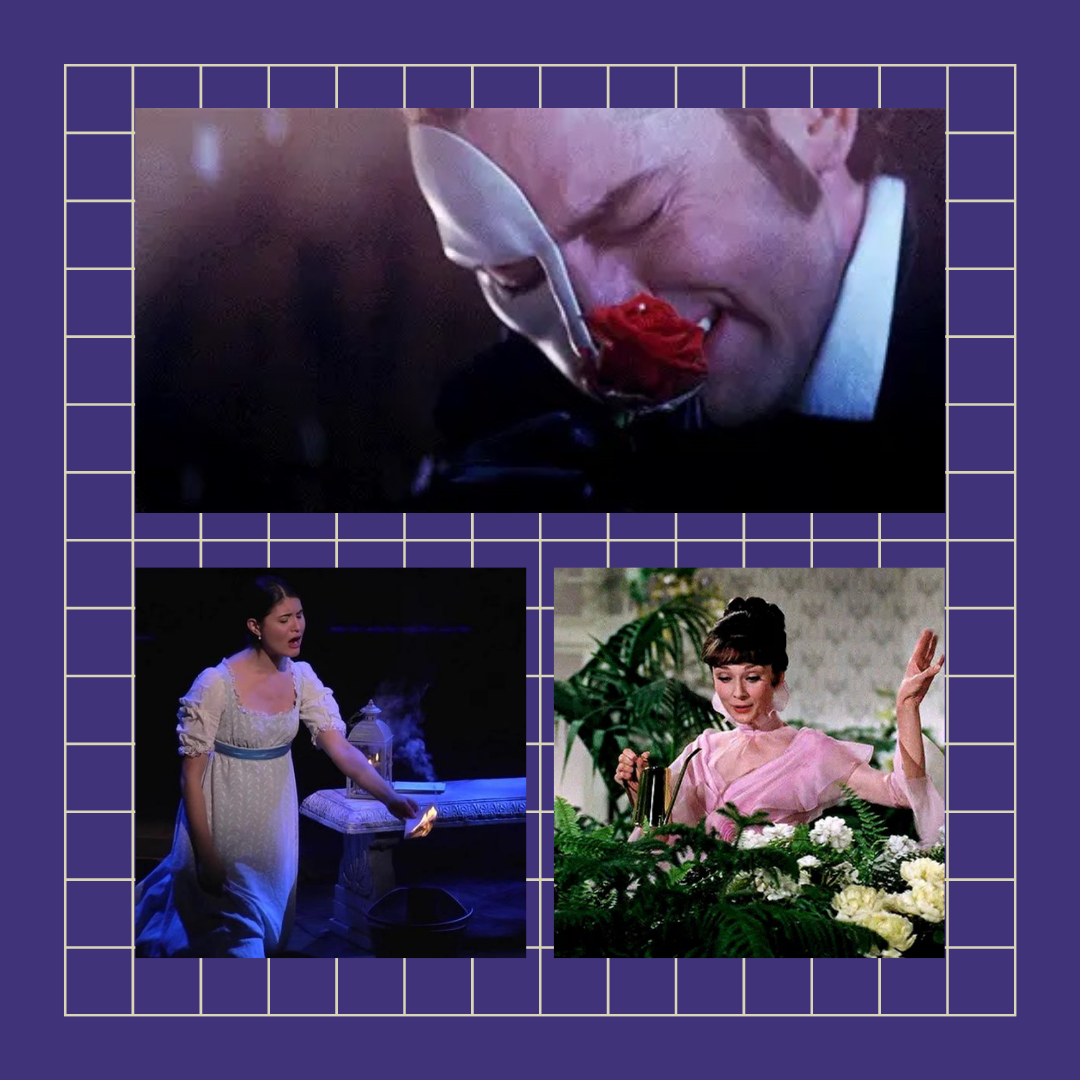
After Alexander cheats on his wife, Eliza, and then tells the world about it to clear his name, Eliza is left in heartbreak and ruin. In “Burn,” Eliza reminisces about their love and grieves the husband she has lost as she burns the many love letters that Alexander wrote to her. Going from the burn in her heart when she first fell in love, to the burning of the letters and then finally her hope that he, himself, will burn for what he has done to her and their family, Eliza writes Alexander off and ‘erases herself out of the narrative.’ I am sure she speaks the truth of many who have been the victims of unfaithful partners.
2. “All I Ask Of You (Reprise)” from Phantom of the Opera
“All I Ask of You” is probably the most well-known love duet by Andrew Lloyd Webber, with Raoul promising to protect Christine from the Phantom and both of them confirming their love for each other. The reprise to this beautiful duet, however, has the Phantom looking on as Christine ‘denies and betrays’ his love for her. As the first act closer, this song is a turning point for the Phantom as his heartbreak and jealousy turn to rage and he swears to take his revenge on everyone who has wronged him. I think we can all relate to this feeling of unreciprocated love and the feelings of rejection, hurt and even anger that goes with it.
3. “On My Own” from Les Misérables
In Les Mis, Éponine is also suffering from the hurt caused by unreciprocated love. Éponine falls in love with her best friend, Marius, as they grow up. She soon realizes, however, that Marius won’t ever feel the same way. What hurts more is that Marius does care for Éponine, but as a dear friend and nothing more. When Cosette and Marius’ love starts to blossom, Éponine’s heart is shattered. As a last effort to be with him, she disguises herself as a boy to fight next to him at the barricade. Marius discovers her and wanting to protect her, he sends her away with a letter for Cosette. Wandering the streets of Paris, Éponine dreams of being loved by Marius, knowing that this will never be a reality. In modern terms, you could say Éponine was “friend-zoned” and “On My Own” shows that even though it doesn’t seem so bad to friend-zone someone, it does still hurt – sometimes more than flat out rejection.
4. “Still Hurting” from The Last Five Years
Jamie decides to move on and Cathy is left hurting. The Last Five Years introduces Cathy at the peak of her heartbreak while telling the story from the opposite perspective (Jamie meeting Cathy) at the same time. In “Still Hurting,” Cathy shares how Jamie seemingly just dropped her and left with no hurt or regret. This is oftentimes how it feels in a breakup – that you are the only one that is suffering a loss while the other person is out enjoying their best life. But as The Last Five Years shows us, there are always two sides to the break-up story – and sometimes there is no right or wrong side.
5. “Mr Cellophane” from Chicago
Ever felt invisible in a relationship? Well, Amos Hart definitely does and expresses this feeling in the quirky, seemingly light-hearted “Mr Cellophane.” Having been ignored and in all sense of the word forgotten by his wife, Roxie, Amos tries to get her attention by stating he is the father of her (unbeknownst to him) fake child. He is however shut down by Billy Flynn who tells him that he can’t be the father since he hadn’t slept with his wife in more than four months. Feeling betrayed, forgotten and ‘see-through,’ Amos compares himself to ‘unimpressive’ and ‘undistinguished’ cellophane. Unlike Amos, it is sometimes better to know your worth and cut off those who make you feel invisible.
6. “Someone Else’s Story” from Chess
Depending on what version of the musical you watch, you will either see Svetlana or Florence lament their loss of love – Svetlana the loss of her husband, Anatoli, and Florence her loss of Freddie. In both cases (even though the lyrics are slightly altered) the root of the song stays the same: reminiscing about a girl who met a boy, fell in love and had her heart broken by a man who changed and forgot about her. They both wish they could warn that girl who foolishly fell in love and tell her to walk away and spare her from the hurt. The twist, of course, is that they are singing about themselves. They don’t want to associate with this story that they are telling and thus distance themselves by singing ‘someone else’s story.’ Sometimes it is easier to just escape the pain by simply removing yourself from it, but one day you must realize the hurt from every broken heart is part of your own story.
7. “Getting Married Today” from Company
For some, the idea of marriage seems unnecessary and for others simply horrifying. A lot of the time the fear only seems to set in the day of the marriage, i.e. cold feet. In this vignette from Company, Amy (or Jamie in the recent revival) is stuck in the midst of a cold-feet-freak-out. While being serenaded by their future husband, Paul, they quickly start to spiral in a perfectly pattered word vomit about all their fears of marriage, like potentially ruining a wonderful husband like Paul, losing their identity in marriage or simply realizing that they married a ‘nut-job.’ So the song barrels through to the point that Amy/Jamie calls off this wedding and storms out. Love is a strong commitment and marriage seems to make that commitment very official, too official for some. So if you find yourself in the shoes of Amy or Jamie just remember; in the end, marriage or not, what is most important is retaining that love that the relationship started with.
8. “Forget About The Boy” from Thoroughly Modern Millie
After being kissed by and seemingly cheated on by Jimmy in one night, Millie is through with him and tells this to her co-workers at Sincere Trust. They give her the advice just to ‘forget about the boy’ and so Millie tries to do exactly that, convincing herself that Jimmy is no good. Soon the rest of her co-workers join in and sing about their own mister wrongs and how they are all much better off without them. A very important part of the breakup process is the last step of acceptance and letting go. Even though Millie does end up with Jimmy, “Forget About The Boy” is still a great anthem for those who broke up and are ready for someone better.
9. “Without You” from My Fair Lady
Eliza Doolittle is taken in by professor Higgens to be “made proper” and to speak like a lady. This process proves to be very difficult and even though they succeed, no recognition is given to Eliza. Insulted and hurt, Eliza leaves Higgins’ house. Later on, Higgins out of confusion complains that women are too irrational and emotional and states that men are the superior sex. The song that follows is Eliza finally standing up to the egotistical and misogynistic Higgens, saying that she’s realized that he isn’t the beginning and the end and stating all the things that will continue existing without his presence. Higgens tries to turn this argument in his favour saying that he has finally made a true woman out of Eliza, but Eliza simply leaves saying that he would not be seeing her again. Eliza found her worth in herself and left the person she once adored to find someone who will truly appreciate her.
10. “In Love With You” from First Date
Casey is traumatized by his past relationship having been left at the altar by his fiancé, Allison. With the help of the girl he is currently on a date with, Casey tries an exercise where he actually breaks up with his ex since he never got the chance to say to her what he felt. In this subverted rock love-ballad, Casey goes off, listing everything he hated about his ex and finally overcomes the trauma of the relationship. Sometimes we harbour feelings towards people in our past without realizing it and this affects our current relationships. Having a chance to vent those feelings and get rid of them is crucial to getting over that ex and moving on!
And there you have it, my top ten picks for best anti-love songs in the musical theatre world and some added relationship advice that came to me as I was writing it. If you have any other good anti-love songs to suggest or good break-up advice, please make yourself heard in the comments down below!




 Musical Cyberspace