The Saturday List: Top Five Musicals of 2019!

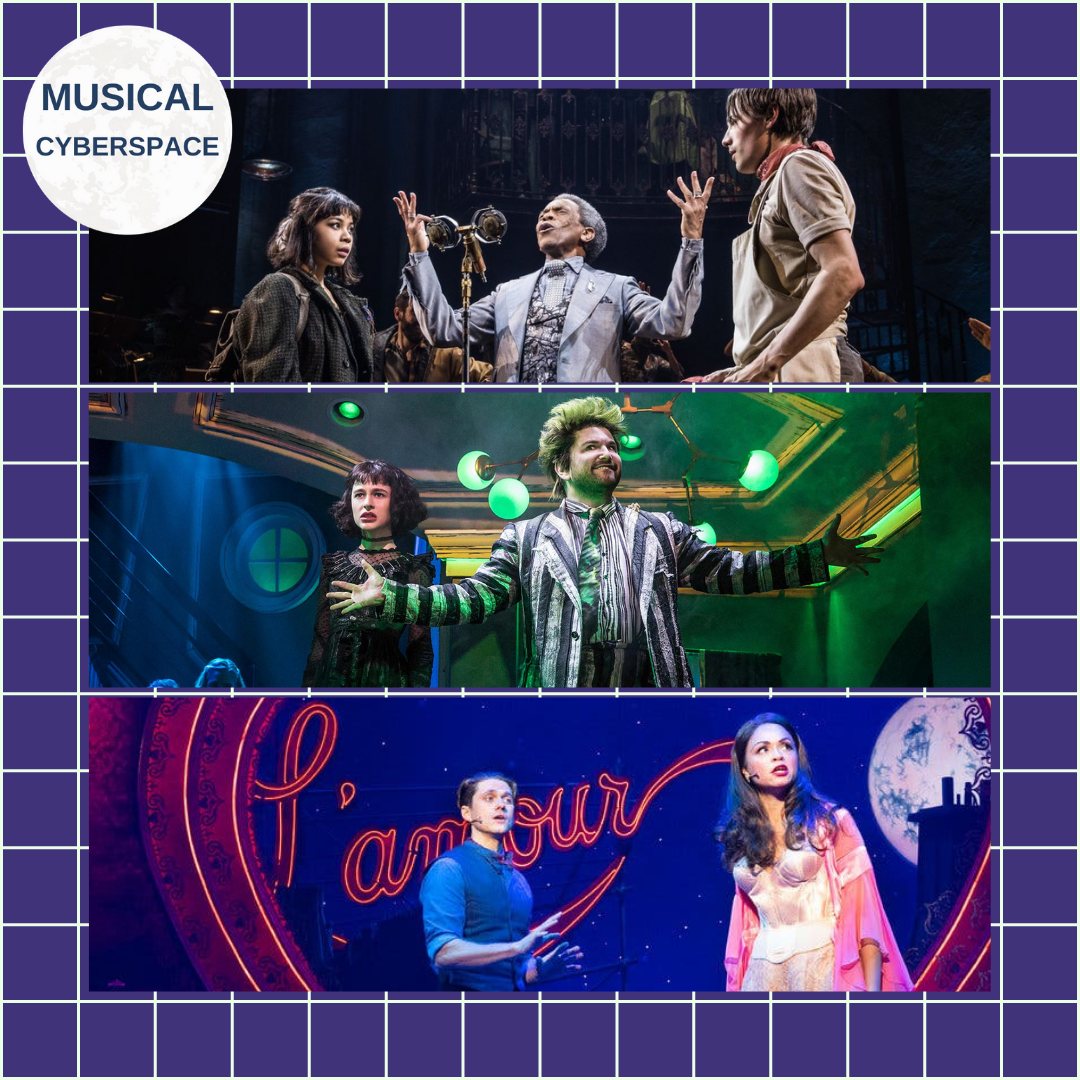
The top 3 musicals of 2019: HADESTOWN, BEETLEJUICE and MOULIN ROUGE
The top three musicals of 2019, as voted by you: Hadestown, Beetlejuice and Moulin Rouge

During March, we ran something of an experiment on our Instagram account and hosted a couple of polls asking our followers to choose between the various musicals that opened on Broadway in 2019. What you’re going to read below includes some brief thoughts on the shows in the order they were ranked by you, dear readers. Yes, the placement of the shows on this Saturday List is all you! So let’s get started….

The four musicals that missed the vote boat were Tina, The Lighting Thief, Jagged Little Pill and Tootsie. Tina is the one that rises to the status of being an honourable mention. The show earned its original Tina, Adrienne Warren, both a Tony Award and a Drama Desk and it shows all signs of picking up steam as it heads towards becoming an international juggernaut. The Lighting Thief may be a casualty because it’s probably just not the kind of show that can find an audience on Broadway and so it pales in comparison with its peers. Jagged Little Pill and Tootsie are two shows that found themselves embroiled in the middle of fairly controversial discussions, the former around the erasure of a nonbinary character and the subsequent management of that situation by the show’s producers and the latter using various aspects of gender identity as pretty poor punchlines and cliched plot devices. As such, it’s understandable that they didn’t receive major support from the majority of the Musical Cyberspace readers who took part in our polls. On to the top five!

5. Ain’t Too Proud

Ain’t Too Proud is the story of The Temptations, a bio-musical that uses the music made popular by the group and a couple of other artists who were their contemporaries to tell their story. A huge number of hits – from “Shout” and “Ball of Confusion” through “If You Don’t Know Me By Now” and “War” – punctuate the evening, sometimes in very inventive ways, although overall the show tends to fall a little into the pattern of “and then…”, “and then..”, “and then…”. Although it is probably most interesting to fans of The Temptations, there is a deeply human element that book-writer Dominique Morisseau to the stories of the individual members of the group which gives it a wider appeal.

4. Be More Chill

This is a show that a lot of people wanted to do well as the buzz of its opening drew near. Despite a long run-up on the road to Broadway via a regional premiere and an off-Broadway run though, it lasted only 177 performances in its main stem run. Adapted from a YA sci-fi novel by Ned Vizzini by Joe Tracz with a score by Joe Iconis, it does seem like something of a long shot and is probably destined to be a cult show. The score pulses with energy as it lights up key moments in the fairly high-concept plot and it yielded a couple of good bops like “More Than Survive” and “I Love Play Rehearsal” and one really great song, “Michael in the Bathroom.” With a West End run coming up in June and a film in development, perhaps Be More Chill will yet find its stride.

3. Moulin Rouge

People have wanted an official stage adaptation of Moulin Rouge for a long time. The original Baz Luhrman film was released in 2001 and the adaptation duties insofar as the book is concerned fell to Josh Logan. The show was a big winner at the 74th Tony Awards, winning 10 awards out of 14 nominations, and is the first of two “Best Musicals” on this list. Like the film, the approach is something that stimulates something of a sensory overload, but the specifics of the stage show are its own, including the interpolation of many new pop songs into Logan’s restructured storyline. It is certainly the kind of celebration of performance that feels apt coming out of the COVID19 pandemic.

2. Beetlejuice

Someone must have said “Beetlejuice” three times because following its closure after 366 performances in 2020, the production is set to reopen on Broadway later this month. Based on the 1988 Tim Burton, the stage show has a book by Scott Brown and Anthony King with a score by Eddie Perfect. Perhaps the best thing that could happen in this adaptation was the throughline given to Lydia, a character who observes and rather hovers around the edges of the film’s narrative, which runs out of steam in its third act, as many of Burton’s films do. On the other hand, not everything in the same show works at the same level – but it moves so fast, that there’s barely any time to notice.

1. Hadestown

Shows with one person behind the book, music and lyrics are relatively rare and Hadestown is one of them, with folk singer-songwriter Anaïs Mitchell being the mastermind behind the show. Having first premiered what would eventually hit Broadway in 2006, Mitchell has chipped away at her artwork bit by bit – an approach that saw the show take home eight awards – including Best Musical and Best Original Score – at the 73rd Tony Awards. There’s only one way to describe Hadestown and that is as an experience. As a storytelling vehicle, it is just totally immersive and draws you into the tale of Orpheus, Euridice, Hades, Persephone, Hermes and The Fates fully. Emerging from that experience, you really feel like you’ve been through something transformative. It’s magical.

Well, that’s that! Would you have ranked the musicals of 2019 in this order? Head to the comment box and sound off!
Posted in The Saturday List | Tagged , , , , , , , , , , , , , , , , , , , , , , | Leave a comment

Forgotten Musicals Friday: LOST IN THE STARS

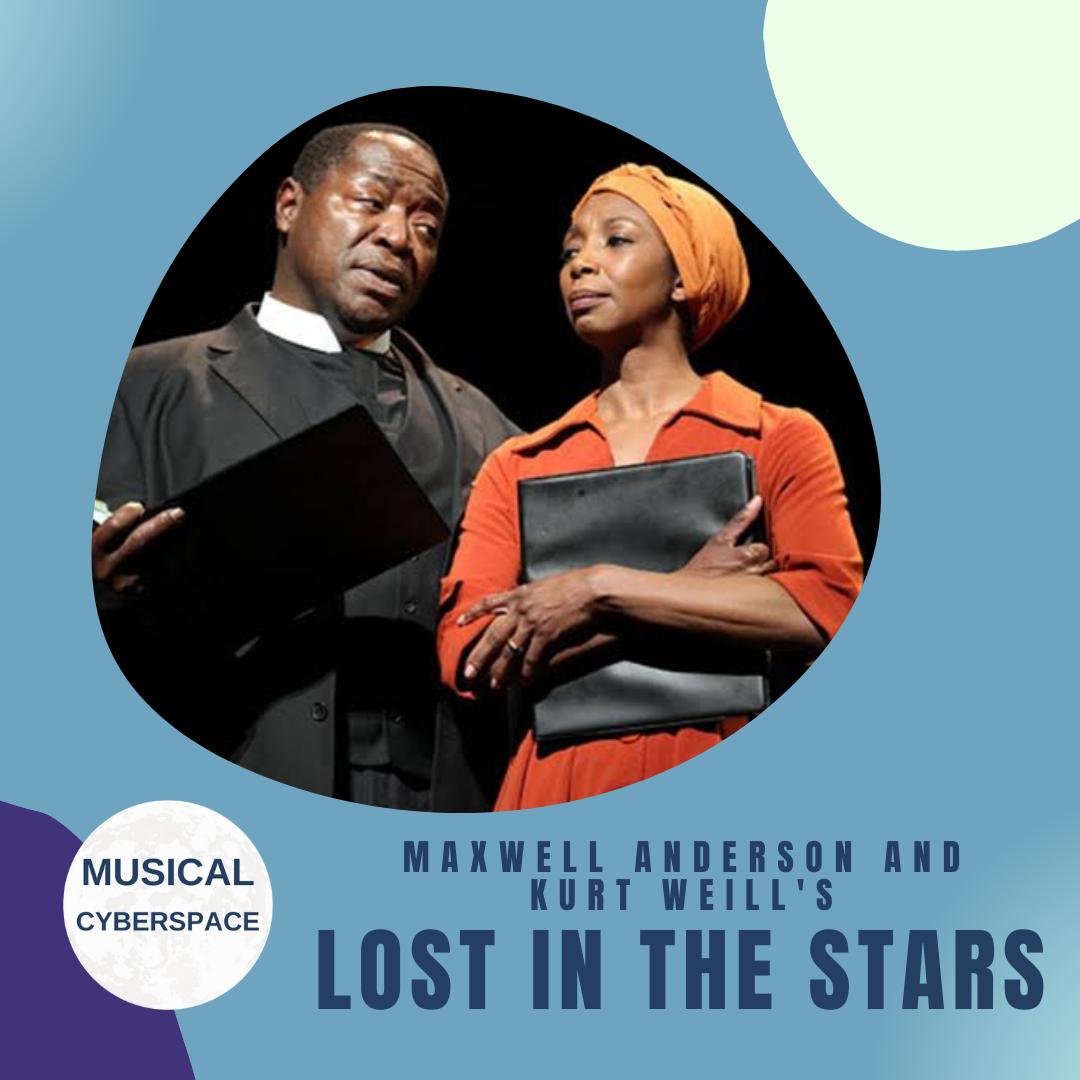
Chuck Cooper and Sharon Washington in a 2011 production of “Lost in the Stars”

In 1949 Broadway saw the premier of ‘Lost in the Stars’ a musical with it’s book and lyrics by Maxwell Anderson and music by Kurt Weill. This musical has largely been left in the back shelves of the Broadway musical library, but what caught my eye was it’s basis; Cry The Beloved Country by Alan Paton. As a South African, the idea of American creatives staging this inherently African story in the late 1940’s, piqued my interest to say the least.

The musical follows a very similar plot to that of the novel it’s based on. Set in South Africa at the very beginnings of what would become Apartheid, Paton’s novel tells a rich and endearing story of a Zulu Reverend, Stephen Kumalo, who travels to Johannesburg from his small Natal village, Ndotsheni, to go find his son, Absalom. Absalom has gotten caught up in a life of petty crime which eventually leads to the murder of Arthur Jarvis, a renowned fighter of racial injustice. Kumalo finally finds his son in jail and asks him about his actions. Absalom confesses to the crimes, but also states that he had two accomplices and that he didn’t intend to kill Arthur. At the trial Kumalo meets Arthur’s farther, James who owns a farm near the village that Kumalo is from. Absalom tells the truth but is found guilty and sentenced to death while his accomplices are acquitted. While his son is on death-row, Kumalo returns to Ndotsheni with his faith shaken. Kumalo then meets James Jarvis’ younger son and they soon become acquainted. James becomes increasingly involved in the village helping them with food and their agriculture. On the day of Absalom’s execution, Kumalo goes into the mountains to observe this this time in peace. On his way though, he finds James and the two men speak about the village, faith, the loss of their sons, but also the bright future of James’ youngest son. Alone, Kumalo falls into prayer and starts weeping, mourning the loss of his son.

Reading Cry the Beloved Country, you clearly see the South African names, context and cultures shine through. This, with some plot points and characters, was ineffectively translated to the stage by Weill and Anderson. The New York Times stating that they clearly had some ‘difficulty’ transforming ‘so thoroughly a work of literary art’ into a theatre piece and that the musical was at times ‘skimming and literal where the novel is rich and allusive.’ Even Paton himself had his qualms with the piece saying that Anderson strayed away from the fact that Christianity and faith has a huge focus in the novel.

On the positive end, the reviews praised Weill’s composition saying that it complimented Paton’s writing and enhanced the narrative. ‘The music is deep, dramatic and beautiful.’ The show also had a fair run of 281 performances and has had some revivals and was turned into motion picture. One of the biggest reasons that this musical hasn’t been completely forgotten is the title song, Lost in the Stars, which has been performed by many legends such as Frank Sinatra, Tony Bennet and Judy Garland to name a few.

All this being said, I have to say I completely disagree with the fact that Weill’s music complemented the story. I actually disagree with the musical in general. The story of Cry The Beloved Country was completely ‘Americanized’ by Anderson and Weill. Having American actors portray people of Zulu and South African heritage is one thing, but having them do it in a general American accent throughout the show completely threw me off. With several mispronunciations of names and not even mentioning some very problematic lyrics, I kept asking “Who thought this was a good idea?” Another point is that of Weill’s music- Looking at it as a separate entity, I can admit it is a good composition. The problem for me lies again in the ‘Americanization’ of it. The score comes across much more African-American, than anything else. Yes, listing to inherently African music and comparing it to African-American music there are definite similarities, but for me Weill failed in setting the musical sound in Southern Africa rather than the United States.

Now, I realize, of course, that I am writing out of a modern context, with a societal lens that has completely shifted since the 1940’s. Yes, Anderson and Weill were Americans, so it makes sense that the show would naturally gravitate to American-isms. Back then they didn’t care as much about appropriation or the idea of authenticity when it comes to representation of different cultures. In modern times we have seen shows like The Lion King, which had a creative team who invested a lot of time in bringing the cultures, languages and feel of Africa into the piece using research and the help of actual people from African countries.

This, however, brings me to the point of this post- there are some musicals that are better left ‘forgotten’ and I feel Lost in the Stars is one of them. As a South African I am clearly more sensitive to this story in particular, but then we must not forget about the musical giants who stole their stories from other cultures to be displayed in an Westernized fashion for Western audiences *cough* The Mikado, Mulan, Pocahontas…*cough*

What would really make this blogpost end in a happy note would be an announcement that Cry the Beloved Country will be RE-adapted to stage as a musical with a fully South African creative team. I do think the novel has a lot of merit to be turned into a musical theatre production and can definitely be story that has weight in today’s society.

Do you think a new and improved adaption of Cry the Beloved Country could work? Or do you think one was enough? Let us know your thoughts down below.

Posted in Forgotten Musicals Friday | Tagged , , , , , , , , , , , , , , , , , , , , , , | Leave a comment

March Monikers: “For Sarah”

The notorious DANCE OF THE VAMPIRES
The notorious Dance of the Vampires

March 2022 at Musical Cyberspace is all about songs with people’s names in the title.

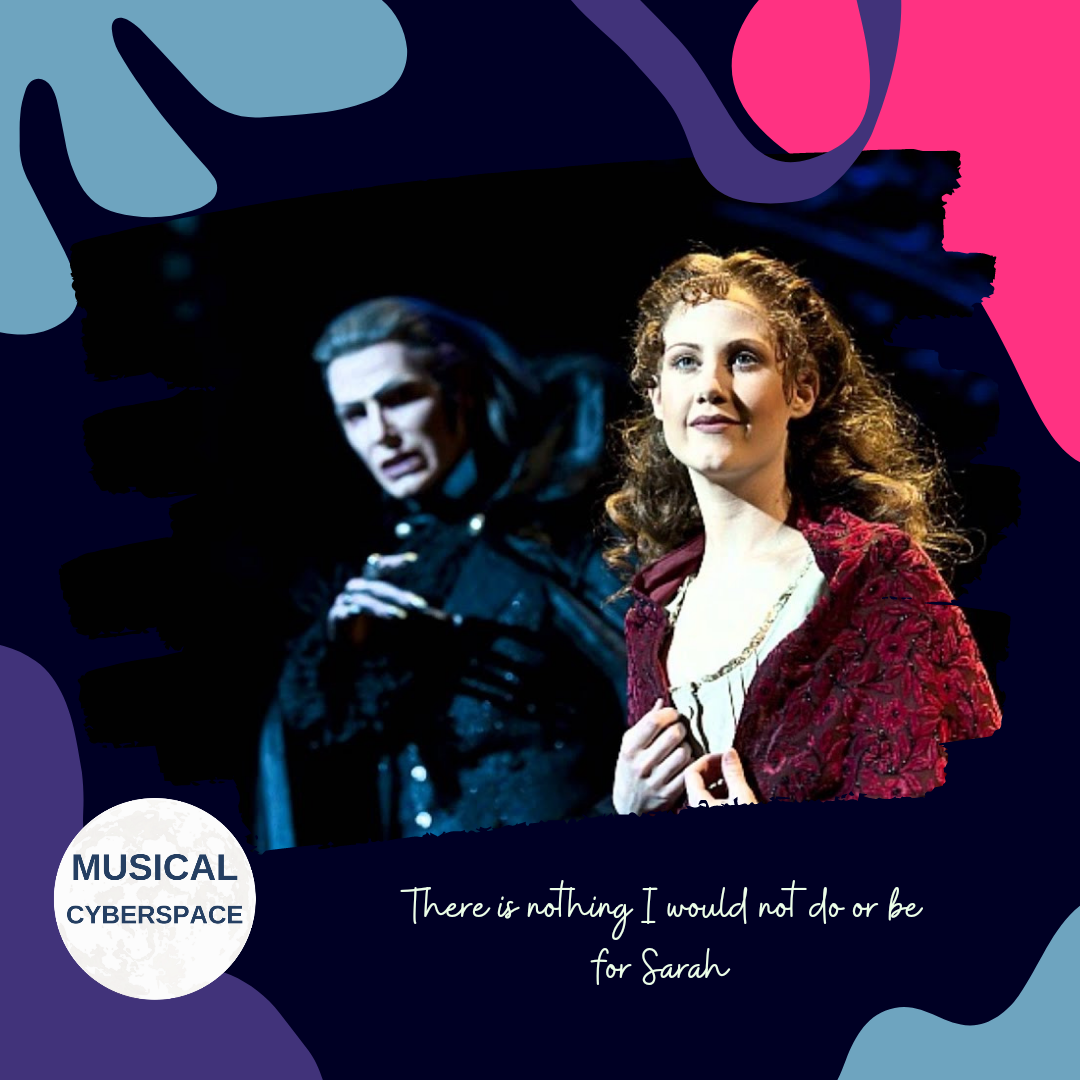
Given the universal hatred for the English language adaptation of this show that appeared on Broadway, perhaps I should have titled this post “Für Sarah”. With music by Jim Steinman and lyrics by Steinman, Michael Kunze, Kirke Kangro, Daniel Wyszogrodzki and/or Miklós Tibor – depending on which version in which language you’re talking about – the show holds a far higher status in Europe than in the United States. This particular song is a moving ballad, let down only by the inconsistent application of the rhyme scheme set up at the start of the song.

If you’re keen to share your thoughts on “For Sarah”, then head on to the comment box at the end of this post.

Posted in 30 Day Challenges, March Monikers | Tagged , , , , , , | Leave a comment

March Monikers: “Blow, Gabriel, Blow”

Sutton Foster - the most recent Reno Sweeney
Sutton Foster – the most recent Reno Sweeney

March 2022 at Musical Cyberspace is all about songs with people’s names in the title.

“Blow, Gabriel, Blow” is a thrilling showstopper in the gospel “get happy” mould from the classic Cole Porter show, Anything Goes. It’s a straightforward piece, beautifully crafted and neatly set up in the script without – in line with the conventions of musical comedy in the 1930s – having to be overly concerned with an organic integration between the book and score. Written to showcase Ethel Merman’s powerhouse belt, many divas of the musical theatre stage from Ethel Merman and Elaine Paige to Patti LuPone and Sutton Foster have put their stamp on this song.

Who’s your favourite? I’m partial to Patti LuPone – can anyone else sing the hell outta “Blow, Gabriel, Blow” the way she does? Head on to the comments and let us know!

Posted in 30 Day Challenges, March Monikers | Tagged , , , , , | Leave a comment

March Monikers: “Mame”

Angela Lansbury, the ultimate "Mame"
Angela Lansbury, the ultimate “Mame”

March 2022 at Musical Cyberspace is all about songs with people’s names in the title.

Jerry Herman loves title songs, especially in the form of a tribute to a fabulous female character written for a musical theatre diva to belt out while a chorus dances with and around her. “Mame”, from the show of the same name, is just such a song, written for the electric Angela Lansbury, who was the star of the original production.

Many a star has since played Mame Dennis, including Celeste Holm, Ann Miller and Christine Baranski, but few people think that anyone has given Lansbury a run for her money. If only she’d been cast in the film…

Keen to share your thoughts on “Mame”? Head on to the comment box at the end of this post.

Posted in 30 Day Challenges, March Monikers | Tagged , , , , , | Leave a comment

March Monikers: “In Buddy’s Eyes”

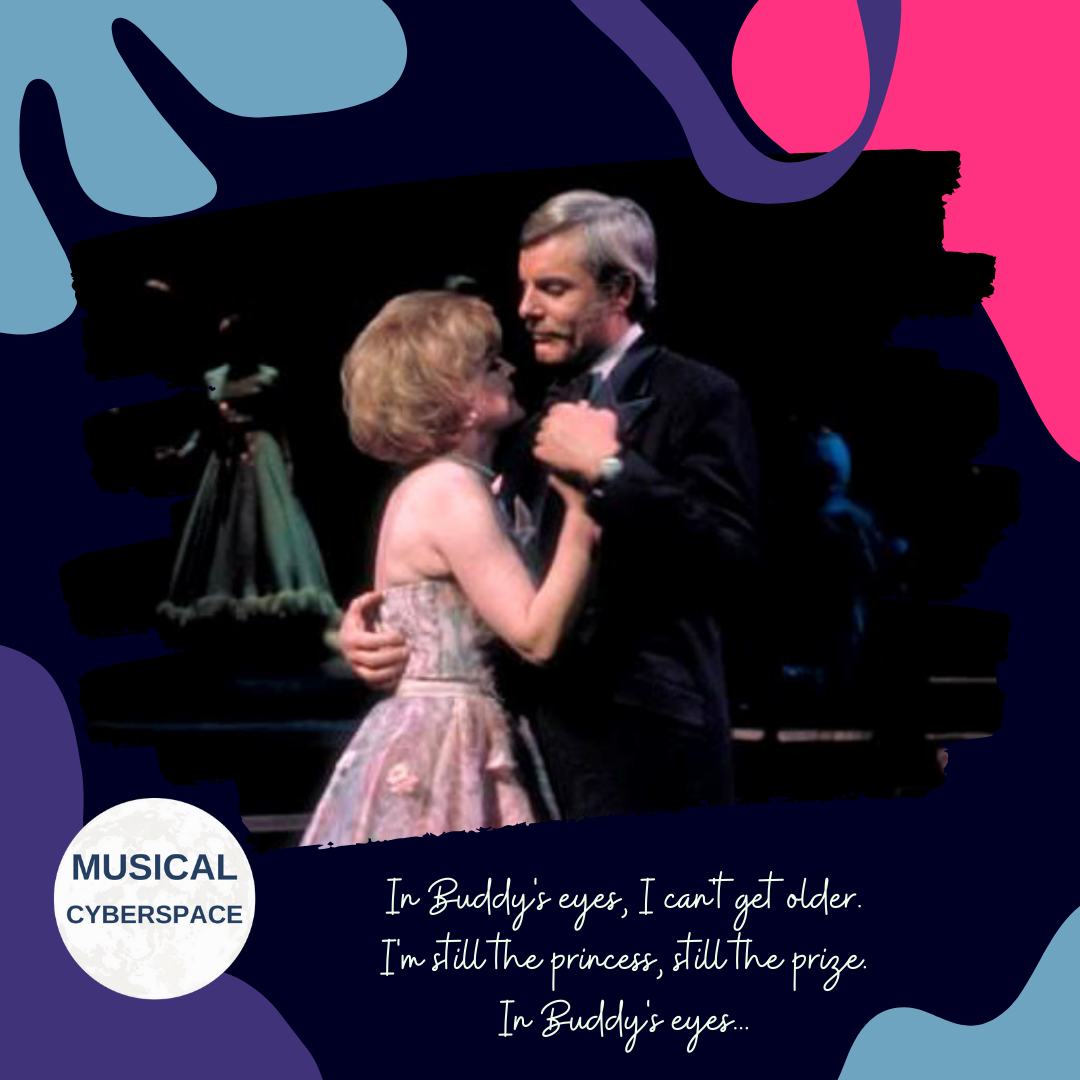
Dorothy Collins and John McMartin in FOLLIES
Dorothy Collins and John McMartin in Follies

March 2022 at Musical Cyberspace is all about songs with people’s names in the title.

“In Buddy’s Eyes” is one of the most poignant songs in Stephen Sondheim and James Goldman’s Follies. On the surface, the song is about a woman who loves the way her husband sees her after many years of marriage. But this is a song by Sondheim, which means there’s more to it. Sally is actually more concerned with how Ben sees her than Buddy. Ben, who she has obsessively loved her whole life, is the reason she has come to the Follies reunion and it is by reminding Ben of the Sally she was so long ago that she hopes to win him back. Tragedy waits in the wings…

There are many fantastic performances of this song from productions and concerts. There would likely be a strong contingency of fans who name Barbara Cook’s rendition as the best of the bunch. For me, that’s fine if you’re looking for a performance of the song by Barbara Cook, which is what you get even in her rendition of the song in Follies in Concert. For a performance of the song as Sally, it is Dorothy Collins who sets the bar. Some have come close to that remarkable interpretation of the entire role, but Collins trumps them all every time.

Keen to share your thoughts on “In Buddy’s Eyes”? Head on to the comment box at the end of this post.

Posted in 30 Day Challenges, March Monikers | Tagged , , , , | Leave a comment

The Saturday List: A Fine, Fine Life for I’D DO ANYTHING’s Nancies

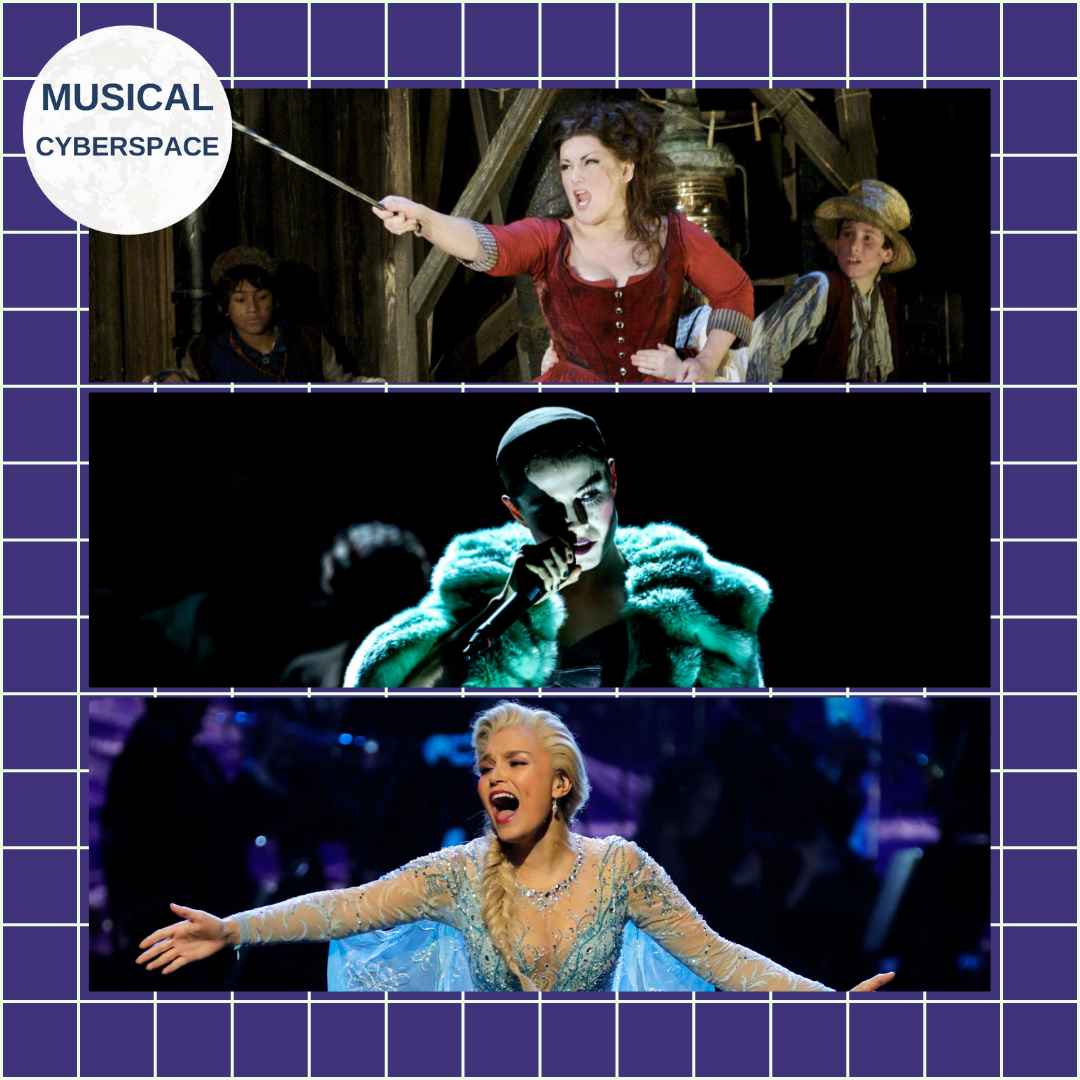
Jodie Prenger in OLIVER!, Jessie Buckley in CABARET and Samantha Barks in FROZEN
Jodie Prenger in Oliver!, Jessie Buckley in Cabaret and Samantha Barks in Frozen

This past week, the world celebrated International Women’s Day and so one of the things I wanted to do with The Saturday List at Musical Cyberspace this week was to celebrate a few women in musical theatre. Having recently watched I’d Do Anything again, I thought it might be a good idea to take a look at where the 12 musical theatre performers who competed for the role of Nancy in the 2009 revival of Oliver! are today. The 2008 BBC talent show cum reality series also searched for performers to play the title role and proved to be a family favourite at the time, although some viewed the show as a problematic way of casting musical theatre roles within the wider context of the entertainment industry.

12. Amy Booth-Steel, whose dress was lime green was the first potential Nancy to be eliminated. This didn’t seem to be too much of a stumbling block for her: some of the credits she has racked up since the show aired include Tori Amos’s musical, The Light Princess, Sister Act and The Sound of Music in the West End and the UK tour of Betty Blue Eyes

11. The “lilac” Nancy, Cleo Royer, was eliminated second. A self-confessed music nut, Royer seems to have faded into the background somewhat, although she appeared in the West End production of Dirty Dancing. Here she is singing “Oom-Pah-Pah”, with all of the other Nancy hopefuls.

10. Tara Bethan – seen here in the orange dress singing “It’s a Fine Life” with the eight remaining Nancies – has performed in Bugsy Malone in London and the UK tour of Joseph and the Amazing Technicolor Dreamcoat since her appearance in I’d Do Anything. She has also worked in television, notably in the Welsh soap opera Pobol Y Cwm.

9. Following her involvement in I’d Do Anything, Francesca Jackson – who wore the baby pink dress in the competition – has toured in Dreamboats and Petticoats, travelled to Paris to perform in A Little Night Music and appeared in the Barry Manilow jukebox musical, Can’t Smile Without You. In the 2011-2012 season, she performed in the West End production of Million Dollar Quartet. Most recently, she has appeared in Tina the Musical, playing the role of Tina Turner’s friend and confidante, Rhonda Graam.

8. One of my favourites in the competition, the gold-clad Keisha Amponsa-Banson‘s career bloomed following I’d Do Anything, with appearances in The Pajama Game, From Here to Eternity, The Lion King, Stand Tall: A Rock Musical, Footloose and Little Shop of Horrors all keeping her on the stage, where she belongs. Her latest credits include Sunday in the Park with George, School of Rock and Caroline, or Change.


7. Sarah Lark, the pale Green Nancy, was an early favourite of mine and ended up as an understudy for the role of Nancy in the West End production that followed I’d Do Anything. She has since performed in two Snow White pantomimes, as Miss Mona in The Best Little Whorehouse in Texas, and in Les Miserables

6. Dark Blue Nancy, Ashley J Russell‘s musical theatre credits include Sister Act, We Will Rock You, Shrek and The Phantom of the Opera. She also appeared in the workshop of Love Never Dies at Sydmonton. She’s also toured the world with Mamma Mia!

5. Like Sarah Lark, Niamh Perry also appeared as a pantomime Snow White, while also appearing in Love Never Dies, Mamma Mia! and The Little Prince. She’s also appeared in the Boy George musical, Taboo and the Stephen Sondheim-Hugh Wheeler classic, Sweeney Todd: the Demon Barber of Fleet Street. She’s also taken on the roles of Mary in The Beautiful Game, and Girl in Once.

4. Rachel Tucker, who wore the yellow Nancy dress, has had a fine career since the show ended. As well as appearing in a reading of Love Never Dies as Meg Giry, Tucker has played Elphaba in Wicked and made her Broadway debut in the Sting musical, The Last Ship. Most recently, she has appeared in Come From Away, both on the West End and on Broadway, and john & jen, the popular Andrew Lippa-Tom Greenwald two-hander.  

3. Blue Nancy Samantha Barks is one of the best known of the I’d Do Anything contestants internationally, having played Eponine in the film version of Les Miserables, a role she played on stage in London. She has also played Sally Bowles in Cabaret, Nancy in Oliver!, Velma in Chicago, Jules in the workshop of Bend it Like Beckham and Mallory/Avril in City of Angels. Alongside further film and television roles, she has also done stints in Amélie, Pretty Woman and Frozen.

2. Runner up Jessie Buckley – who wore the dark green Nancy dress, turned down understudying Nancy to play Anne in A Little Night Music. She’s done a fair amount of work on film, including Judy and The Lost Daughter, the latter of which has earned her an Academy Award nomination. We’ll hear whether she wins that award when the Oscars are presented towards the end of this month. Her television credits include The Woman in White, Chernobyl and Fargo. On stage, she’s done a fair deal of Shakespeare and is currently playing Sally Bowles in a high-profile revival of Cabaret opposite Eddie Redmayne.

1. Purple-clad Jodie Prenger won the competition and the role of Nancy in the 2009 UK revival of Oliver! Appearing in Les Miserables in between the competition and the opening of that production, she has subsequently appeared in Monty Python’s Spamalot, Shirley Valentine and A Taste of Honey as well as pantomime productions of Dick Whittington and Robin Hood.

Having just had the opportunity to revisit I’d Do Anything and its twelve finalists, do you think the right person won the competition? Who would you like to see more of on stage in the future? And what other shows do you think could have similar series leading up to opening night? It would be great to hear your thoughts in the comments section below!

Posted in The Saturday List | Tagged , , , , , , , , , , , , , , , , , , , , , , , , , , , , , , , , , , , , , , , , , , , , , , , , , , , , , , , , , , , , , , , , , , , , , , , , , , , , , , , , , , , , , , , , , , | 2 Comments

March Monikers: “Bobby and Jackie and Jack”

Jim Walton, Ann Morrison and Lonny Price in the original MERRILY WE ROLL ALONG

March 2022 at Musical Cyberspace is all about songs with people’s names in the title.

Steeped in the kind of dramatic irony that is provided by the distance of time, “Bobby and Jackie and Jack” is a song written by the characters that appear in Merrily We Roll Along about the USA at the dawn of the 1960s, with obvious references to the Kennedys, as well as other political figures of the time. This show, which flopped big time on Broadway, was created by George Furth and Stephen Sondheim. It famously tells the story of its protagonists in reverse chronology, a puzzle that has engaged directors who want to tackle the show ever since.

Sondheim, although creating a piece that fits in perfectly with the milieu of the show, sounds like he is offering a pastiche of some of his own early work. It’s clever, a novelty song that is – in the context of the show – perhaps cleverer than it is good, which makes it precisely the right kind of song for the moment in the show when it appears.

Taking a song that once again plays best on cast albums rather than in isolation, it’s difficult not to choose the original Broadway cast for the best rendition of the song. The original cast recording of Merrily We Roll Along is one of those definitively great recordings. How lucky we are to have it!

Keen to share your thoughts on “Bobby and Jackie and Jack”? Head on to the comment box at the end of this post.

Posted in 30 Day Challenges | Tagged , , , , , , , | Leave a comment

Forgotten Musicals Friday: SNOW WHITE

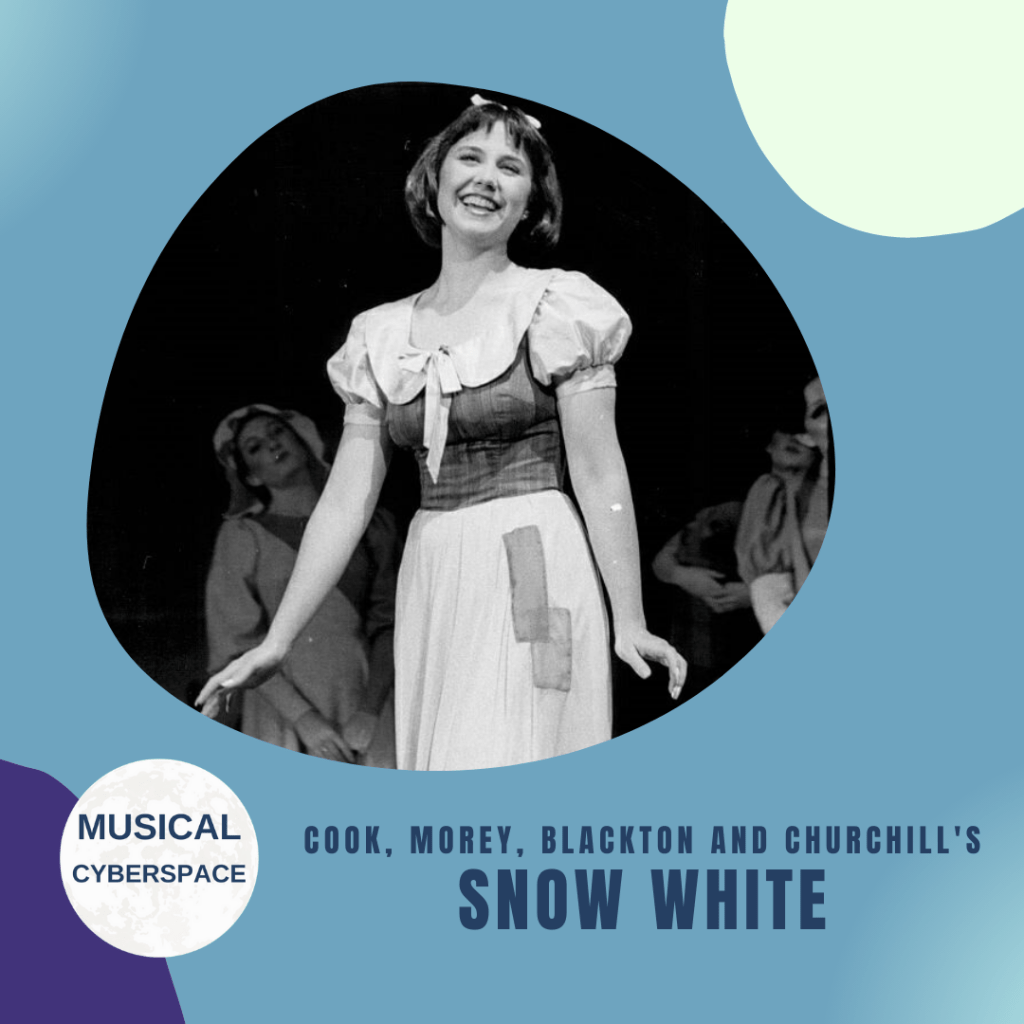
Mary Jo Salerno as Snow White

Disney Theatricals may have hit the big time when Beauty and the Beast opened on Broadway in 1994, but the animated feature that started it all, Snow White and the Seven Dwarfs, was adapted for the stage a quarter-century before that auspicious calendar event. The initial 1969 production at The Muny in St Louis was revived there in 1972, with a 1979 engagement at Radio City Music Hall that was a key part of that venue’s diversification plans following its near closure. The show was subsequently televised and released on video, but the show soon slipped into memory and then into cultural insignificance. So how about we celebrate it again today?

The live production of Snow White is indeed a curiosity. Taking the 1937 film as a basis, the story is somewhat expanded in Joe Cook’s Book for the show. Following a prologue that gives us the full spiel about the wish that gives Snow White (Mary Jo Salerno) both her looks and name, we jump forward in time to her father’s second wedding day. The Queen (Anne Francine) is given a bit of a backstory, now coming from a faraway kingdom called Shi-tan, which appears to be a regrettable kind of magical mash-up of Middle and Far Eastern appropriations. Snow White’s father, the King (Thomas Ruisinger), still being alive, the Queen uses her lady-in-waiting, Luna (Yolande Bavan), to traffic Snow White to a remote village where hard labour would destroy her beauty, which the Magic Mirror (Charles Hall, who also voices the Hag) has reluctantly pointed out to his mistress. From there on out, the story plays out very much as the film does, although Prince Charming (Richard Bowne) is built up slightly to have him work with the Huntsman (Bruce Sherman) to expose the Queen’s treachery to the King.

A couple of new songs by Jay Blackton and Joe Cool are thrown into the mix with Frank Churchill and Larry Morey’s eight favourites from the film. The first of these is the forgettable “Welcome to the Kingdom,” which is then followed by the “Queen’s Presentation.” Later, the Prince warbles out a classic 1920s style charm song-cum-lament, “Will I Ever See Her Again?” The lyric of this song lists all of Snow White’s virtues, taking pains to rhyme ‘delicate charms’ with ‘slender arms.’ Far less entertaining is the perfunctory finale, signposted as “Here’s The Happy Ending.”

Frank Wagner’s staging of the show placed human actors alongside theme park-style costumes for the dwarfs and the Hag and a set of woodland characters that offers audiences full-on furry fantasy realness. A live horse is thrown into the mix for Prince Charming to ride – so there’s a clear attempt to use just about every trick in the book along with the expected set designs and special effects. The transformation of the Queen into the Hag is quite spectacular on video and must have been something to see performed live.

The overall result? Well, it’s not great but the children in the audience of the pro-shot that was released on video relished it. That said, there are some fantastically camp moments, more than enough to justify the show’s cult status in Disney’s theatrical history.

Snow White’s next stage appearance would be the notorious opening number of the 1989 Academy Awards ceremony, something that haunts all beings with taste to this very day. A second, much shorter stage adaptation of the film, Snow White: an Enchanting Musical, would be created for Disneyland just after the turn of the century. A typical theme park attraction, the newer production could never replace this grand, crazy, camptastic extravaganza of a show – which Disney seems to have disowned to some extent in its quest to dominate Broadway, the West End and the world.

Got a Snow White memory you’d like to share? Drop us a comment at the bottom of this post!

Posted in Forgotten Musicals Friday | Tagged , , , , , , , , , , , , , , , , , , , , , , | Leave a comment

March Monikers: “Simon Zealotes”

Giovanni Spano and Ben Forster in Jesus Christ Superstar

March 2022 at Musical Cyberspace is all about songs with people’s names in the title.

I first thought about including “Simon Zealotes” from Jesus Christ Superstar in this series of posts when I posted “Tommy, Can You Hear Me?” earlier this month. The two songs are certainly varied in tone and content, but there is something that connects them in the way that the chrous of the lyric is structured.

Like “This Jesus Must Die” from the same show, this number offers more of the post-modern political reading that is one of the multiple perspectives of the Christ narrative as retold here by Tim Rice and Andrew Lloyd-Webber. The song offers a neat little cameo for the actor playing Simon and as he spurs the crowd into a frenzy of adoration for Jesus. The piece builds brilliantly out of “Hosanna” and makes for an effective contrast when “Poor Jerusalem” follows it.

Keen to share your thoughts on “Simon Zealotes”? Head on to the comment box at the end of this post.

Posted in 30 Day Challenges, March Monikers | Tagged , , , | Leave a comment