12. “Our Kind Of Love”
This song springs out of a discussion between Christine and Mary about the events of the previous evening. They are, as yet, unaware of Ginger’s death. Mary voices her disapproval of Christine’s relationship with Del and the song is Christine’s reply: an argument that love doesn’t conform to the boundaries that their situation places upon them.
“Our Kind of Love” is a stirring number and is one of the great successes of The Beautiful Game. The melody is not a new one and was originally part of a song called “The Heart is Slow to Learn”, which was intended for a proposed sequel to The Phantom of the Opera. In that earlier setting, it was a treacly reflection on lost opportunities and the cruelty of love as it might be seen from the perspective of the characters in that show. Here it becomes an anthem against the personal effects of the war in an arrangement that strips the song of its reflective verses and drops the song’s key so that it can be belted passionately instead of being warbled by a legit soprano. So far, so good.
How do Elton’s lyrics measure up? Despite the fact that some of the sentiments in the song are expressed in a manner that is somewhat awkward in terms of condensing a complete thought into a compact lyric (such as ‘Our kind of love’s for those who dare’ in the first verse), Elton delivers his most disciplined set of lyrics in the show thus far – until the final verse, that is:
All kinds of love bring us together
Causes the broken heart to mend
People must love, now and forever
There’s only one love in the end.
Here we see two flaws. The first has to do with rhyme, the inclusion of the standard pop lyric combination of ‘together’ and ‘forever’. The second is the error in concord caused by the clause in the second line, which should read ‘All kinds of love… (cause) the broken heart to mend’. If this were only a pop song, the conventions that frame popular songwriting would excuse such errors. However, in musical theatre, which endeavours to communicate drama through the heightened language of song, they are inexcusable.
In spite of this, I enjoy this song a great deal and think it has an immense impact in the show as a whole. The only problem in this regard is its allocation to Christine, who has already sung “Let Us Love in Peace”, which means that, at this point, Christine is overshadowing Mary. Mary is one half of the show’s primary romantic couple and should be more prominent that Christine. This is something that really should have been addressed by Elton as a dramatist in collaboration with Lloyd Webber as they created the piece.
After the song, John arrives with the news of Ginger’s death. Thomas also comes over to ask John to go with them to get revenge. Mary convinces John that violence won’t do any good and he refuses to go with Thomas. The final song of Act I takes us from this domestic scene to Ginger’s funeral as all wish for a life free of the war that they have to endure.
13. “Let Us Love In Peace (Reprise)”
As a straightforward reprise, this song suffers the same problems in its lyric as the first version of the song that appears in the show. Given here to Bernadette, it lacks the impact it should have because the character’s relationship with Ginger hasn’t really been established well enough in the show to achieve the payoff it attempts. Father O’Donnell’s line of dialogue mid-song really does the work:
We are gathered here today to give thanks for the life of Gregory O’Shaugnessy. He would have been eighteen next week.
This sequence would have a far greater impact if Elton, as the show’s librettist, wasn’t so overtly trying to manipulate the audience’s emotions by creating an obviously heart-wrenching situation. Were we more deeply invested in Ginger and Bernadette, the characters who are directly affected by the situation, that would solve the problem.
The final music we hear in Act I returns to the musical theme that began the “Overture” before fading into silence as a menacing drum beats, leaving us wondering what awaits these characters in the second act.
Purchases from Amazon.com
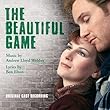

FROM LEFT TO RIGHT:
1. The Beautiful Game Original London Cast CD.
2. The Beautiful Game Vocal Selections.
Pages:
1 2 3 4 5 6 7 8 9 10 11 12
About David Fick
teacher + curator + writer + director + performer = (future maker + ground shaker) x (big thinker + problem shrinker) x (go getter + detail sweater)

 Musical Cyberspace
THE BEAUTIFUL GAME: 2000 OCR Track by Track
12. “Our Kind Of Love”
This song springs out of a discussion between Christine and Mary about the events of the previous evening. They are, as yet, unaware of Ginger’s death. Mary voices her disapproval of Christine’s relationship with Del and the song is Christine’s reply: an argument that love doesn’t conform to the boundaries that their situation places upon them.
“Our Kind of Love” is a stirring number and is one of the great successes of The Beautiful Game. The melody is not a new one and was originally part of a song called “The Heart is Slow to Learn”, which was intended for a proposed sequel to The Phantom of the Opera. In that earlier setting, it was a treacly reflection on lost opportunities and the cruelty of love as it might be seen from the perspective of the characters in that show. Here it becomes an anthem against the personal effects of the war in an arrangement that strips the song of its reflective verses and drops the song’s key so that it can be belted passionately instead of being warbled by a legit soprano. So far, so good.
How do Elton’s lyrics measure up? Despite the fact that some of the sentiments in the song are expressed in a manner that is somewhat awkward in terms of condensing a complete thought into a compact lyric (such as ‘Our kind of love’s for those who dare’ in the first verse), Elton delivers his most disciplined set of lyrics in the show thus far – until the final verse, that is:
Here we see two flaws. The first has to do with rhyme, the inclusion of the standard pop lyric combination of ‘together’ and ‘forever’. The second is the error in concord caused by the clause in the second line, which should read ‘All kinds of love… (cause) the broken heart to mend’. If this were only a pop song, the conventions that frame popular songwriting would excuse such errors. However, in musical theatre, which endeavours to communicate drama through the heightened language of song, they are inexcusable.
In spite of this, I enjoy this song a great deal and think it has an immense impact in the show as a whole. The only problem in this regard is its allocation to Christine, who has already sung “Let Us Love in Peace”, which means that, at this point, Christine is overshadowing Mary. Mary is one half of the show’s primary romantic couple and should be more prominent that Christine. This is something that really should have been addressed by Elton as a dramatist in collaboration with Lloyd Webber as they created the piece.
After the song, John arrives with the news of Ginger’s death. Thomas also comes over to ask John to go with them to get revenge. Mary convinces John that violence won’t do any good and he refuses to go with Thomas. The final song of Act I takes us from this domestic scene to Ginger’s funeral as all wish for a life free of the war that they have to endure.
13. “Let Us Love In Peace (Reprise)”
As a straightforward reprise, this song suffers the same problems in its lyric as the first version of the song that appears in the show. Given here to Bernadette, it lacks the impact it should have because the character’s relationship with Ginger hasn’t really been established well enough in the show to achieve the payoff it attempts. Father O’Donnell’s line of dialogue mid-song really does the work:
This sequence would have a far greater impact if Elton, as the show’s librettist, wasn’t so overtly trying to manipulate the audience’s emotions by creating an obviously heart-wrenching situation. Were we more deeply invested in Ginger and Bernadette, the characters who are directly affected by the situation, that would solve the problem.
The final music we hear in Act I returns to the musical theme that began the “Overture” before fading into silence as a menacing drum beats, leaving us wondering what awaits these characters in the second act.
Purchases from Amazon.com
FROM LEFT TO RIGHT:
1. The Beautiful Game Original London Cast CD.
2. The Beautiful Game Vocal Selections.
Share this:
Related
About David Fick
teacher + curator + writer + director + performer = (future maker + ground shaker) x (big thinker + problem shrinker) x (go getter + detail sweater)