8. “The Final (A Game of Two Halves)”
The theatrical centrepiece of the first act is a reproduction of a football game. Clearly intended to be a visually spectacular marriage of drama, movement, dance, music and vocals, the number is a little hard to follow on disc without knowing what’s going on onstage. It is an incredibly evocative piece and its greatest achievement is in how it translates the ritual of sport into a ritual of theatre. All of the major elements of a good game of football can be found here: expressions of unity within a team, verbal sparring between the teams, the kick-off, support and heckling from the crowd, match commentary, a slow motion replay, an argument with the referee, a red card and – most importantly – a few goals. The music used to capture these moments includes snatches of melody that were established in the “Overture” and in “The Beautiful Game”.
The first two verses of the song deal with team unity and Father O’Donnell’s team (“Us”) being heckled by the opposition (“Them”). Once again, Elton displays a lack of regard for the rhyme scheme he himself sets up for the lyric, seen in the first verse as indicated below:
This is it, what a blast, in the final at last
We’re a dream of a team
We’re just totally excited
What a thrill, twenty-nil, we’ll go in for the kill
On a roll for a goal
We could take on Man United.
Here we see Elton playing with sets of internal rhyme. The first inconsistency we see is between lines 1 and 3: it seems that Elton is going for a triple rhyme here, but that he missed the one in the first line. This is confirmed in the second verse, where the corresponding lines both feature a triple rhyme (‘pass’/’arse’/’class’ and ‘back’/’attack’/’crack’).
Separating these verses is the kick-off, some chanting from the crowds and a fair deal of football represented in the medium of dance. The dance continues after the opposition’s verse leading to some kind of impressive display on John’s part that is then repeated in slow motion (in a short set of lyrics starting – with ‘Oh, what a lovely little move…’ – where Elton manages the rhyme scheme, but loses control on the metre in the first line), before being brought back up to speed by a musical phrase taken from “Clean the Kit”:
We’re the team that rocks
We’re the dog’s bollocks
This is a satisfying musical touch that links John’s achievement with his desires, but Elton botches the lyric by putting the the emphasis on the wrong syllable in the word ‘bollocks’.
The number continues with the crowd singing derisively about a ‘ginger git’ who seems to be making his way down the field with the ball. The cast recording excludes the dialogue that makes it absolutely clear that this is Ginger O’Shaugnessy, who has already been established (briefly) as a poor soccer player in the opening scene, and that he is being cheered on by Bernadette. This is the first really noticeable appearance of these characters in the show and is the first step of a series of events contrived only to manipulate the audience into an emotional reaction when Ginger is killed by a gang of Protestants after the match. This particular episode plays off well in the context of the show; it is the later vignettes that seem forced – more about that when we come to them.
The first goal is score and the match continues. As the opposing team makes a move to score against Father O’Donnell’s team, the priest coaches from the sidelines, using the melody that was used for the first two verses of this number, which should indicate a return to the rhyme scheme and metrical conventions of those lyrics:
My God this looks tense, they’ve got past our defence
Slide in low, on the toe,
Get stuck in, have a go, risk a booking
Bring him down on the ground, don’t just piddle around
Chance your luck, chop him up
You can see that the ref’s not looking.
There’s clearly only the most superficial attempt at maintaining the metrical composition of the verse here and although it seems there is a proposal towards maintaining the rhyme scheme, this flounders in the event by missing out on the triple rhyme in the first line and by trying to rhyme ‘down’ with ‘ground’ and ‘around’ and ‘luck’ with ‘up’. More sloppy work from Elton.
The next big moment is the argument between Thomas and the referee. Remember Thomas? He’s the dogmatic Catholic from the top of the show and he plays soccer like he lives life: aggressively. He gets a red card and is sent off. Elton once again dispenses with any attempt at crafting his lyrics into the metrical pattern that is required of this melody, which is the same one used for John’s solo lines about his fancy move and the slow motion replay. This free kick that this allows the opposition evens up the score and the rest of the match follows. John scores the winning goal at the final minute, which is celebrated with a hearty chorus of “The Beautiful Game”.
The biggest achievement of this complex number is how Lloyd Webber manages to reflect in music the rhythm of a football game. It is a pity that Elton doesn’t match him step for step in his contribution to the sequence. It seems that Elton’s modus operandi involves writing whatever he likes and, if it fits in by chance, that’s good enough for him.
Purchases from Amazon.com
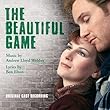

FROM LEFT TO RIGHT:
1. The Beautiful Game Original London Cast CD.
2. The Beautiful Game Vocal Selections.
Pages:
1 2 3 4 5 6 7 8 9 10 11 12
About David Fick
teacher + curator + writer + director + performer = (future maker + ground shaker) x (big thinker + problem shrinker) x (go getter + detail sweater)

 Musical Cyberspace
THE BEAUTIFUL GAME: 2000 OCR Track by Track
8. “The Final (A Game of Two Halves)”
The theatrical centrepiece of the first act is a reproduction of a football game. Clearly intended to be a visually spectacular marriage of drama, movement, dance, music and vocals, the number is a little hard to follow on disc without knowing what’s going on onstage. It is an incredibly evocative piece and its greatest achievement is in how it translates the ritual of sport into a ritual of theatre. All of the major elements of a good game of football can be found here: expressions of unity within a team, verbal sparring between the teams, the kick-off, support and heckling from the crowd, match commentary, a slow motion replay, an argument with the referee, a red card and – most importantly – a few goals. The music used to capture these moments includes snatches of melody that were established in the “Overture” and in “The Beautiful Game”.
The first two verses of the song deal with team unity and Father O’Donnell’s team (“Us”) being heckled by the opposition (“Them”). Once again, Elton displays a lack of regard for the rhyme scheme he himself sets up for the lyric, seen in the first verse as indicated below:
Here we see Elton playing with sets of internal rhyme. The first inconsistency we see is between lines 1 and 3: it seems that Elton is going for a triple rhyme here, but that he missed the one in the first line. This is confirmed in the second verse, where the corresponding lines both feature a triple rhyme (‘pass’/’arse’/’class’ and ‘back’/’attack’/’crack’).
Separating these verses is the kick-off, some chanting from the crowds and a fair deal of football represented in the medium of dance. The dance continues after the opposition’s verse leading to some kind of impressive display on John’s part that is then repeated in slow motion (in a short set of lyrics starting – with ‘Oh, what a lovely little move…’ – where Elton manages the rhyme scheme, but loses control on the metre in the first line), before being brought back up to speed by a musical phrase taken from “Clean the Kit”:
This is a satisfying musical touch that links John’s achievement with his desires, but Elton botches the lyric by putting the the emphasis on the wrong syllable in the word ‘bollocks’.
The number continues with the crowd singing derisively about a ‘ginger git’ who seems to be making his way down the field with the ball. The cast recording excludes the dialogue that makes it absolutely clear that this is Ginger O’Shaugnessy, who has already been established (briefly) as a poor soccer player in the opening scene, and that he is being cheered on by Bernadette. This is the first really noticeable appearance of these characters in the show and is the first step of a series of events contrived only to manipulate the audience into an emotional reaction when Ginger is killed by a gang of Protestants after the match. This particular episode plays off well in the context of the show; it is the later vignettes that seem forced – more about that when we come to them.
The first goal is score and the match continues. As the opposing team makes a move to score against Father O’Donnell’s team, the priest coaches from the sidelines, using the melody that was used for the first two verses of this number, which should indicate a return to the rhyme scheme and metrical conventions of those lyrics:
There’s clearly only the most superficial attempt at maintaining the metrical composition of the verse here and although it seems there is a proposal towards maintaining the rhyme scheme, this flounders in the event by missing out on the triple rhyme in the first line and by trying to rhyme ‘down’ with ‘ground’ and ‘around’ and ‘luck’ with ‘up’. More sloppy work from Elton.
The next big moment is the argument between Thomas and the referee. Remember Thomas? He’s the dogmatic Catholic from the top of the show and he plays soccer like he lives life: aggressively. He gets a red card and is sent off. Elton once again dispenses with any attempt at crafting his lyrics into the metrical pattern that is required of this melody, which is the same one used for John’s solo lines about his fancy move and the slow motion replay. This free kick that this allows the opposition evens up the score and the rest of the match follows. John scores the winning goal at the final minute, which is celebrated with a hearty chorus of “The Beautiful Game”.
The biggest achievement of this complex number is how Lloyd Webber manages to reflect in music the rhythm of a football game. It is a pity that Elton doesn’t match him step for step in his contribution to the sequence. It seems that Elton’s modus operandi involves writing whatever he likes and, if it fits in by chance, that’s good enough for him.
Purchases from Amazon.com
FROM LEFT TO RIGHT:
1. The Beautiful Game Original London Cast CD.
2. The Beautiful Game Vocal Selections.
Share this:
Related
About David Fick
teacher + curator + writer + director + performer = (future maker + ground shaker) x (big thinker + problem shrinker) x (go getter + detail sweater)