
Broadway has often looked across the Atlantic for creative renewal, and just over a century ago, it found something of the kind in André Charlot’s Revue of 1924, a sophisticated import refreshingly unlike anything American audiences were used to seeing. The revue was a compilation of newly written material alongside audience favourites from Charlot’s London productions, offering Broadway a distinctly British brand of theatrical wit at a moment when American revues were becoming ever bigger, brasher and more extravagant.
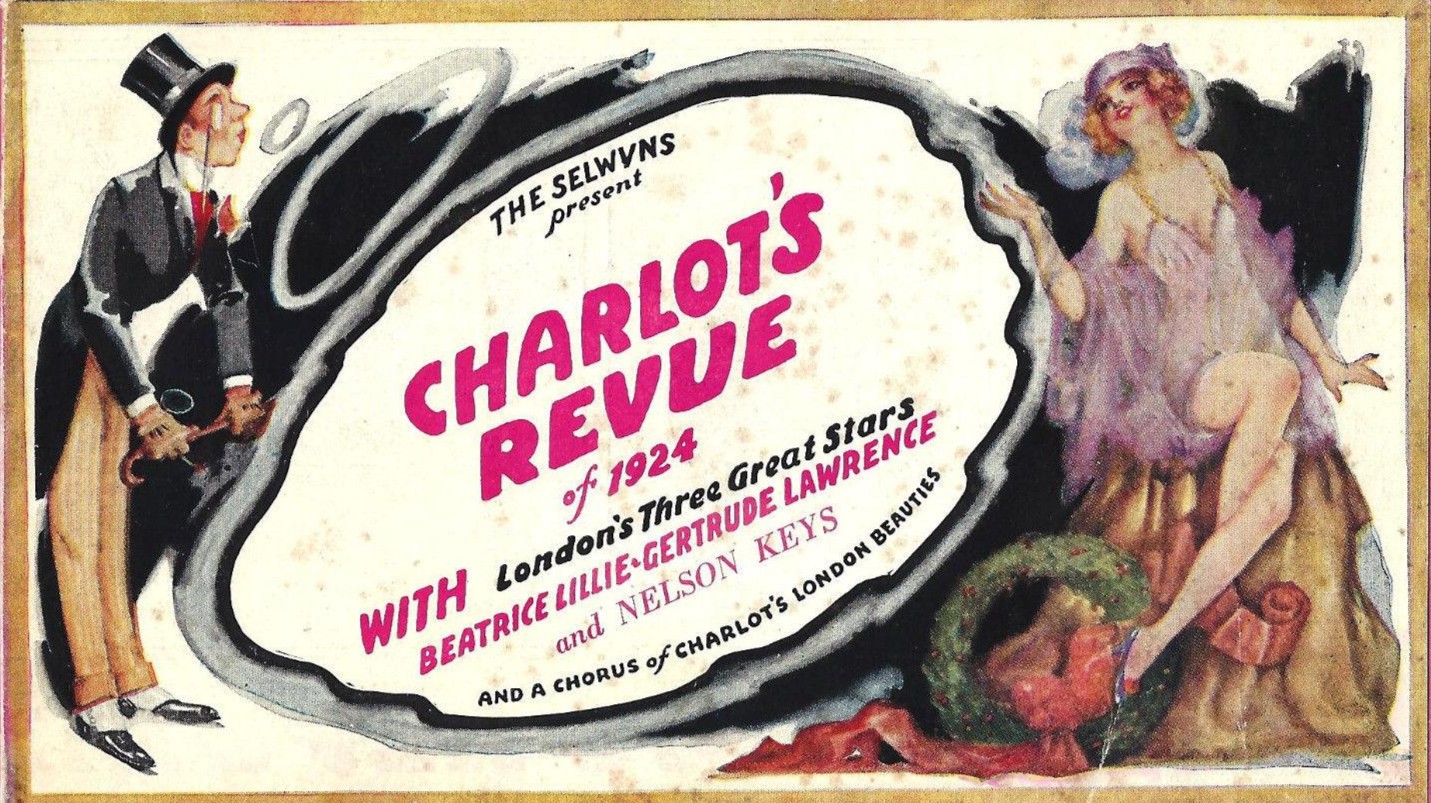
In scale, Charlot’s revue was noticeably smaller than its American counterparts. Notably absent were the sprawling staircases and mass choruses and in their place was something leaner and more intimate, essentially a drop that could be atmospherically lit to suggest mood rather than spectacle. What the production lacked in size, however, it made up for in polish, personality and a sharply observed sense of humour that felt unmistakably British.
Central to the revue’s success were its three leading performers: Beatrice Lillie, Gertrude Lawrence and Jack Buchanan, all of whom were greeted with enormous enthusiasm by New York audiences. Lillie’s formidable comic gifts were fully on display. She skewered theatrical pretension as a concert diva whose self-belief vastly outstripped her vocal ability, delivered dryly savage comedy as a tea-shop waitress and mined unexpected laughs from the persona of a faded ingénue clinging to past glamour.
Lawrence offered the kind of theatrical alchemy that would become her trademark: pathos gently entwined with sentiment. She also revealed her comic range in a skit as a razor-sharp Mayfair wife. Less comfortably, from a contemporary perspective, she also appeared in material portraying a Limehouse Chinese girl, a reminder that even the most elegant revues of the period were shaped by attitudes that now sit uneasily with modern audiences.
Buchanan completed the trio with suave assurance. A stylish song-and-dance man, he partnered both women with ease, proving himself an adaptable and charismatic presence. His ability to glide between charm, comedy and romance made him an ideal anchor for a revue that relied on personality rather than spectacle.

Musically, André Charlot’s Revue of 1924 was a rich showcase of London songwriting talent, with a particularly strong showing from Noël Coward, for whom the revue marked a significant breakthrough in the States. Songs such as “There’s Life in the Old Girl Yet” and “Parisian Pierrot” announced Coward as a writer with a witty, urbane and emotionally astute voice. Alongside Coward’s contributions were songs by Ivor Novello, including “March with Me” and “Night May Have Its Sadness”, as well as work by Philip Braham, Ronald Jeans and Douglas Furber. The revue also included material by the American team of Noble Sissle and Eubie Blake, notably “I Was Meant for You”, creating a genuinely transatlantic musical conversation.
The result was a critical and popular triumph. André Charlot’s Revue of 1924 ran for 298 performances, an impressive achievement for a production so understated in its physical trappings. More importantly, it established a template for a new kind of revue: intimate, performer-driven, witty rather than bombastic and rooted in sharp observation. Its success led to a second edition of the revue and opened the door to American careers for both Lillie and Lawrence, who would go on to become enduring figures on the Broadway stage.
Seen from today’s vantage point, André Charlot’s Revue of 1924 feels less like a curiosity and more like a reminder of what revues once did so well. They were incubators: places where writers, performers and styles could be tested, refined and celebrated in front of an audience without the weight of a fully fledged book musical.
It’s hard not to wonder whether there’s room again for this kind of show. In an era dominated by large-scale commercial spectacles, it could be glorious to see a revival of the intimate, intelligent revue, a space where emerging writers and performers can sharpen their craft, take risks and let personality, wit and musicality do the heavy lifting.

 Musical Cyberspace