
Back in 2001, Gerard Alessandrini took a swing at revising a forgotten Irving Berlin musical, Mr. President, a 1962 show that featured a book by writing duo Howard Lindsay and Russel Crouse, who had previously collaborated with Berlin on Call Me Madam, and scripted musicals like Hooray For What!, Happy Hunting and The Sound of Music. Alessandrini’s revisal took its inspiration from the then-recent 2000 presidential elections, during which George W. Bush and Al Gore competed for the number one spot in the United States government. The past fortnight in American politics saw some interesting shifts in the road to the country’s upcoming elections that make one wonder whether the time is ripe to revisit Mr. President once more. With Kamala Harris set to face off against Donald Trump this November, is this the kind of satirical show that would be a pertinent reflection of the times? For this week’s Forgotten Musicals Friday, let’s put together a campaign for this politically-tinged musical to see whether it gets our vote.

When Mr. President opened on Broadway, Berlin was nothing short of an institution when it came to musicals, both on stage and on screen, with an Oscar (for “White Chirstmas”) and a Tony Award (for the score of Call Me Madam) to his name. That he was teaming up once more with Pulitzer Prize winners Lindsay and Crouse, whose play State of the Union was recognised in 1945 as the kind of original distinguished play dealing with American life that the Pulitzer committees love, was something that further heightened its profile. The fact that State of the Union dealt with the personal and political challenges faced by a fictional presidential candidate, similar narrative territory to their proposed collaboration with Berlin, must have been a compelling lure to get producers to open up their chequebook. We hear a lot about Oscar bait. Could this have been Pulitzer bait? That’s probably a stretch; the point is that this show was teeming with potential when it was conceived.
As a glimpse into the Oval Office, Mr. President promised a lot. The story follows fictional US President, Stephen Decatur Henderson, who faces professional troubles after a disastrous trip to the Soviet Union and some personal turmoil with his children. Romance, intrigue and humour abound as the first family negotiates the Cold War and Henderson’s political faux pas, which cost him his re-election when his term in office ends. After Henderson loses the steps away from his political work, he becomes bored with civilian life post-presidency and decides to jump back into the political fray. Will he redeem himself? That’s the question that drives the show to its jolly finale.

Sounds intriguing, right? In the end, it wasn’t. Things were rocky for Mr. President right from the start and when the show first tried its luck out of town in Boston, the reception was as cool as a New England breeze. Even so, the creative team didn’t give up. After extensive revisions, Mr. President ran again at the National Theatre in Washington. While President John F. Kennedy and First Lady Jacqueline Kennedy said they thought Berlin had a hit on his hands, the reviews were lukewarm at best. In fact, let’s be brutally honest: the buzzword for this show was “corny” – not exactly a ringing endorsement from the critics.
When the show transferred to Broadway, it opened after four previews at the St. James Theatre. Directed by Joshua Logan and choreographed by Peter Gennaro, Mr. President somehow managed to stagger through 265 performances in a season where it was pitted against heavyweights like Oliver!, A Funny Thing Happened on the Way to the Forum and Stop the World – I Want to Get Off. The musical received unenthusiastic reviews from the New York press and while Berlin’s score was said to have some highlights, the consensus was clear: Mr. President felt old-fashioned and out of touch.
Today, Mr. President is mostly remembered by its original cast album, although a rare production pops up here and there. (If you’d like to take a crack at it, the rights are available through Concord Theatricals.) Listening to the cast recording, it sounds like this show would have gone over like gangbusters in the 1940s, with some great numbers like In “Our Hide-Away” and “I’m Gonna Get Him” dotting the score. Songs like “Let’s Go Back to the Waltz,” with its gorgeous nostalgic melody, surely make some people wistful for the days of elegant ballrooms and sparkling chandeliers. By the 1960s, though, Mr. President simply lacked the vitality needed to compete with the other shows of the season, making it a sad swan song for its creators. As things turned out, it was the final original score Berlin would write for the Broadway stage and the final collaboration for Lindsay and Crouse.
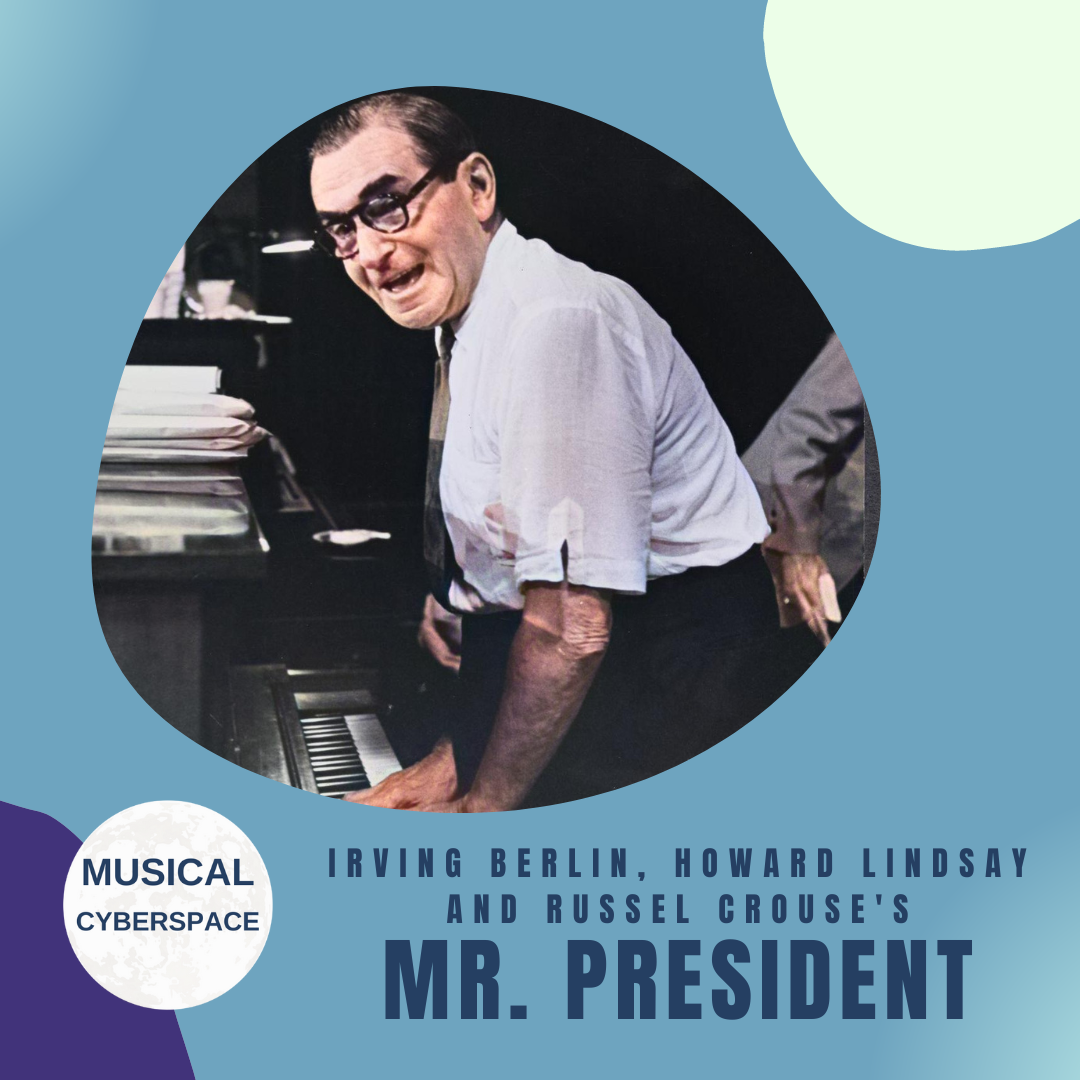
The cast recording reminds us that Mr. President had some big names on the bill, including Robert Ryan and Nanette Fabray. By all accounts, Ryan was miscast, but Fabray was definitely one of the bright spots in what was considered a largely bland production. She sells a song like “The First Lady” with such charm that it almost makes you forget how tired some aspects of this show feel. Truth be told, the cast works hard to put across the material. For instance, Anita Gillette, a favourite Main Stem ingenue of the 1960s, delivers “The Secret Service” and The Washington Twist”,” where Berlin tries to be hip and it doesn’t quite land, in a way that makes the songs work in spite of themselves. Wisa D’Orso also leaves a better impression singing “The Only Dance I Know” than the song itself does, given that it sees Berlin getting up to the same type of culturally problematic shenanigans he employed in “I’m an Indian Too.” Overall, the score feels like it is trying very hard to be liked, which makes it all the more difficult to enjoy in some ways. It takes a couple of listens to the cast album to appreciate fullywhat the score has to offer.
If Mr. President felt dated in the 1960s, it feels even more off the mark now. Alessandrini’s 2001 Off-Broadway revisal drew some appreciation for its zippy staging, but it is clear that the material was just too flaccid to carry Alessandrini’s satirical intentions effectively. And while it’s true the score could work better with a revised book, does Mr. President have much to say a quarter-century later?
Mr President was not the hit Berlin hoped for. While it is a book musical, it feels more like This Is the Army than Annie Get Your Gun, a collection of pleasant, hummable and sometimes even memorable songs rather than a show with a cohesive score. Having reviewed the campaign materials, I’m sad to say that Mr President is not going to win our vote today. To my mind, we’d be better off with a revival of Of Thee I Sing.

 Musical Cyberspace
Interesting, thanks. Must have a listen!
Thanks! Hope you enjoy it!