
How about a little niche frivolity? For this week’s Saturday List, I thought it might be fun to take a look at songs with people’s names in the title. Of course, there are likely to be many hundreds of songs like this, from “Our Polly is a Sad Slut” (The Beggar’s Opera) to “Lucy’s Song” (Suffs), so perhaps we need to bring in the parameters a little. In fact, let’s bring them in nice and tight and look at the songs with people’s names in the title written by Stephen Sondheim to other people’s music. This presents us with just three scores – those Sondheim wrote with Leonard Bernstein for West Side Story, with Jule Styne for Gypsy and with Richard Rodgers for Do I Hear a Waltz? Is the orchestra of your imagination striking up the introduction of your favourite number from those shows? Great – then let’s dive right in – and just for the sheer joy of it, let’s consult Finishing the Hat to see some of Sondheim’s thoughts on each of these songs too!
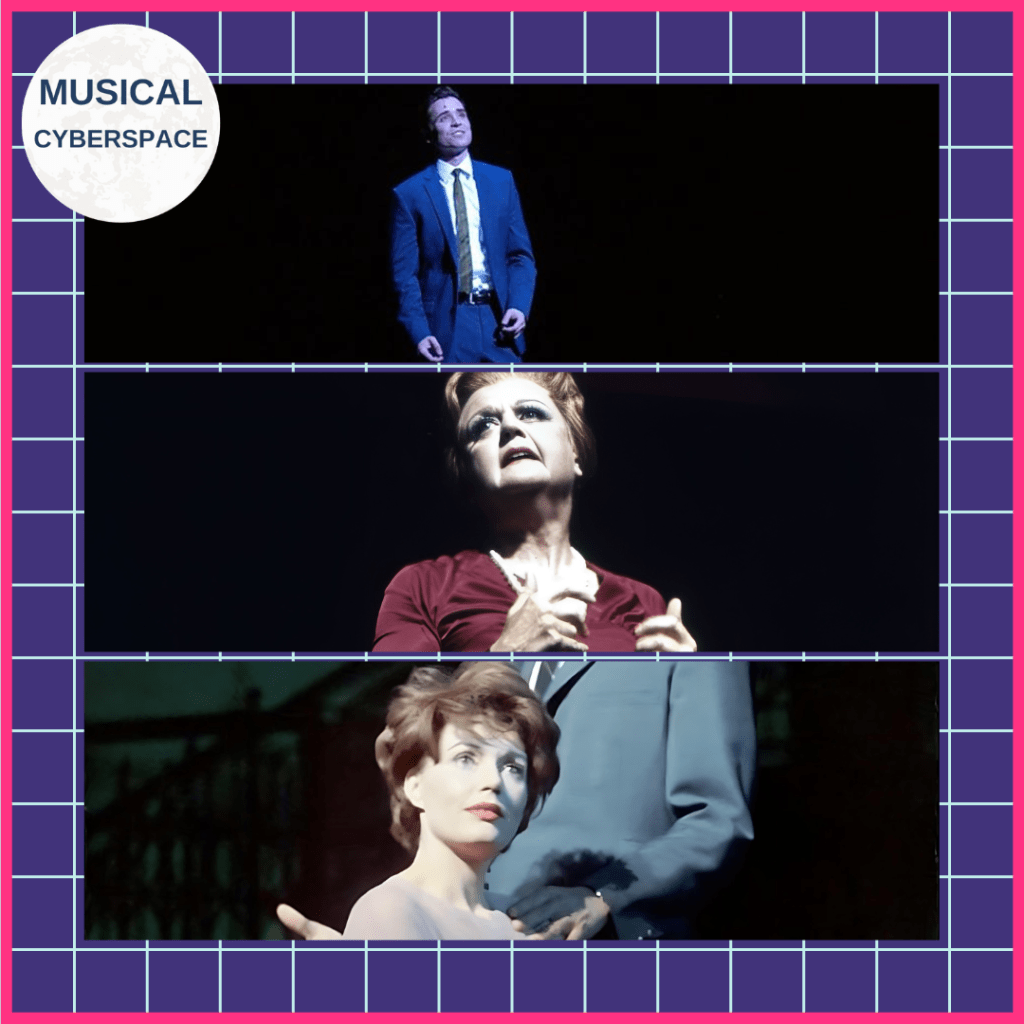
6. “Everybody Loves Leona” from Do I Hear a Waltz?
It’s true that no songs with a name in the title made it through to the opening night of Do I Hear a Waltz? Sondheim felt that “Everybody Loves Leona” was too on the nose for the show he wanted to write and for the character it was depicting.
I had to write “Everybody Loves Leona” and hear it performed before I could see it was too bald a statement and made her sentimentally self-pitying. Leona’s unhappiness expresses itself in self-deprecating humour and anger, which is why she’s worth caring about and why the audience likes her. Indirection is her mode.
Listening to the song, you get what he means. It might have been interesting to hear someone else sing the song about or to her, an angle Sondheim would pursue in the similarly titled “Everybody Loves Louis” from Sunday in the Park with George. The issue of balancing a character’s self-discovery with their emotion is also something he came back to, delivering the classic “Being Alive,” which brings Company to its conclusion. “Everybody Loves Leona” was reincorporated into the show when it was revised and staged in revival in New Jersey in 1999. Although Arthur Laurents revamped the book and Sondheim revised some of the lyrics, Do I Hear a Waltz? played and went, continuing to be the kind of show that was, in Sondheim’s words, ‘pleasant, but no showstopper.’
5. “Baby June and Her Newsboys,” “Dainty June and Her Farm Boys” and “Madame Rose’s Toreadorables” from Gypsy
Sondheim doesn’t have much to say in Finishing the Hat about this trio of numbers, other than to say the concept is less on the nose than “Mother’s Day,” the song he and Styne first wrote for this motif and running gag in Gypsy. He also mentions that the “Cow Song” from the “Farm Boys” sequence was one of the baker’s dozen of trunk songs Styne passed along to him when they began writing the show. The final tidbit he has to offer is that he really struggled to write the all-important “Let Me Entertain You” lyric, which brilliantly tracks the development of Louise’s character through the show’s narrative.
I whined to (Jerome Robbins) that the hardest kind of lyric to come up with is a lyric with no specific situation, the kind which has so many possibilities that there is no basis for choosing one. He glared at me impatiently and said, “Just do what it’s about.” “Like what?”I challenged.” “I don’t know. Something along the lines of ‘Let us entertain you.'”
Even with that bit of advice, Sondheim procrastinated and only wrote the lyric in December 1958, a couple of months before rehearsals for Gypsy commenced, when he found a way to transform an idea he had originally thought to be ‘blunt and flavourless’ into something that helped to shape the dramatic structure of Gypsy from beginning to end. One of the things that’s so delightful is seeing Sondheim come up with a voice for Rose, who has ostensibly written the songs for the act, as a lyricist. It’s full of the kinds of things he preaches against in Finishing the Hat, like emphasising the wrong syllable of a word for the sake of a rhyme as in ‘historical news is being made‘ and ‘biggest scoop of the decade.’ (If Rose didn’t write the songs and they’re meant to be old vaudevillian songs, it adds up to the same thing.) At any rate, these three numbers offer great joy in the show as well as on the many cast recordings of the score, camp hilarity at its best.
4. “Have an Egg Roll, Mr Goldstone” from Gypsy
Ah, the dependable list song! Songs like “Have an Egg Roll, Mr Goldstone” are euphoric if they’re good enough, and this one’s a bop! It’s interesting reading what he was to say about the technique of writing a number like this.
List songs are comparatively easy to write, because they don’t require developing ideas, but if the song has little to say and the songwriter doesn’t keep filling the list with witty or surprising examples, the result is an increasingly monotonous waste of time.
Sondheim himself indicates that one of the jokes in “Have an Egg Roll, Mr Goldstone” is Rose’s generosity, which contrasts her thrifty behaviour everywhere else in the show – that’s how excited she is. It’s also full of references to her favourite kind of food – Chinese – and things get even more fun when Rose becomes so exhilarated that she starts mixing up her words. There’s another Gypsy anecdote that is a perfect example of an actor putting their own stamp on the lyric. In the original production, Ethel Merman played the song’s middle section – ‘There are good stones and bad stones’ and so on – as an extension of her delight. The Rose of the first revival – and a Rose of the first class – Angela Lansbury, added another layer by having Rose think up the different kinds of stones in this part of the list, which showed the character trying to top herself – a perfect statement of who she is. While Sondheim was concerned whether “Have an Egg Roll, Mr Goldstone” was too hollow, he needn’t have worried. It’s great – and in the show’s context, it has even more to offer: besides bringing the scene to its climax, its ebullience sets up “Little Lamb” brilliantly.
3. “Maria” from West Side Story
Sondheim doesn’t often write an unabashedly romantic lyric, but “Maria”, set to Bernstein’s music, certainly fits the bill. A glorious testament to a young woman met in a few magical moments at a dance and the unforgettable sound of her name, the song is heard early on in West Side Story as Tony, a former member of a gang known as the Jets, expresses his newfound love for Maria, the sister of the leader of a rival gang, the Sharks. The song makes credible the sudden, yet profound love that connects Tony and Maria – an impressive feat, expertly achieved. Characteristically, Sondheim was critical of his work here, implying in Finishing the Hat that some of his writing on the song was rather feeble.
Originally, Tony was to have been a blond Polish-Catholic…. This gave the name “Maria” a religious resonance, which I pushed with the line ‘Say it soft and it’s almost like praying.’ Of course, once we withdrew the Polish-Catholic connection, the line made little sense and merely contributed a kind of overall wetness to the lyric – a wetness, I regret to say, which persists throughout all the romantic lyrics in the show….
Be that as it may, his collaborators loved the words he crafted for “Maria,” as did Oscar Hammerstein II. With the show first opening in 1957, then breaking through into popular culture in a huge way thanks to its 1961 film adaptation, there are scores of takes on this song from various productions, studio recordings and covers by musical theatre and musical theatre-adjacent artists. With Larry Kert setting the bar high on the original Broadway cast recording as he acts this pivotal moment of the drama through song, one of the more recent recordings is Ansel Elgort’s in-role take on the song in the 2021 film adaptation of the show. In between, the likes of Michael Ball, Jeremy Jordan, Aaron Tveit and Colm Wilkinson have all performed the song – and there’s even a live recording of Ariana DeBose singing the song at a concert at Birdland. We’re spoiled for choice.
2. “Gee, Officer Krupke” from West Side Story
“Gee, Officer Krupke” is an absolutely brilliant social satire in the form of a frenetic vaudeville act. Incidentally, this was the only song written for West Side Story where the entirety of the music was complete before the lyric was written. It had been written for Candide and was titled “Where Does It Get You In the End?” in that show. In its new form, Bernstein’s music and Sondheim’s lyrics document a possible and all too probably probable downward spiral for boys who have taken up with what might have been “bad influences” in the 1950s. A sharp, comic role play that develops out of the manic tension that has mounted up after the killings of Riff and Bernardo, the song was shifted to an earlier spot in the film version where it is just as comic, but less disturbing. The number’s movement from the second act to the first was Sondheim’s suggestion when the show was in tryouts, as he struggled to believe that ‘a gang on the run from being accessories to a double murder would stop on the street to indulge in a sustained comic number.’ The shift was not possible in the stage show due to the mechanics of its stage design. After seeing the film, Sondheim wasn’t as certain of his convictions.
I’m no longer sure it if was for the better or not, and ever since then I’ve been haunted by the feeling that I shouldn’t have opened my mouth.
Tony Kushner and Steven Spielberg obviously felt the way Sondheim had felt back in the 1950s and once again moved up “Gee, Officer Krupke” in the 2021 film. This time, it was set at the police station and the gang’s role-play builds up to a manic trashing of the kind of space that represents the system in which they are trapped.
1. “Rose’s Turn” from Gypsy
Is anyone really surprised this is number one? It’s probably the best female solo number in the musical theatre canon. An extensive poll by Marc Bonanni, aka BwayGhostlight (give him a follow here), seems to corroborate this.
It’s also the song Sondheim calls ‘the high point of [his] theatrical life. The story begins behind its creation is legendary. Originally, this moment in the show was to be the kind of dream ballet that popped up in many a musical play in the 1940s and 1950s, with Rose coming face-to-face with the characters in the show who had left her. There was just one problem: Jerome Robbins didn’t have time to choreograph the number. (Would we have had a Dream Rose, or would Ethel have popped on a pair of character shoes and let rip?) With Styne having gone off to a party, Robbins and Sondheim met at the theatre where they were rehearsing at 7pm to work out what they were going to do. By 10pm, they had cobbled together and conceptualised the staging of what would become “Rose’s Turn.” When it was presented to Styne the next day, he fell for it hook, line and sinker and the number was fleshed out so they could present it to Ethel Merman. Merman was less certain, but she soldiered on through a number that gave her more acting to do than had been required of her from her entire catalogue of roles – and she triumphed, as did all the Roses who would follow her, from Lansbury to Imelda Staunton. I can’t wait to hear Audra McDonald’s take on the number in the upcoming Broadway revival later this year.
Final Thoughts
There’s something inherently magical about songs with names in their titles, especially when they spring from the mind of Stephen Sondheim. Whether it’s the unbridled joy of “Have an Egg Roll, Mr Goldstone,” the sharp satire of “Gee, Officer Krupke,” or the sheer theatrical triumph of “Rose’s Turn,” these songs encapsulate the brilliance of Sondheim’s lyrical prowess and the emotional depth he brings to musical theatre. They remind us of the power of names, the stories they hold, and the moments they immortalize on stage. As we revisit these musical gems, we celebrate Sondheim’s contributions and the timeless impact of the characters he names, who continue to resonate with audiences, generation after generation. So next time you hear a familiar name in a show tune, let it transport you back into the magical world of musical theatre, where every name tells a story and every story is worth singing about.

 Musical Cyberspace
Aaron Tveit’s singing “Maria” with the New York Philharmonic was wonderful.
He does a great job!
“Gee, Officer Krupke” occupies a special place in my life. It has crossed my path in a significant way twice.
I played Officer Krupke a few years ago for a youth production (being slightly too old to count as ‘youth’), which was great fun, even if I did end up rather bruised after the run. Not as bruised as some of the Jets, though.
Then, one of the local groups did a concert version of the show, and in a moment of madness decided to cast me as all of the Jets for this song. So I performed it as a solo, with others joining in for the chorus, which meant I got to put on several different characters with four different voices. The end, where the judge, psychiatrist and social worker offer their opinions one after the other was, well, crazy. The audience loved it, but it was definitely rather bizarre!
Wow! That sounds like Mandy Patinkin doing his take on “Buddy’s Blues” in the Follies concert!