
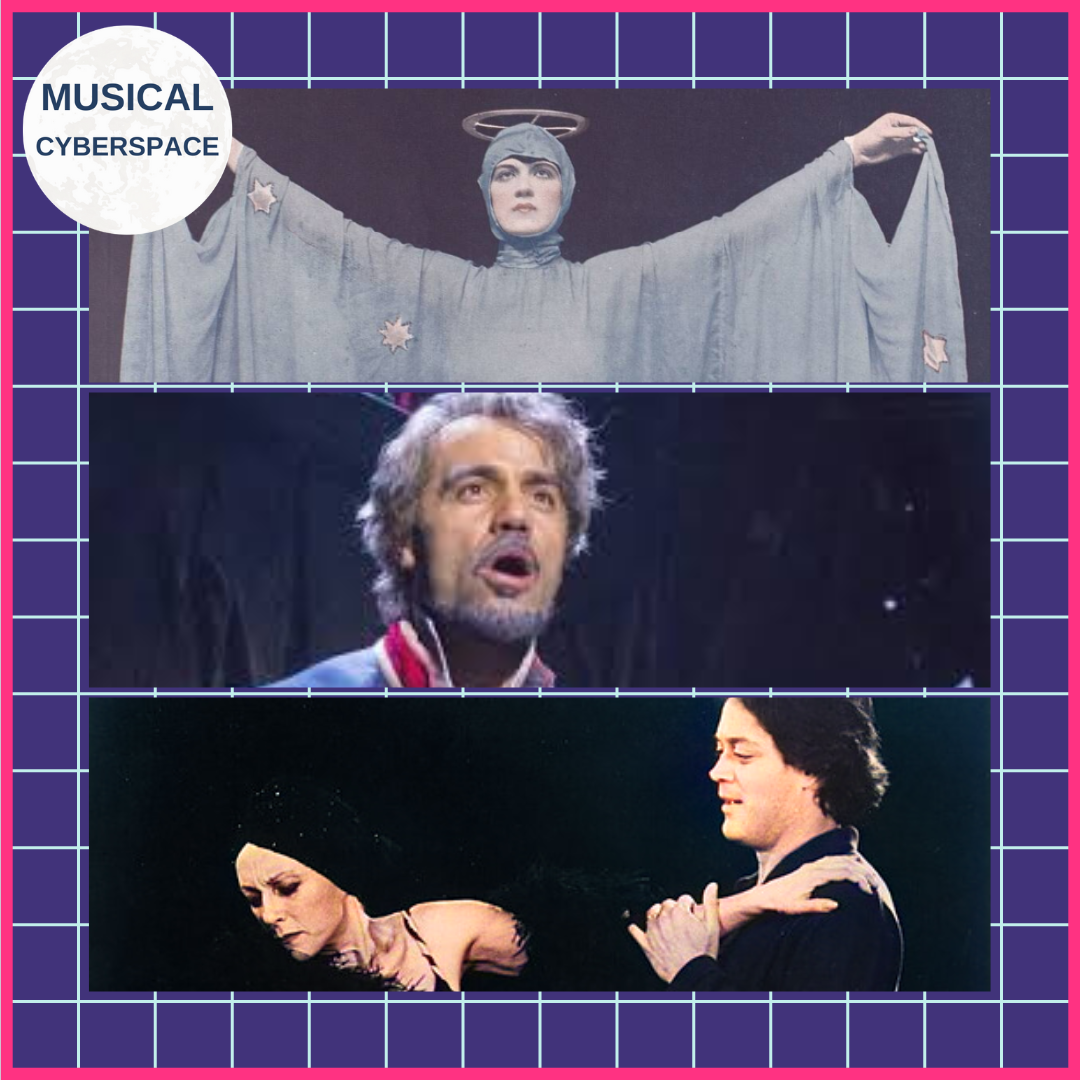
Pack your bags and buckle up, fellow travellers, as we embark on a whirlwind adventure inspired by the classic novel, Around the World in Eighty Days! But wait—there’s a twist! We’re taking our cue from a musical sequel to Jules Verne’s popular tale, Round in Fifty, in which Phileas Fogg challenges his nephew, Phil, to beat his record of circumnavigating the globe. If Phil doesn’t complete his trip in fifty days, Phileas will disinherit him. With a plot as wild as the journey itself, this musical extravaganza penned by Sax Rohmer, Julian Wylie, and Lauri Wylie, with songs by Clifford Harris, Jas W. Tate and Herman Finckby, this show, which opened on this day in 1922, was a theatrical escapade like no other. Join me as I follow Phil’s quest to break records and win his inheritance, listing a favourite musical from each of the show’s locales. So, grab your passports, and let’s set sail on a globe-trotting expedition that’s sure to leave us breathless with excitement!
1. We Open in London… with Round in Fifty
Why not begin our trip by taking a closer look at the show that has inspired today’s post. Round in Fifty is a glittering testament to the vibrant energy of early 20th-century musical revues, with a kaleidoscope of scenes that whisked audiences on a global journey brimming with laughter and spectacle. Crafted as a showcase for the comedic genius of George Robey, who played Harold, Phil’s attendant opposite Alec Kellaway as the romantic lead, the production found itself adorned with an unexpected gem when American vaudeville sensation Sophie Tucker joined the cast. Across the seventeen scenes in the show, the audience was transported from France to Italy, then to China and the USA. Each locale was brought to life with exquisite sets and costumes, masterfully orchestrated by the talented Dolly Tree, whose hundreds of designs left an indelible mark on London’s theatre scene at the time. Yet, perhaps the most groundbreaking aspect of the show was its innovative use of technology, featuring filmed backdrops and film clips that dramatised aspects of the plot in a multi-modal manner often seen in productions today but which must have been breathtaking more than a century ago. Round in Fifty was ultimately embraced as a delightful romp from beginning to end, enchanting audiences for 469 performances before embarking on a triumphant tour.
2. We next play Boulogne… with Les Misérables
In the second scene of Round in Fifty, Phil has to make it through customs in Boulougne, accompanied by a drunk Harold, leading to what was by all accounts a rib-tickling comic set piece for George Robey. When considering a favourite musical with a French setting, there are several contenders for the top spot, including An American in Paris, The Phantom of the Opera, Dirty Rotten Scoundrels, Beauty and the Beast and Can-Can. There may even be someone who would go for Bad Cinderella. Indeed, there are scores of musicals with a French setting or that are set partly in France. For me, none is better than Alain Boublil and Claude-Michel Schönberg’s epic Les Misérables, with additional lyrics by Jean-Marc Natel and an English translation by Herbert Kretzmer.
Set in the 1800s, Les Misérables tells the story of Jean Valjean, a paroled convict (he stole a loaf of bread to feed his starving nephew) who seeks redemption after a bishop inspires him with a tremendous act of mercy and the means to start a new life. Javert, a police inspector with a rigid view of justice, pursues him throughout the action of the play, which sweeps everyone into the June Rebellion of 1832, during which a band of idealistic republicans tried to overturn the monarchy from a street barricade in Paris. The score features many memorable songs, including “I Dreamed a Dream,” “On My Own,” “Master of the House,” “One Day More” and “Do You Hear the People Sing?”
Les Misérables is a show which has become somewhat underrated because most people think about more recent incarnations of the show, which have become broader and more bloated as the years have gone by. In truth, Les Misérables was never more effective than in the first decade following its English-language premiere in 1985. The updated staging, while taking great advantage of technical innovations in the theatre, just isn’t as effective as the impactful original staging, which I was lucky enough to see twice as a teenager, although sadly not with the original cast. (Both of the companies I saw were outstanding though!)
It is always refreshing to go back and listen to the original cast recording with Colm Wilkinson as Jean Valjean, Roger Allam as Javert, Patti LuPone as Fantine, Susan Jane Tanner as Madame Thénardier, Alun Armstrong as Thénardier, Frances Ruffelle as Éponine, Rebecca Caine as Cosette, Michael Ball as Marius and David Burt as Enjolras. Even on record, the performances are detailed, layered with subtleties that are all too often brushed over in modern renditions. One marvels, for example, at LuPone’s vocal colouring in Fantine’s big number, “I Dreamed a Dream,” and how grounded Caine’s delightful Cosette is. As the Thénardiers, Armstrong and Tanner, are hilarious without being overly broad and menacing without being overly indicative of it. It’s true that Wilkinson would be in better voice by the time the masterful tenth anniversary concert came along, and it’s also true that there have been some incredible performances in the show from the likes of Ramin Karimloo, Lea Salonga, Ruthie Henshall, Norm Lewis and Philip Quast over the years. But everything rings true in this document of the show in its early days.
3. We then play Brindisi… with Nine
Lots of bars in Brindisi! (Apologies to Cole Porter for all these references, and the sub-headings!) The Italian sequence of Round in Fifty saw Liliane Gilbert and a procession of women parading as the world’s favourite liquers, a colourful costume parade of drinks from peach brandy to creme de menthe. There’s another show set in Italy that involved parades of women swirling through the leading man’s mind, and that is Maury Yeston and Arthur Kopit’s Nine. Other Italian-set favourites include A Funny Thing Happened on the Way to the Forum, Passion and The Light in the Piazza – but Nine seems the most apt choice for today’s purposes.
Nine sees film director Guido Contini in a crisis. At 40 year of age, his personal life is falling apart, with his wife, Luisa, threatening to leave him. Guido’s two obsessions – filmmaking and his web of romantic entaglements – have left her feeling neglected as he obsesses of the shooting of a film he has not been able to write and romps about with his mistress, Carla. Playing out at a spa in Venice, the show shifts in and out of Guido’s memories, and everything brought to life through some dazzling songs and musical sequences, including “My Husband Makes Movies,” “A Call from the Vatican,” “Folies Bergères,” “Be Italian” and “Unusual Way.”
Nine is a musical that simply envelopes you. It is the most glorious and enchanting maze. Watching or listening to Nine is a magical experience. Fans hold strong opinions about which should be the “go-to” recording of the show. The 1987 Australian Cast Recording and the 1992 London Concert Cast Recording always feature highly, but I’m partial to the two Broadway cast recording and probably play the 2003 revival recording most frequently – but comparing the different albums of Nine would take a whole “Saturday List” of its own to really look at things well.
If there is anything to regret about Nine, it is that the film, which is gorgeously designed and shot and features a simply divine cast, just doesn’t capture the ethereal beauty of this masterpiece of the stage.

4. Our next jump is Hong Kong… with Lute Song
I don’t feel spoiled for choice when selecting a favourite musical set in China. What is it to be? Aladdin? Chee-Chee? Chu Chem? Nothing feels right. As things stand, I’ll go for Lute Song. On the one hand, Lute Song is a milestone in American theatre, a well intentioned attempt to move away from an exotic, pandering or offensive depiction os China. On the other hand, it remains problematic in the way it represented China, using yellowface in the make-up design as well as a sense of generic so-called Oriental pageantry in its dramatic structure, musical approach and design.
The story of Lute Song focuses on a young student, Tsai-Yong,who leaves his wife, Tchao-Ou-Niang, to make a name for himself as a magistrate. When he succceeds and marries Nieou-Chi, her father forbids Tsai-Yong to reconnect with his family. When a famine hits his home town, Tsai-Yong’s parents die of starvation and Tchao-Ou-Niang sells her hair to pay for their funeral. Nieou-Chi intervenes and reunites Tchao-Ou-Niang with Tsai-Yong.
Lute Song lost something like $100 000 of its initial investment, but it was considered by many contemporary critics to be a succès d’estime. It appeared on lists naming the best plays of 1946 and the reviews raved about the show’s aesthetics, which today would elicit eye rolls (for example, when the show’s star, Mary Martin, is dressed in designer gowns even when the character she is playing is at her poorest) or worse (in designed where Chinese ideography used randomly to infer some kind of overall integrity in the design).
In that vein, the Chinese set piece from Round in Fifty was “The Romance of the Tea Leaves,” a tableau in which showgirls dressed in black and white costumes that made them look like ivory carvings came to life. Maybe it’s just best for us to book a ticket on a steamer and head to other musical shores.
5. Then San Francisco… with Dogfight
Round in Fifty next jumps across the Pacific Ocean for a stop in the USA. In San Francisco, everyone breaks Prohibition in a cabaret club, is then thrown into prison (where they are treated to a variety show) and ends up taking part in the harvest festivities at a local orange grove. There are quite a few musicals set in San Francisco, including classics like Flower Drum Song and to more recent shows like Mrs Doubtfire. The one I’m going highlight is Benj Pasek, Justin Paul and Peter Duchan’s Dogfight.
Dogfight tells the tale of Eddie Birdlace, an 18-year-old Marine who is being sent to Vietnam, and Rose Fenny, a shy young waitress, who go to a party together in November 1963. The kicker? Eddie has put $50 in the pot of a “dogfight” game, where the Marine who brings brings the ugliest date to the party will win all money and Rose has no idea. There’s lots of room for some great showtunes in this story, including “Nothing Short of Wonderful,” “Pretty Funny,” “First Date/Last Night” and the impactful title song.
If there’s one Off-Broadway show that should have a Broadway transfer, this is it. (Of course, there are many more, but you know – what’s a turn of phrase between friends?) Dogfight predates Pasek and Paul’s smash hit, Dear Evan Hansen, and it may be the better of the two shows. Had it transferred, we might not have seen the faceoff between Kinky Boots and Matilda at the following year’s Tony Awards and this show would perhaps have been more well-known than it is.
Nonetheless, the original cast recording preserves incredible performances from leading players Derek Klena and Lindsay Mendez, with an incredible cameo from Annaleigh Ashford, who plays Marcy, the winner of the dogfight. It’s a moving story – a difficult one to witness for sure, but its unforgettable.
6. Then New York… with West Side Story
The penultimate stop on Phil Fogg’s journey is New York. Is there any other more popular setting for musicals than the city where the genre was born? There’s A Chorus Line, On the Town, Wonderful Town, Newsies, In the Heights – even Hamilton! But the ultimate show set in New York, one that captures the city’s dynamics at a particular time in American history, has got to be West Side Story.
Set in the 1950s, West Side Story is set against the backdrop of gang rivalry between the white Jets and the Puerto Rican Sharks. Tony, a former Jet and the best friend of the gang’s leader, Riff, falls in love with Maria, who just happens to be the sister of the Sharks’ leader, Bernardo. The sophisticated score numbers several classics in its song list, including “Something’s Coming,” “America,” “Tonight,” “One Hand, One Heart,” “A Boy Like That/I Have a Love” and “Somewhere.”
Where does one even begin to start praising West Side Story? For its total concept and staging by Jerome Robbins? It’s incredible score by Leonard Bernstein and Stephen Sondheim? The cleverly transposition of Romeo and Juliet into the show’s book by Arthur Laurents? The classic original performances by Larry Kert, Carol Lawrence, Chita Rivera and the rest of that first, mind-blowing cast? Then there are the two films, the first a Hollywood classic and the second an even better movie adaptation, not to mention the revival that brilliantly incorporated Spanish translations of some of the lyrics by Lin-Manuel Miranda. Even the contoversial staging by Ivo van Hove, which ran for 24 performances before being shut down by the COVID-19 pandemic had much to offer.
All of these things are just a part of the legend that is West Side Story, which is certainly one of the greatest musical theatre shows ever created.
6. Then we open again, where? (In London… with Sweeney Todd)
The world is round and so, this being an around the world story, we must end where we began, back in London, with Phil Fogg making his triumphant return at the Gridiron Club. After New York, London must be high up on the list of the most popular settings for musicals, with just some of the shows set there including My Fair Lady, Baker Street, Mary Poppins and Oliver! But if there’s no place like London, then there’s no show like Sweeney Todd: the Demon Barber of Fleet Street.
In Stephen Sondheim and Hugh Wheeler’s 1979 show, we are asked to attend the tale of Sweeney Todd, who was sent to Australia on a trumped up charge by Judge Turpin, who wanted to seduce his wife. Formerly known as Benjamin Barker, Sweeney Todd sets up shop in Nellie Lovett’s meat pie shop and the pair soon cook up a plan to exact revenge on the judge. In the meantime, Todd will slaughter his customers and Lovett will use the bodies to make meat pies, thus destroying the evidence. A subplot involves Johanna, Sweeney Todd’s daughter, who is now the ward of Judge Turpin, and a sailor Anthony, who has fallen in love with her. Some of the show’s classic songs include “The Worst Pies in London,” “Pretty Women,” “A Little Priest” and “Not While I’m Around.”
One of the great things about Sweeney Todd is how pliable the material is. The original production offered a grand staging by Harold Prince on a set designed by Eugene Lee. But is has also been done on a very small scale in a more immersive production Harrington’s Pie Shop in London. There was even a staging by John Doyle where the actors playing their own instruments. There is so much that can be done with this musical.
That said, has anything ever surpassed that original staging, with Angela Lansbury’s indelible Nellie Lovett and Len Cariou’s tortured Sweeney Todd? I’m not sure – but I’m always open to watching a new take on this classic show.
And just like that, folks, our musical itinerary inspired by Round in Fifty comes to a close. We may need to bid adieu to the exotic locales and daring adventures we’ve encountered along the way, but the catchy tunes and thrilling plot twists we’ve encountered can be relived time and time again through proshot recordings and cast albums. So here’s to the magic of musical theatre and the joy of exploration: until our next adventure, may Round in Fifty continue to inspire you to sing and dance around the world!

 Musical Cyberspace