
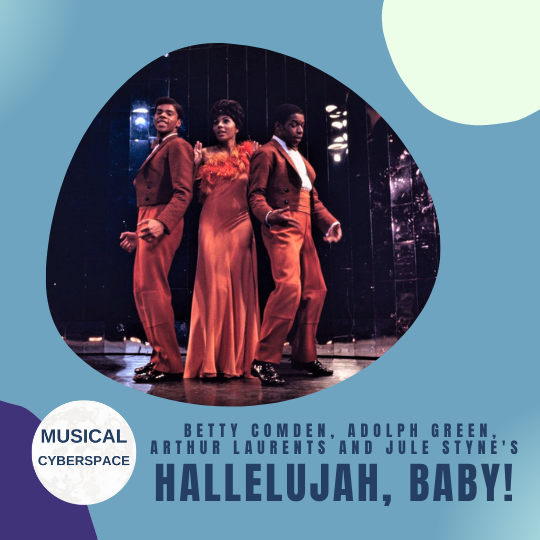
Today is the anniversary of Arthur Laurents’s birth, so it seems apropos to mine his work for this week’s Forgotten Musicals Friday. A couple of his shows have slid into the musical theatre memory, and one such musical is Hallelujah, Baby! The show, with music by Jule Styne and lyrics by Adolph Green and Betty Comden, premiered on Broadway in 1967 and won the Tony Award for Best Musical. Even quite hardcore musical theatre fans write off the show as little more than a trifle, even though it aims to deal with some noble themes, and it was one of a handful of the older Best Musical award-winners that has not had a contemporary revival.
Hallelujah, Baby! tells the story of Georgina, an African-American woman who faces many challenges as she navigates life in the 20th century through the civil rights era, contemporary to the time of its creation. Through her experiences, Arthur Laurents attempts to address the racial discrimination faced by people of colour as they strive for acceptance, success and fulfilment in a society built around whiteness and the privilege that comes with it.
Its tackling of such a complex issue falters in a couple of ways. Laurents himself indicated that his approach had been too soft. He attributes some of his choices to the compromises he and the rest of the creative team had to reach in the material when the show had to be built around Leslie Uggams rather than Lena Horne. Effervescence replaced steel. Optimism and hope displaced the harsh realities and complexities of systemic racism. And the emphasis on Georgina’s personal triumphs obscured the more widely felt social experiences of African-American people. Let’s put it this way: it’s no Bring in ‘da Noise, Bring in ‘da Funk, Passing Strange or Caroline, or Change.
Laurents attempted to revise the show in 2004 for a production at The George Street Playhouse, adding an epilogue that brought the show up to the moment and aiming for a darker and more intense overall approach. Despite some new lyrics by Amanda Green, Laurents found himself cornered by the score, which very much sets the show’s tone. Cosmetic adjustments to the book would not be able to bring the show closer to how its creators originally envisioned it would be.
Could four white theatremakers have explored this theme fully? In her New York Times review of the 2004 production, Naomi Siegel inferred the problem implicit here before writing off the show as being ‘entertaining, if not profoundly enlightening.’
It is easy to imagine the scene:
New York City, mid-1960’s. Four talented musical theater artists, writing for Broadway, decide to do their bit to try to heal an America torn by race riots and urban violence. They create a historically referenced musical on the subject of America’s institutional racism….
The theme makes them proud.
Good intentions are not enough to open the gates of heaven, but Hallelujah, Baby! isn’t exactly knocking at the gates of hell. It’s simply a well-meant product of its time – and that is all it will ever be.

 Musical Cyberspace