
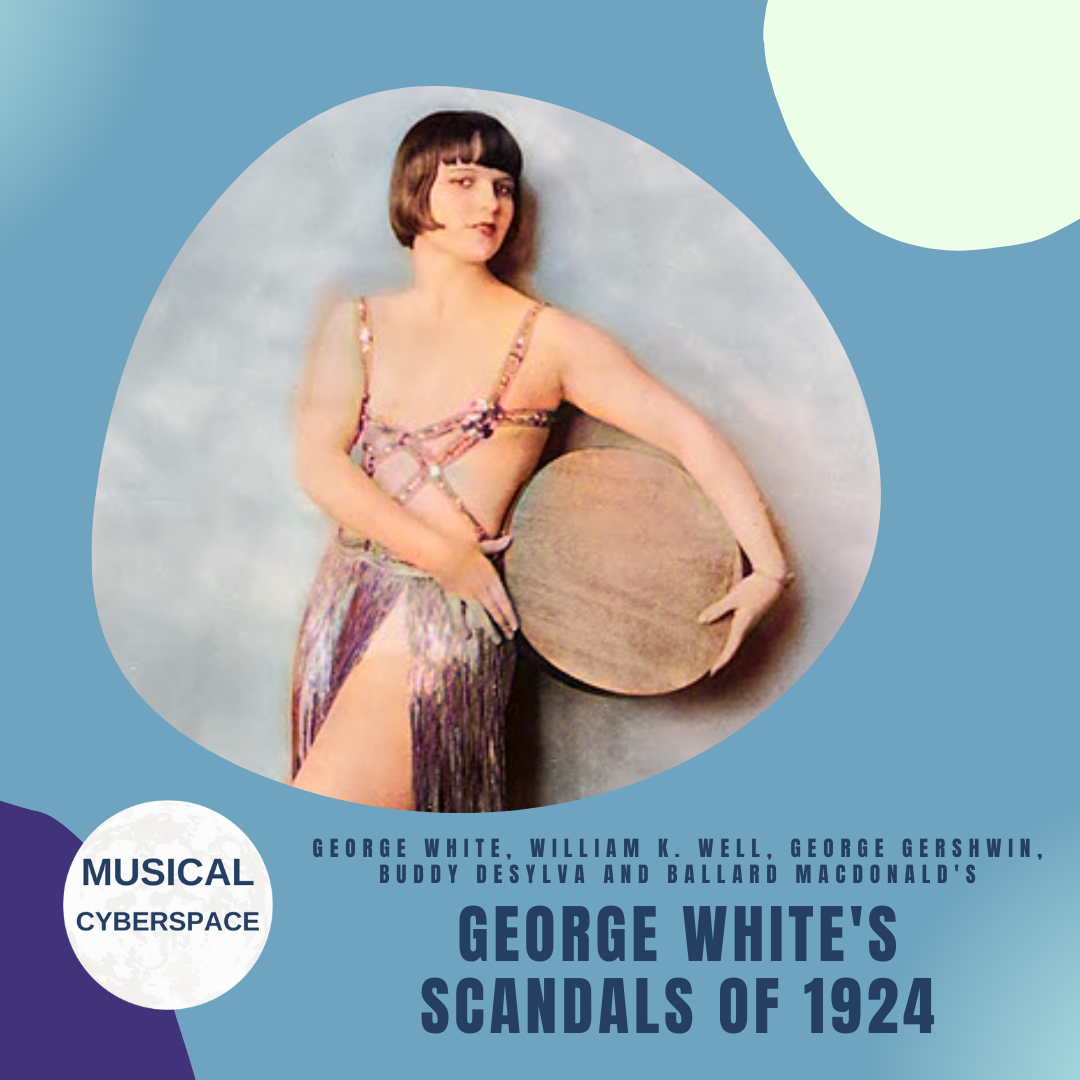
In a year’s time, George White’s Scandals of 1924 will have bowed on Broadway a century ago. 30 June was the opening night of this sixth edition of the long-running series of revues. Arguably, none of the Scandals, which followed the model of the Ziegfield Follies, is significant individually, but there is no question that the set was a cultural touchstone. The revues were a stepping stone in the careers of several stage and film stars – including Ray Bolger, Bert Lahr, Ethel Merman and Ann Miller – and provided a space in which many early George Gershwin melodies were heard. The 1926 edition of the revue propelled the Black Bottom from its regional origins into a national dance craze – think of it as being the TikTok dance challenge of its day – and 1920’s “Scandal Walk” was featured in the television series, The Young Indiana Jones Chronicles.
George White’s Scandals of 1924 included skits by George White and William K. Wells, interspersed with songs that set George Gershwin’s music to Buddy DeSylva and Ballard MacDonald’s lyrics and one number provided by Sam Gould, Charlie Winston, Lew Pollack and Will Mahoney. Some critics felt it was the best of the Scandals to date, while others thought it the very essence of vulgarity, with one critic observing that ‘decent women hid their faces until they could get used to the spectacle!’
The show opened strong with a cute take on the traditional opening number. The Williams Sisters sang “Just Missed the Opening Chorus” to the audience, reproaching them for their tardiness. This song introduced a series of four comedy skits focused on the theme of lateness and the rest of the acts followed. Lester Allen and Tom Patricola clowned up a storm, while Richard Bold and Helen Hudson were lauded for their gorgeous voices. The breakout star of the show was Will Mahoney, a vaudeville performer who would go on to become the highest-paid variety star in the United States and, much later in his career, earn a Tony Award nomination for his performance in the 1955 revival of Finian’s Rainbow.
The show had its fair share of spectacle too. One sequence used a dramatic lighting effect to transform a bevy of chorus girls in bathing costumes into a set of apparently nude marble statues, one of whom was then transformed into the Venus de Milo through some further stage magic. The costumes, designed by Erté and Juliette, were imported from Paris and were a feast for the eyes.
When it came to songs for the ages, George White’s Scandals of 1924 gave us “Somebody Loves Me,” which would later appear in the films Broadway Rhythm, Rhapsody in Blue, Lullaby of Broadway and Pete Kelly’s Blues. The song’s popularity was still rock solid almost three decades later when a 1952 film starring Betty Hutton was built around and named after the song. Outside of stage and film, there have been dozens of recordings, with artists as diverse as Nat King Cole, Meat Loaf, Kiri Te Kanawa and Ella Fitzgerald offering their interpretation of the piece.
George White’s Scandals of 1924 would run at the Apollo Theatre in New York for 196 performances before going on tour. A new edition of the show would appear the following year, with nine further outings – including a couple on film – to follow.

 Musical Cyberspace