
On the Score
My thoughts about the cast recording of The Beautiful Game, which features a track-by-track analysis of the score as it was arranged then is available here. I will not spend time rehashing my thoughts on the material as stated there in this post and will focus on the new songs composed for this revision of the show.
“The Boys in the Photograph” is a lilting ballad that frames the show. It has a catchy melodic hook and is probably the most memorable of the new songs created for the show. As discussed above, I have concerns about its integration into the action of the show.
“Born in Belfast” is a rock song for Del and Christine, a replacement for “Let Us Love in Peace, which is now sung by Ginger and Bernadette. The song is energetic and reminiscent of the rock rebellion songs written for Candy and Amos in Whistle Down the Wind. The song is better suited to these characters than its predecessor, but it is not instantly memorable. The dialogue leading up to the song should be pruned: at present, it feels as if new dialogue is appended to the dialogue that led into “Let Us Love in Peace” and some of it is redundant.
As mentioned above, “Let Us Love in Peace” has been moved to a position later in Act I and reallocated to Ginger and Bernadette. This choice is a good one, allowing the audience to invest properly in these characters before Ginger is killed. This makes the buildup to that event seem more organic rather than merely manipulative, as it did in The Beautiful Game.

Tammi Meyer and Gareth Worth as Bernadette and Ginger sing "Let Us Love in Peace"
The musical structure of the wedding scene has been altered. Still starting with “The Happiest Day”, the sequence has thankfully dropped Father O’Donnell’s introduction to the ceremony, which was oddly sung to a musical reprise of “Off to the Party”, the song that outlines the various states of drunkenness that the team aims to achieve after winning the final. The song in which Mary and John expressed their marriage vows, “To Have and to Hold”, has been cut and a new version of “All the Love I Have” has replaced it. “All the Love I Have” has all the makings of a lush romantic ballad, but was let down by poor lyrics in its original version at the end of the show (which is now a reprise of the song). Here, the lyrics are still a little sentimental, but that makes sense given that they appear to be wedding vows created by the young couple for this occasion. Whether that is credible as part of an Irish Catholic wedding in the early 1970s is uncertain.
The ceremony is still followed by the honeymoon scene with the truly awful song, “The First Time”, an attempt at creating comedy by juxtaposing a lush Aspects of Love style melody with lyrics that contrast the tone of the music by stating the crass realities of the situation. This attempt failed miserably in The Beautiful Game and it fails here. One assumes that the attempt is in place because the show gets more serious and darker from here on out, but the show doesn’t need a comedy moment to counter this: what it needs is to play into the romanticism of the moment. This idea is supported even further because of what the audience is asked to believe at the end of the show. If we are to believe John’s sudden change of heart, we need to believe completely that what shifts his mindset has been there all along. I would prefer it were the song cut completely and see the version of “All the Love I Have” used at the wedding shifted here, with “To Have and to Hold” restored to that sequence. This would solve several problems present in the dramaturgy of the second act in its current form.
The problematic reprise of “God’s Own Country” when Del and Christine take their leave remains in the second act. It makes little sense for these characters to be singing this song given the way that they have been established throughout the show. It would make more sense to create a ballad-styled reprise of “Born in Belfast” that can separate their personal feelings regarding the loss of ties with friend and family, which they certainly do feel, from patriotic sentiments, which they most certainly do not take on board. Perhaps Mary could sing lines from the “God’s Own Country” reprise in counterpoint to this reprise, if that could be worked out musically. It is, after all, her personal statement on how she feels about Ireland and what is happening there.
A new song for Thomas and John, “It Will Never End”, has been written for the scene in which John confronts Thomas and which ends with Thomas being shot to death. The scene works well without the song and the song seems to disrupt it. However, it is an asset to the score to have a second song featuring Thomas, as he is a major character and his philosophy is sometimes somewhat tenuously drawn. Perhaps the song needs to be shifted to an earlier point in the show to solve that problem.
The major problem in regard to the score remains Elton’s poor craftsmanship at a lyricist. To make the show all that it could be, he would have sit work through the lyrics of each song meticulously to ensure that his use of rhyme is consistent and that all lyrics are married the music both metrically and sensibly.
Purchases from Amazon.com
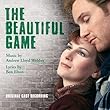

FROM LEFT TO RIGHT:
1. The Beautiful Game Original London Cast CD.
2. The Beautiful Game Vocal Selections.

 Musical Cyberspace
I saw this production twice. I bought the recording of ‘The Beautiful game’ a few weeks before watching the show, and already got the sense of an empty hole in the whole musical, and was curious to see if the new production would fix that. I
I feel the changes were minor and if anything, took away from the original. Mainly, I love the song ‘Our Kind of Love’ from the original, and I do not agree with the composer that the melody was ill fitting and worth scrapping, or rather, phantomised. It is a beautiful melody and provides a good shift in style from the rest of the score which is generally less quicker and short phrased. Perhaps, if the new home of the melody worked, I would have let this go, but as Love Never Dies, it does little for me.
The new title song, as you very successfully put it, needs to be worked in to the show much more strategically. Now, if there ever was a song that does not feel right, it is The Boys in the Photograph and not the late Our Kind of Love.
Absolutely what I thought about Born in Belfast- nice but really a rehash of ‘Tire Track and Broken Hearts’. The title projections were bland.
I think, as you’ve pointed out, that there is way too much conceptional elements in the show, and too little drama. The way the photograph of the players has been used as a motif and a kind of metaphor made me think of it as a motif, and did not help me suspend my disbelief further into the story. I dislike the way the boys fade out one by one on the screen, it is way too obvious. The whole idea of a photograph is a beautiful thought- sentimental and a snapshot of young life, caught before the boys get caught by the world’s divides. However, to blow it up like this drains it of spontaneity, and I was deflated and a bit disappointed in how it is written into the show.
The set was good in portraying the home of the characters as a cold and troubled place. However, I wanted more intimacy in terms of use of space to portray the cozy and loving moments, however brief they were. For example, the wedding scene and the following bedroom scene overbears the wedding couple. The party scene downstairs is way too long- ‘Let us love in piece’ could start sooner.
I agree that the choreography in this production is limited in ways, made worse by the problem of such a large set- the actors needed to make use of space and claim their world much more. Strangely, the soccer game choreography seemed very ‘staged’ to me, not groundbreaking enough. I am not entirely convinced by the staging of ‘God’s Own Country’, with the actor downstage right right through leaving the space deserted.
In general, I just struggle to like the convention of songs spread out with spoken dialogue in between each one, and no music to accompany. Some of my favourite shows, like Aspects of Love, are sung through, and though that is not the style of this musical, it still bothered me. This would be helped by your suggestion that the title song be divided throughout the piece in shorter motifs, that would link moments together, and tie up a story that I find really problematic in its current form.
I’m a big fan of Lloyd Webber, and thought Aspects of Love was awesome in the Joburg theatre last year. But when one friend asked me at interval (of The Boys), ‘So what is the story really?’, all I could say sounded like a concept, and I struggled to pitch the show to him- makes me wonder how Ben Elton/ LLoyd Webber cope with doing that.
I agree with your views on the ending. The original ending was much more touching and beautiful, and believable. I actually struggled to believe my eyes when John came back, and before I could even swallow this- the curtain went down. As if Ben Elton thought, ‘Okay folks, there’s your happy ending, now go home! Now leave me, I’ve got to figure out what Christine does when she sees the Phantom after 10 years on Coney Island, because the world cares so much!’
Thanks for great review!
Interesting review.