
On the Book
I was surprised by the scope of the book in The Boys in the Photograph. The book is as extensive as the musical plays of Richard Rodgers and Oscar Hammerstein II, which is unusual for a Lloyd Webber musical. There is a great deal to commend it. Characters and theme are communicated clearly to the audience through the action of the play. The dialogue rings true.

The triumphant moment after "The Final" in THE BOYS IN THE PHOTOGRAPH
However, a few minor flaws in the book prevent the show from being entirely effective. The most prominent of these flaws has to do with the structure of the show, particularly in its integration of the new title song at the start of the play, as well as that of the new ending.
The problem with the title song and its placement in the show is that the number is a conceptual number, epic as opposed to dramatic, that directly follows another conceptual number, “The Beautiful Game”. Both songs establish various aspects of the show, but neither takes the action of the show forward. Along with the dialogue in the first scene, this makes the show overly idea-based in its exposition, when it should be springing into the action of the piece more quickly. Perhaps a better strategy would be to introduce “The Boys in the Photograph” in snatches, a bit of underscore here and a verse there, and to leave the full length version of the song for the final scene, where some work is required to pull the various threads of the show to a more satisfying conclusion.
The ending also suffers from shifting modes from the dramatic to the epic during the final scene in order to give the main character, John, time to change his mind and return to his family instead of going off to fight for the IRA. The original ending was less romantic, but offered the hopeful idea that the war might be resolved in future generations, by seeing John’s son, Sean, start the same journey that his father did, in the hope that he would play “the game” better than his parents did. Elton hopes that this new ending is more upbeat, but I would not quite describe it in that way: although it certainly is unabashedly romantic, the war continues as the play comes to a close. An epilogue of surtitles follows in the curtain call, documenting the steps towards reconciliation taken in Ireland since that time, but this is trivia that could really be printed in the playbill. It has little impact or relevance on the stage itself.
The problem that the final scene of The Boys in the Photograph faces is that the time taken for John to make the decision mentioned above seems too short, given the offstage transformation in his character we are expected to accept credibly when he returns. The scene during which John tells Mary he will join the IRA and the confrontation that ensues takes place in a park. When John finally leaves, Mary is left along to her thoughts. As she looks at the iconic photograph and considers the respective fates of each of the members of ‘the great team of 1969’, the action freezes as various lines from earlier in the show are heard in a kind of aural montage. At the end of this short sequence, John suddenly reappears, having changed his mind. The show would be far better served if the scene ended properly following John’s departure and a final scene was added which transformed all this conceptual deadweight into action. Mary’s dialogue could remain intact and combined with a reprise of the full version of the title song, where all the motifs heard here and there as proposed above could come together, and possibly we would find think that she truly is to spend the rest of her life alone, raising her child without John in her life. How effective it would be to see John appear in that setting, having had the time ‘to remember who he is’, as he expresses it.
Purchases from Amazon.com
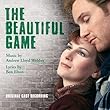

FROM LEFT TO RIGHT:
1. The Beautiful Game Original London Cast CD.
2. The Beautiful Game Vocal Selections.

 Musical Cyberspace
I saw this production twice. I bought the recording of ‘The Beautiful game’ a few weeks before watching the show, and already got the sense of an empty hole in the whole musical, and was curious to see if the new production would fix that. I
I feel the changes were minor and if anything, took away from the original. Mainly, I love the song ‘Our Kind of Love’ from the original, and I do not agree with the composer that the melody was ill fitting and worth scrapping, or rather, phantomised. It is a beautiful melody and provides a good shift in style from the rest of the score which is generally less quicker and short phrased. Perhaps, if the new home of the melody worked, I would have let this go, but as Love Never Dies, it does little for me.
The new title song, as you very successfully put it, needs to be worked in to the show much more strategically. Now, if there ever was a song that does not feel right, it is The Boys in the Photograph and not the late Our Kind of Love.
Absolutely what I thought about Born in Belfast- nice but really a rehash of ‘Tire Track and Broken Hearts’. The title projections were bland.
I think, as you’ve pointed out, that there is way too much conceptional elements in the show, and too little drama. The way the photograph of the players has been used as a motif and a kind of metaphor made me think of it as a motif, and did not help me suspend my disbelief further into the story. I dislike the way the boys fade out one by one on the screen, it is way too obvious. The whole idea of a photograph is a beautiful thought- sentimental and a snapshot of young life, caught before the boys get caught by the world’s divides. However, to blow it up like this drains it of spontaneity, and I was deflated and a bit disappointed in how it is written into the show.
The set was good in portraying the home of the characters as a cold and troubled place. However, I wanted more intimacy in terms of use of space to portray the cozy and loving moments, however brief they were. For example, the wedding scene and the following bedroom scene overbears the wedding couple. The party scene downstairs is way too long- ‘Let us love in piece’ could start sooner.
I agree that the choreography in this production is limited in ways, made worse by the problem of such a large set- the actors needed to make use of space and claim their world much more. Strangely, the soccer game choreography seemed very ‘staged’ to me, not groundbreaking enough. I am not entirely convinced by the staging of ‘God’s Own Country’, with the actor downstage right right through leaving the space deserted.
In general, I just struggle to like the convention of songs spread out with spoken dialogue in between each one, and no music to accompany. Some of my favourite shows, like Aspects of Love, are sung through, and though that is not the style of this musical, it still bothered me. This would be helped by your suggestion that the title song be divided throughout the piece in shorter motifs, that would link moments together, and tie up a story that I find really problematic in its current form.
I’m a big fan of Lloyd Webber, and thought Aspects of Love was awesome in the Joburg theatre last year. But when one friend asked me at interval (of The Boys), ‘So what is the story really?’, all I could say sounded like a concept, and I struggled to pitch the show to him- makes me wonder how Ben Elton/ LLoyd Webber cope with doing that.
I agree with your views on the ending. The original ending was much more touching and beautiful, and believable. I actually struggled to believe my eyes when John came back, and before I could even swallow this- the curtain went down. As if Ben Elton thought, ‘Okay folks, there’s your happy ending, now go home! Now leave me, I’ve got to figure out what Christine does when she sees the Phantom after 10 years on Coney Island, because the world cares so much!’
Thanks for great review!
Interesting review.